If the Ace was the spark, the Two of Wands is the moment right after: the first idea has taken root, and now you have to look far ahead to decide where to take it. It's the card of the vision that precedes action, of the plan being drawn while you're still standing on the threshold. You haven't set off yet, but you already know you will.
Its signature is ambitious planning. Where the Ace grabbed, the Two observes: the energy of fire becomes gaze, calculation of the possible, mapping of the territory to be conquered. The number two brings duality, and here it reads as the inner crossroads between what you hold and what you could have.
The symbolism of the card
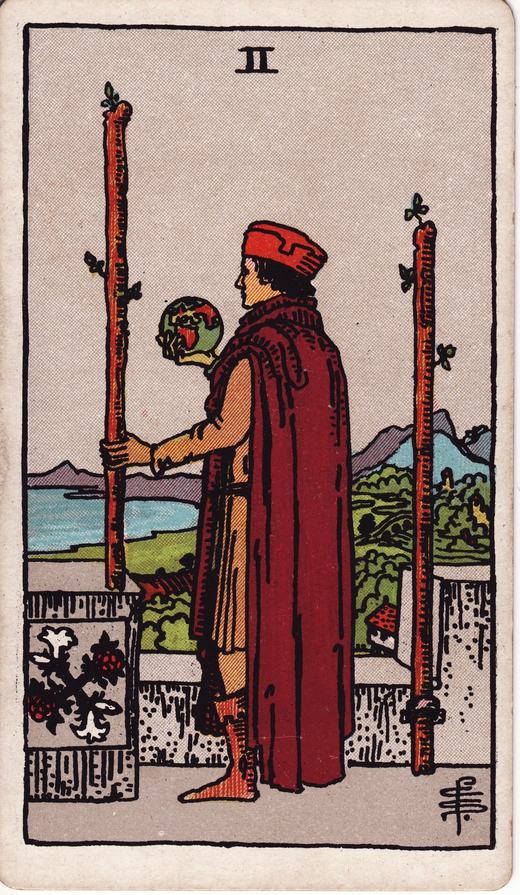
A figure stands on the parapet of a fortification, set on raised ground that overlooks the landscape. He holds a wand in his right hand — secured to the merlon by a metal clamp — and in his left he holds a small globe of the world, balanced between his fingers as if weighing the entire planet. A second identical wand is fixed to the parapet at his left, free but not gripped.
Below him stretches a landscape of wooded hills crossed by a river, and in the distance you can make out dwellings and a coastline beyond the sea. The figure is dressed in red, the color of active will, and wears a hat from which a scarf flutters in the wind. His gaze is fixed far off: he isn't contemplating what he has, he's imagining what he could.
The Two of Wands upright
Upright, the Two of Wands is vision and planning: you have a solid starting point, and now you're calculating what to build from there. It marks a phase of strategic reflection before action, where you look far and weigh possibilities. This isn't hesitation — it's the necessary stage where an idea becomes a project, where the direction is chosen before the move.
The card invites you to think big without losing contact with the real. The globe in hand says the horizon is yours, but the wands clamped to the parapet remind you that a concrete base is needed. When it appears, it asks you to define the destination before setting off — not the detailed route, but the north you'll steer by.
The Two of Wands reversed
Reversed, the Two of Wands speaks of stalled plans or short sight: the horizon has narrowed, the possibilities have closed out of fear of the unknown or indecision. You stay at the parapet without picking a direction, and the absence of a plan becomes the choice itself. It can also point to plans spoken but never turned into action.
A less immediate reading concerns the globe slipping from hand: you're holding so many visions that you choose none, and dispersion takes the place of planning. Here the invitation is the opposite of the usual: not 'think more', but 'pick a direction and stop gazing at all the others'.
The Two of Wands in love
In love, the Two of Wands upright marks a phase of evaluation: you're looking beyond the present situation to understand what you truly want, or you're imagining a shared future still to be built. It favors couples who pool visions and plans. Reversed, it signals hesitation, fear of choosing, or vague expectations that block commitment. The question is whether you know where you want to go, or whether you're simply watching the horizon without deciding.
The Two of Wands in work and money
At work, the Two of Wands upright is strategic planning — setting a company's direction, sizing up expansion, weighing markets and long-term opportunities. It favors phases where you look past the daily grind to build the future. Reversed, it points to a lack of vision, half-finished projects, or fear of risk that stalls growth. Before you act, ask whether you truly have a direction or are just filling the present.
How to read the Two of Wands in spreads
A card's meaning shifts with the position it occupies. Here is how the Two of Wands behaves in the most common spreads.
In the Celtic Cross
| Position | What it indicates |
|---|---|
| present situation | You're standing at the parapet, with a solid base and an open horizon: this is the moment to choose where to go. |
| obstacle | Indecision or fear of the unknown is keeping you still — you have the resources but not the direction. |
| near future | A vision will clarify, and with it the direction to imprint on the path. |
In the Three Card spread (past · present · future)
| Position | What it indicates |
|---|---|
| past | A planning or a founding vision that shaped what you live today. |
| present | You're called to look far and choose a destination before moving. |
| future | An opening of horizon: opportunities that ask for vision and the courage to set off. |
Common mistakes in interpretation
The most common mistake is reading the Two of Wands as a card of passive waiting or idle daydreaming. It isn't idle contemplation — it's active planning, the act of choosing a direction while the base is still secure. Confusing it with hesitation misses its strength. A second misunderstanding is reading it as a promise of guaranteed success: the card says the vision is there, not that it will realize itself.
Keywords
| Orientation | Meaning |
|---|---|
| Upright | planning, future choice, vision, horizon, opportunity, strategy |
| Reversed | fear of the unknown, no plan, indecision, short sight, stalled plans, hesitation |
Frequently asked questions about Two of Wands
Does the Two of Wands point to a decision to make?
Yes, but at the level of direction more than a precise choice. The card suggests you have a base and options, and it's time to look far and define where you want to go. It doesn't ask you to settle every detail, but to choose the north you'll steer by.
Does the Two of Wands reversed mean the decision is wrong?
Not necessarily. It more often points to indecision, fear of choosing, or a narrowed vision. It can also signal that you're postponing a necessary choice, or getting lost among too many options without picking one. The invitation is to define a direction, not to chase the perfect one.
Is the Two of Wands a travel card?
It can be, but rarely in the sense of immediate departure. More often it speaks of travel imagined or planned — the horizon you trace before you actually hit the road. If it concerns a move, it usually points to a considered choice rather than a whim.
Want to see the Two of Wands in a full reading?
Try a free spread on Theurgos →