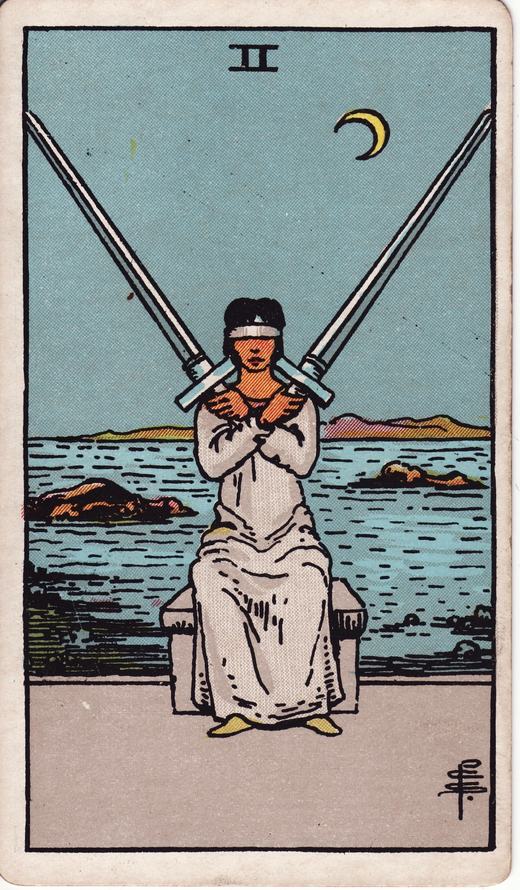
The Two of Swords is the card of the impasse: two equal and opposite forces held in balance only because neither moves. It is the tension of knowing a decision must be made and choosing, for now, not to make it — because every option costs, and the blindfold shields you from having to look.
The symbolism of the card
A female figure sits on a stone bench at the centre of the scene, her eyes covered by a white blindfold. With both hands she grips the hilts of two swords, crossed over her chest in a defensive X. She wears a white robe that covers her down to her feet. Behind her stretches a restless sea, and in the distance rocks and a small island lie under a pale sky.
The blindfold is the point: the woman is not blind, she has blindfolded herself. The two swords are not turned against an enemy but held in a cross to keep out what she refuses to see. The uneasy water behind her is the emotional matter flowing beneath the forced calm of her pose — the balance is only apparent, held up by sheer force of closed eyes.
The Two of Swords upright
Upright, the Two of Swords describes a deliberate stalemate: a situation in which two alternatives hurt equally, and you choose to stay still rather than accept either. This is not ignorance but conscious avoidance. You know a decision is pending, and you are putting it off.
The card can indicate a truce, a fragile agreement held together by the fact that neither side yields. In that sense it is a useful suspension while it lasts — it buys time — but it resolves nothing. Sooner or later the blindfold has to come off, because no one can hold crossed swords forever.
The Two of Swords reversed
Reversed, the block releases: the held-back decision is finally taken, the blindfold falls, the fake equilibrium gives way. Often this comes as a relief — the paralysis had lasted too long, and moving is better than lingering, even toward an imperfect choice.
A second reading is less rosy: the reversal can mark a decision made on impulse, under the pressure of no longer being able to hold out. The block dissolves not from clarity but from exhaustion. In that case it is worth slowing down one last time before letting the swords drop: removing the blindfold with care, not tearing it off.
The Two of Swords in love
In love the upright Two of Swords paints a relationship in stalemate: two people keeping their distance, dodging the decisive conversation, holding a truce that feels cold. It can also flag indecision between two people or two romantic paths, the heart left hanging. Reversed, the blindfold comes off: either clarity is finally found and a choice made, or the accumulated tension blows open. The block can no longer hold — better to face it before it bursts on its own.
The Two of Swords in work and money
At work the upright card describes an impasse: a choice deferred, two options balancing each other, a negotiation in stand-by where no one yields. It shields you from the worst but freezes the project. Reversed, the stalemate breaks: you decide, you sign, you step out of the wait. Take care only not to decide from sheer fatigue — when pressure rips off the blindfold, that is the moment to choose with the head, not to surrender.
How to read the Two of Swords in spreads
A card's meaning shifts with the position it occupies. Here is how the Two of Swords behaves in the most common spreads.
In the Celtic Cross
| Position | What it indicates |
|---|---|
| present situation | The matter is in stalemate: two forces balance each other and you are postponing the decision, keeping them at bay. |
| obstacle | What holds you back is avoidance: the refusal to face the choice that has to be made. |
| near future | The stalemate will not last: pressure or new information will push you to lift the blindfold. |
In the Three Card spread (past · present · future)
| Position | What it indicates |
|---|---|
| past | It tells of an impasse already lived, a stretch of suspension in which a decision was dodged. |
| present | It catches you at the centre of the stalemate, blindfolded before a choice you keep deferring. |
| future | It signals that the way out runs through clarity: stop holding the swords crossed and choose. |
Common mistakes in interpretation
The Two of Swords is often read as plain “uncertainty”. But it is not timid hesitation: it is a deliberate choice not to see. The woman has blindfolded herself. To mistake it for harmless indecision is to underrate it — its real theme is avoidance, and avoidance always has a price.
Keywords
| Orientation | Meaning |
|---|---|
| Upright | stalemate, difficult choice, avoidance, blindfold, fragile truce, forced balance |
| Reversed | decision made, clarity regained, block removed, breakthrough, impulsive choice, broken truce |
Frequently asked questions about Two of Swords
Is the Two of Swords a positive card?
It is a neutral card of suspension: it does not announce harm, but it does not resolve anything either. It signals that you are at a crossroads and putting off the decision — a useful truce until it becomes avoidance.
What does the reversed Two of Swords mean?
That the stalemate dissolves: the decision is taken, the blindfold falls. Often a relief; sometimes, though, the choice is made from exhaustion rather than clarity, and one last pause is wise.
Does the Two of Swords answer yes or no?
It tends toward “not yet”: the decision is deferred. It is not a no, but it asks you to stop holding the swords crossed before it can truly answer.
Want to see the Two of Swords in a full reading?
Try a free spread on Theurgos →