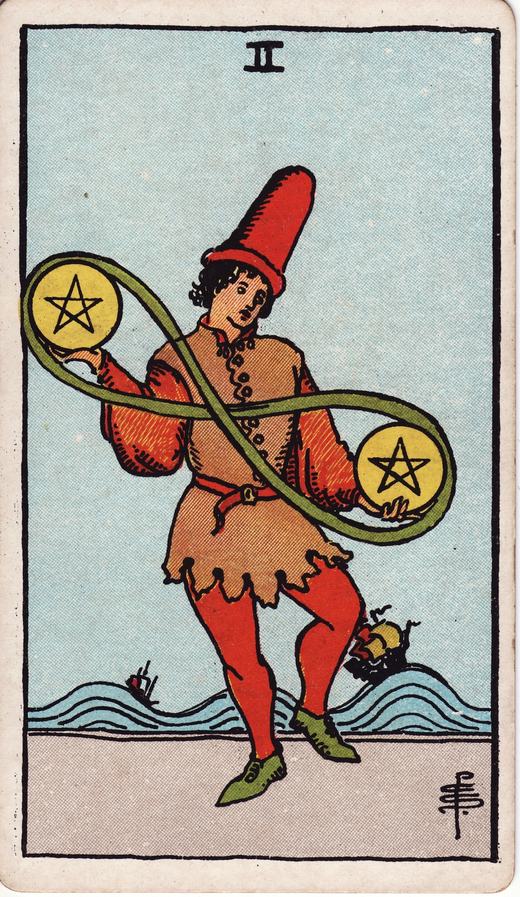
The Two of Pentacles is the juggler's card — the one who keeps everything airborne at once and cannot afford to stop. Life has asked you to run several things in parallel: work and family, two projects, income and outgoings — and you manage it with agility, but with no margin for error.
This is dynamic balance, not stability reached but stability in motion. It holds as long as the dance continues; one extra weight, one wave too high, and the whole act topples.
The symbolism of the card
A young juggler stands centre frame, making two coins dance, bound together by a ribbon twisted into the shape of an infinity sign — the mark of continuous balance, of endless alternation. The two coins chase each other and never stop, because stopping would mean dropping everything.
Behind him, beyond the harbour, the sea is rough: two ships rise and fall on tall waves, one climbing as the other descends. The seething water says the context is unstable, and that the juggler keeps his footing precisely where the ground beneath him is heaving. His hat, its brims curved like the infinity symbol, drives the theme home.
The Two of Pentacles upright
Upright, the Two of Pentacles describes a phase of active balancing: you are juggling multiple priorities, weighing options, trying to square a budget or a calendar. This isn't calm — it's intelligent juggling. The card acknowledges the effort and suggests that, for now, the balance holds.
Its invitation is to flexibility: in this stretch adaptability matters more than perfection. Accept that some things must stay airborne and look for the right rhythm, not the definitive solution. As long as you dance with the circumstances, you keep your footing.
The Two of Pentacles reversed
Reversed, the juggler drops a ball: too many projects, too many deadlines, too many demands. What was balance becomes overload, and the coins threaten to fall. The card signals that you've taken on more than you can carry, or that a real hierarchy among priorities is missing.
The second reading is about quality: when you keep everything airborne, nothing gets true attention. Reversed, the Two asks you to choose — to drop something on purpose, before everything falls. Saying no isn't weakness; it's the only way to save what matters.
The Two of Pentacles in love
In love the Two of Pentacles upright speaks of a relationship that has to be balanced against the rest of life, or of a heart divided between two possibilities. The couple works when both accept the demands, even when they're heavy. Reversed, it signals that the relationship sits at the bottom of the priority list, squeezed by work and obligations: one partner feels neglected, and the emotional balance threatens to break.
The Two of Pentacles in work and money
At work it describes multitasking, overlapping deadlines, budgets to square. It belongs to whoever handles several clients, several projects, several roles at once. The card rewards adaptability but asks for order: without a system, overload turns to chaos. Reversed, it warns that you're underestimating the load and that before taking on more you need to lighten the list.
How to read the Two of Pentacles in spreads
A card's meaning shifts with the position it occupies. Here is how the Two of Pentacles behaves in the most common spreads.
In the Celtic Cross
| Position | What it indicates |
|---|---|
| present situation | You are keeping several spheres in balance at once, and so far your agility is holding the weight. |
| obstacle | The real obstacle is the lack of clear priorities: everything feels urgent and nothing gets its proper weight. |
| near future | More demands will arrive to manage; flexibility rather than rigidity will save you. |
In the Three Card spread (past · present · future)
| Position | What it indicates |
|---|---|
| past | It points to a stretch where you balanced a lot, perhaps with effort, laying the groundwork for where you stand now. |
| present | You're caught mid-juggle: too much in the air, a constant choice about what to weigh most. |
| future | It suggests learning to say no, because the demand will always outrun your capacity. |
Common mistakes in interpretation
The Two of Pentacles is often mistaken for a card of lightness. It isn't: juggling is tiring. At other times it's read only as chaos, forgetting that balance, while it holds, is a genuine skill. The mistake is failing to recognise how much it costs to keep everything airborne — and never asking whether it's worth it.
Keywords
| Orientation | Meaning |
|---|---|
| Upright | balance, juggling, adaptability, priorities, multitasking, flexibility |
| Reversed | disorganisation, overload, imbalance, overestimation, chaos, deferred choices |
Frequently asked questions about Two of Pentacles
Is the Two of Pentacles good or bad?
Neither, simply dynamic. Upright it shows you're managing several things well; the risk is fatigue. The card evaluates your method more than the outcome.
What does it mean for money?
A moving budget: income and outgoings balancing by effort, several accounts open at once. It works as long as you keep track; it slips if you lose the thread.
How do you resolve it when reversed?
By choosing. Reversed it means overload: the way out is to drop something on purpose, set real priorities, delegate or say no.
Want to see the Two of Pentacles in a full reading?
Try a free spread on Theurgos →