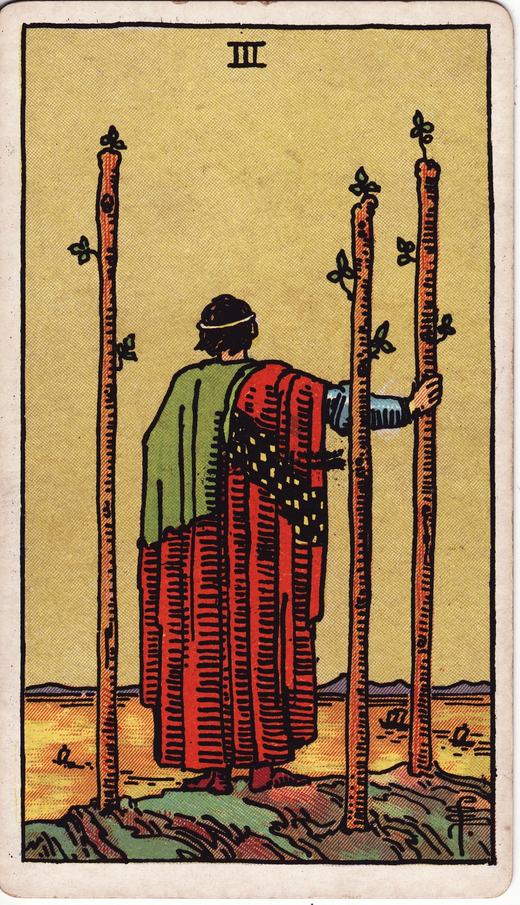
The Three of Wands marks a step forward from the Two. The vision has become gesture: you've invested, you've set things in motion, and now the first results are on their way — but not yet arrived. It's the card of fertile waiting, of someone who has done their part and watches what they launched move off to bear fruit elsewhere.
Its signature is an expansion that asks for patience. No longer the planning of the Two, not yet the harvest: the Three is the moment the ships have sailed and all that's left is to await their return, knowing you did what you could.
The symbolism of the card
A figure stands on a rocky balcony overlooking the sea, seen from behind but recognizable by the yellow-and-red robe. Two wands are fixed to the parapet beside him, and a third is firmly gripped in his hand. His gaze is on the waters below, where three ships are sailing toward the horizon — sails spread, heading out to the open sea.
The landscape is rocky and golden, with the sea stretching out of sight. The ships aren't decorative details: they represent what has been sent out into the world — trade, projects, energies put in motion. The figure's raised position says the decisive action is already done, and now he watches what he launched take its own course.
The Three of Wands upright
Upright, the Three of Wands is expansion and opportunity in motion: what you've set in motion is starting to pay off, even if the full harvest will take time. It signals progress, an open perspective, the sense of having invested well and now needing to let things mature. The ships have sailed, and that's already a success.
The card invites you to resist impatience. The Three rewards whoever can wait without letting go — who trusts the process they've set in motion. This isn't the moment to launch new initiatives, but to tend the ones underway and to look far, knowing the worst — the uncertainty of the start — is already behind you.
The Three of Wands reversed
Reversed, the Three of Wands speaks of delays and obstacles: the ships are slow to return, the projects hit resistance, the expansion stalls through circumstance or lack of investment. It can point to having moved too soon, without the solid base required, or to waiting curdling into sterile frustration.
A less obvious reading concerns motion imagined but not real: you believe you're expanding, but the ships never actually sailed. You're mistaking intention for action, and fooling yourself that you invested when you only thought about it. Here the invitation is severe: stop counting ships you never sent.
The Three of Wands in love
In love, the Three of Wands upright points to a relationship growing and expanding: the first steps are done, and now the story finds its rhythm, asking for time and trust. It can also signal a long-distance bond or a meeting that ripens slowly. Reversed, it warns of delays or of only-apparent expansion — you think the story is moving while it really stagnates. Check whether you've both truly invested, or whether one of you is simply waiting.
The Three of Wands in work and money
At work, the Three of Wands upright is genuine expansion: projects taking off, opportunities opening, trade or collaborations extending. It favors activities that require long-term vision and patience to see the fruit. Reversed, it signals obstacles to growth, premature investments, or projects slow to take off. Before going further, ask whether the base is solid or whether you moved before your time.
How to read the Three of Wands in spreads
A card's meaning shifts with the position it occupies. Here is how the Three of Wands behaves in the most common spreads.
In the Celtic Cross
| Position | What it indicates |
|---|---|
| present situation | You've launched something into the world and now await the fruit — the decisive action is done, patience is what's needed. |
| obstacle | Delays or a lack of real investment are slowing the growth: the ships are late, or never sailed. |
| near future | Promises the first results of what you started with care and vision. |
In the Three Card spread (past · present · future)
| Position | What it indicates |
|---|---|
| past | A brave choice or an investment made, from which what you see now derives. |
| present | You're in a phase of controlled expansion: motion is there, tend it without forcing it. |
| future | Points to opportunities coming, the fruit of patience held and work well begun. |
Common mistakes in interpretation
The most common mistake is confusing the Three of Wands with the Two, mistaking fertile waiting for mere planning. The Three is past that: you've already acted, the ships have already sailed. A second misunderstanding is treating it as a card of idleness or passive waiting. It isn't — it asks patience, yes, but the patience of someone who knows they've invested, not of someone who did nothing hoping for a miracle.
Keywords
| Orientation | Meaning |
|---|---|
| Upright | expansion, progress, opportunity, fertile waiting, perspective, investment |
| Reversed | delay, obstacles, frustration, lack of investment, stalled expansion, illusion of motion |
Frequently asked questions about Three of Wands
Is the Three of Wands a positive card?
Yes — it signals progress and opportunity on the way: what you started is growing. But its positivity only ripens with patience. This isn't the moment to force, but to tend what's already moving. It rewards whoever can wait for the fruit without stopping believing in the process.
What does it mean when the ships are slow to return?
It points to delays, obstacles, or a phase where results are slow to arrive. It can also signal that the investment wasn't enough, or that you moved before the base was solid. The invitation is to verify what actually set off and what stayed only intention.
Does the Three of Wands always concern work and trade?
No, even though the image of the ships suggests it. It speaks of any long-term investment, of any energy set in motion that needs time to bear fruit — a relationship, a course of study, a creative work, an inner shift. The logic is the same: you launched something, now you wait for it to come back matured.
Want to see the Three of Wands in a full reading?
Try a free spread on Theurgos →