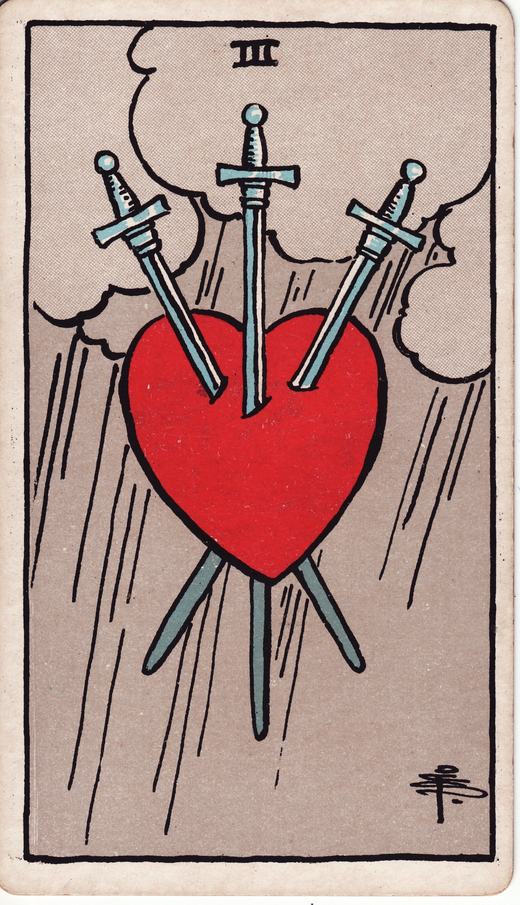
The Three of Swords is the card of acute pain: the kind that strikes where you are most exposed, the heart. Unlike other “hard” cards, this one hides nothing and sweetens nothing — its task is to name the suffering, because only what is acknowledged can begin to heal.
The symbolism of the card
At the centre of the card floats a large red heart, pierced by three crossed swords. The blades meet in the middle of the heart, their points jutting clean at the sides. Behind it a grey, overcast sky pours a thick slanting rain that soaks the whole scene.
There is no human figure: only the heart, the swords, the rain. The image is bare on purpose, because the pain of the Three of Swords needs no frame — it is the feeling itself, laid open. The red of the heart is the only warm colour, and the grey of the sky tells how everything else fades when pain takes the stage.
The Three of Swords upright
Upright, the Three of Swords announces real pain: betrayal, a break-up, a wound straight to the heart. This is no small misunderstanding: it is the card of suffering you cannot turn another way. It can mark a bitter quarrel, a separation, a truth that hurts precisely because it is true.
The card does not ask you to endure in silence: it asks you to look. Denying the pain only drives it deeper. The Three of Swords invites you to acknowledge the wound, to let it bleed rather than cover it, because the first step of healing is admitting that something genuinely hurt.
The Three of Swords reversed
Reversed, the Three of Swords speaks of healing: the wound begins to close, acute pain turns into memory. It is the card of forgiveness — not necessarily reconciliation, but releasing the poison of the injury. The rain stops falling, the sky opens up.
A second reading deserves attention: the reversal can also point to denied pain, still buried, that keeps working under the surface. Real healing means passing through the wound, not skipping it. If the reversal arrives too soon, it may warn of a grief being suppressed that still asks to be felt.
The Three of Swords in love
In love the upright Three of Swords is the card of the broken heart: betrayal, a break-up, a painful truth within a relationship. It offers no immediate comfort, only truth. Reversed, it points to slow recovery — the wound mending, forgiveness becoming possible, the ability to engage again. Mind you do not mistake forgiveness for suppression: healing is not pretending it never happened.
The Three of Swords in work and money
At work the upright card signals a stinging defeat, a missed hire, a collaboration that breaks badly, a vote against that stings. It is when the professional turns personal. Reversed, it points to recovery: the incident is processed, the lesson drawn, a fresh start on more honest ground. Here too, pain left unworked returns as resentment — better to pass through it fully.
How to read the Three of Swords in spreads
A card's meaning shifts with the position it occupies. Here is how the Three of Swords behaves in the most common spreads.
In the Celtic Cross
| Position | What it indicates |
|---|---|
| present situation | A wound sits at the centre of the matter: real pain, to be recognised and not minimised. |
| obstacle | What holds you back is unprocessed pain, or the fear of looking at the wound for what it is. |
| near future | The worst of the storm is close to passing: healing announces itself, but it asks for time. |
In the Three Card spread (past · present · future)
| Position | What it indicates |
|---|---|
| past | It tells of a wound already inflicted, a pain that marked you and still informs how you react today. |
| present | It catches you in the thick of suffering: the card asks you to let it exist, not to cover it. |
| future | It signals a path of healing: the pain does not vanish, but learns to become memory. |
Common mistakes in interpretation
The Three of Swords is often feared as a sentence, as though it announced inevitable misfortune. In fact it names a pain that is usually already underway — its job is to bring it into the open, not to conjure it from nothing. To dread it is to give it more power than it has: the card heals, when you let it speak.
Keywords
| Orientation | Meaning |
|---|---|
| Upright | pain, betrayal, heartbreak, suffering, wound, truth that hurts |
| Reversed | healing, forgiveness, moving past pain, mending, recovery, denied pain |
Frequently asked questions about Three of Swords
Is the Three of Swords a negative card?
It is a card of pain, yes, but not of condemnation: it names a real wound so it can be recognised and, in time, healed. Its purpose is truth, not punishment.
Does the reversed Three of Swords mean the pain is over?
Often yes: it points to healing, forgiveness, recovery. But it can also warn of pain still denied, pretended away while it keeps working beneath the surface.
Does the Three of Swords answer yes or no?
It leans toward no: difficulty, a wound, an uncomfortable truth. It is not a final sentence, but it signals that the current situation hurts and must be faced.
Want to see the Three of Swords in a full reading?
Try a free spread on Theurgos →