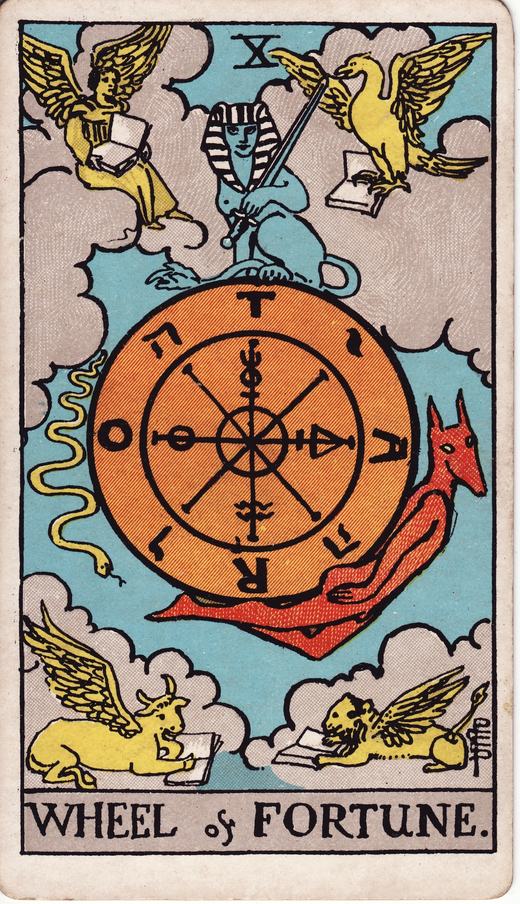
The Wheel of Fortune is the card of the movement that does not depend on us. After the personal conquests of the Chariot, Strength and the Hermit, the tenth Arcanum opens onto the dimension of destiny, of the cycle, of time turning. It is no threat to freedom: it is its complement. There are things we choose and things that happen to us, and wisdom lies in recognising which is which.
The symbolism of the card
In the Rider-Waite image a great eight-spoked wheel occupies the centre of the scene. Crouched at its top is a blue sphinx, motionless, holding a sword: the awareness that watches without joining the turn. On the left a serpent descends along the wheel — Typhon, the evil that falls — and on the right a jackal-headed figure rises, Anubis, the god who accompanies toward the light. On the wheel are inscribed the letters TARO interspersed with the consonants of the name of God in Hebrew, and on the inner spokes the alchemical words that fix the eternal cycle of becoming.
At the four corners of the card, four winged creatures — an angel, an eagle, a bull, a lion — read closed books. They are the fixed signs of the zodiac and the four evangelists, the eternal forces that witness change without being subject to it. The whole tells a single thing: everything turns, and the only true freedom is learning to stay on the wheel without being crushed.
The The Wheel of Fortune upright
Upright, the Wheel announces a turning point. The cycle is spinning: what was still moves, what was low rises, what seemed impossible suddenly unlocks. It is a card of fortune and change, but its fortune is not a reward for merit — it is the turn of fate, favouring those ready to rise when the wheel lifts.
The card invites you to welcome change rather than resist it, and to read the situation in a cyclical key: this phase, good or bad, will not last forever. Those who can recognise their moment — when to push and when to wait — work with the wheel rather than against it.
The The Wheel of Fortune reversed
Reversed, the Wheel indicates resistance to change or an unfavourable cycle: setbacks, events beyond your control, the sense of losing your grip on a situation turning the wrong way. It is not a punishment: it is the descending side of the wheel, which by its nature always comes back around to rise.
The less obvious reading is the opposite: the reversed Wheel can indicate a change endured passively, without any awareness. Fate turns and you sit on it like a stone, dragged along rather than taking part. Here the invitation is not to resist the change, but to stop being subject to it: to begin choosing again within what cannot be prevented.
The The Wheel of Fortune in love
In love the upright Wheel is a meeting of timing: the right person arriving when least expected, a relationship resuming after a pause, a change of phase that renews the bond. It speaks of the moment when fate favours the encounter — but does not guarantee it will last, because the wheel keeps turning. Reversed, it signals sudden ups and downs, emotional instability, a relationship that seems to slip out of hand. The advice is not to force: some emotional cycles must be crossed, not blocked.
The The Wheel of Fortune in work and money
At work the upright Wheel is a change of cycle: a new opportunity arriving from outside, a change of sector, a fortunate phase in which doors open. It favours those who can seize the favourable moment without being caught unprepared. Reversed, it signals setbacks, sudden reversals, a work situation changing against expectations. Remember that not everything depends on you — but how you respond does, and that is where the difference is played.
How to read the The Wheel of Fortune in spreads
A card's meaning shifts with the position it occupies. Here is how the The Wheel of Fortune behaves in the most common spreads.
In the Celtic Cross
| Position | What it indicates |
|---|---|
| present situation | You are in the midst of a change of cycle: the movement is inevitable, the question is whether to ride it or endure it. |
| obstacle | Resistance to change or a momentarily unfavourable cycle holds the situation back. |
| near future | A turn approaches — often unexpected, often favourable, never definitively predictable. |
In the Three Card spread (past · present · future)
| Position | What it indicates |
|---|---|
| past | A change of course that set everything in motion, from which the present situation derives. |
| present | You are at a turning point: fate is spinning and asks to be read, not stopped. |
| future | The cycle turns in your favour, but remember it rises and falls: seize the moment without giving up or deluding yourself. |
Common mistakes in interpretation
The Wheel is often read as pure luck, a kind of winning ticket. That is imprecise: it indicates change and cycle, not necessarily prosperity, and its fortune must be seized on the wing. The mirror error is to live it as total fatalism, as if nothing depended on us: the card invites you instead to tell what is in your power apart from what is not, and to play your part well within the turn.
Keywords
| Orientation | Meaning |
|---|---|
| Upright | cycles, change, destiny, turning point, fortune, passage |
| Reversed | misfortune, resistance to change, stagnation, adverse course, change endured, unfavourable cycle |
Frequently asked questions about The Wheel of Fortune
Is the Wheel of Fortune always a lucky card?
Not always: it indicates a turning point and a movement of the cycle, which can be rising or falling. Upright it tends toward the favourable — something unlocks, fate turns to your advantage — but it is change, not a guaranteed reward, and it must be seized at the right moment.
Does the Wheel mean everything is destiny?
Not exactly. It indicates the dimension of the cycle and of what is beyond control, but it does not cancel freedom: the card invites you precisely to tell what depends on you apart from what does not, and to work your part well within a larger turn.
What does the reversed Wheel indicate?
It indicates resistance to change, a momentarily unfavourable cycle, or a change endured passively. It is no condemnation: the wheel by nature turns, and even the adverse phase will pass. The invitation is not to endure the change, but to begin choosing again within it.
Want to see the The Wheel of Fortune in a full reading?
Try a free spread on Theurgos →