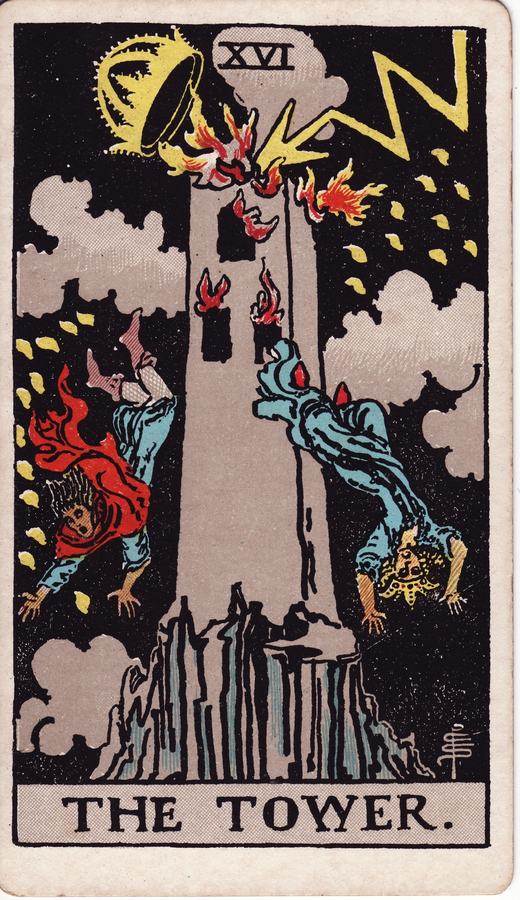
The Tower is the card of sudden collapse, and also one of the most necessary in the deck. What was built on false foundations falls: an illusion, a lie, a structure held up by sheer avoidance. The card does not punish: it reveals. And what it brings down is precisely what would, sooner or later, have fallen anyway.
Its lightning is violent but not arbitrary: it strikes where a hidden crack already was, where a house had been built without looking at the ground. For this, among the feared cards, it is also one of the most honest: it brings to light what needed to be seen.
The symbolism of the card
In the classical image a tall tower, topped by a golden crown, is struck by a bright lightning bolt that splits it from the top. The crown — symbol of power, of pride, of the mental structure believed untouchable — flies off under the blow. From the windows come twenty-two small flames shaped like Yod, the first letter of the divine name: twenty-two, like the letters of the Hebrew alphabet, like the paths of the tree of life.
Two figures fall into the void, one head-down, the other on their back, and their gestures seem of astonishment more than of pain. Below, a stormy sea and a dark rock: the solid ground that remains when all the rest proves unstable. The sky is black, but the lightning lights it up like day. Every detail says: it is the truth that strikes, and what withstands the collapse is what was true.
The The Tower upright
Upright, the Tower announces a sudden rupture: a revelation that changes everything, a structure that falls, a truth that explodes where a lie had been built over. It can be a relationship, an identity, a certainty, an entire life believed solid and proving to be paper. The collapse frightens — but it frees.
In practice the card asks you not to defend at all costs what is falling. What the lightning strikes down was already false: trying to hold it up prolongs the illusion and prepares a second, worse collapse. What survives the blow, instead, is what is truly worth rebuilding on — and in this, paradoxically, the Tower is a card of salvation.
The The Tower reversed
Reversed, it indicates a collapse avoided, or postponed at a high price: the fear of change holds up a now-unstable structure, props are placed under a house that will not stand, a truth that would explode is avoided. The card warns that delaying does not mean averting: what does not fall today will fall tomorrow, and the wait will only make it more painful.
The less immediate reading concerns the quality of the delay: sometimes the reversed Tower describes the moment you survive a collapse that had frightened you — the worst is past, the rubble begins to be explorable. In that case the card does not threaten, but relieves: it indicates you came out alive, and that now you can choose what to rebuild, instead of being swept away.
The The Tower in love
In love the upright Tower signals a sudden crisis that shakes a bond so far accepted as it appeared: a hidden truth emerges, a dynamic no longer sustainable explodes. It does not necessarily announce the end — it can mark the moment when a couple, forced to face each other, chooses to rebuild on true ground. Reversed, it describes the crisis postponed, the relationship held up by pretence, the fear of a collapse one tries to avoid: here the Tower warns that what is not faced will burst, and that delaying it will make it worse.
The The Tower in work and money
At work the card indicates the sudden jolt: a restructuring, a truth about a project or an environment surfacing all at once, a collapse of professional certainties. It can be painful, but it reveals what could truly be relied on. Reversed, it warns against defending untenable positions, holding on to compromised collaborations or projects, pretending all is well out of fear: better to dismantle with care, now, what will not hold in any case.
How to read the The Tower in spreads
A card's meaning shifts with the position it occupies. Here is how the The Tower behaves in the most common spreads.
In the Celtic Cross
| Position | What it indicates |
|---|---|
| present situation | A rupture or revelation underway: what was false is collapsing, and it is best to let it fall. |
| obstacle | The refusal to see, the attachment to a now-unstable structure. |
| near future | A jolt on its way: painful, but revealing of what is true. |
In the Three Card spread (past · present · future)
| Position | What it indicates |
|---|---|
| past | An important collapse already crossed, from which the present structure of your life derives. |
| present | You are in the midst of a jolt: do not defend what is falling. |
| future | Rebuilding on true ground: what remains after the lightning is what counts. |
Common mistakes in interpretation
The Tower is feared as an omen of catastrophe and read only as loss. That is a serious misunderstanding: the lightning strikes what was already false, and the collapse is revelation before destruction. The opposite error is to think it 'always bad' and ignore the relief it brings. In many spreads it is one of the most honest cards in the deck: where there was a lie, it clears space for something true.
Keywords
| Orientation | Meaning |
|---|---|
| Upright | sudden rupture, revelation, cataclysm, collapse of the false, truth that explodes, radical turn |
| Reversed | collapse avoided, change delayed, fear of rupture, denial, resistance to the truth, rubble to explore |
Frequently asked questions about The Tower
Is the Tower always a negative card?
No, though it is among the hardest. It brings down what was built on the false, and that collapse is revelation before ruin. It often comes where one had avoided looking; left to act, it frees. Those who defend already-cracked structures fear the Tower; those who wanted the truth thank it.
Does the Tower announce a literal disaster?
Rarely. Almost always it concerns psychological, relational or life structures — a certainty that falls, a truth that surfaces, a project that proves untenable. Its violence is of an inner order: it shakes what you believed so that you can rebuild on true ground.
Does the Tower answer yes or no?
It leans toward no, because it signals that something behind the question does not hold: the answer is not in the direction asked, but in looking at what is collapsing and that perhaps, secretly, you would want to see fall.
Want to see the The Tower in a full reading?
Try a free spread on Theurgos →