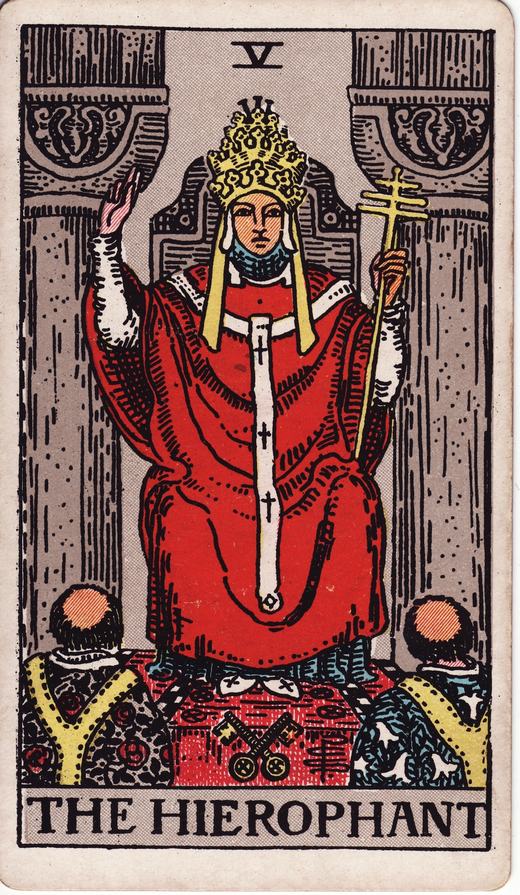
Where the Emperor fixed the laws of the world, the Hierophant consecrates those of the spirit — or, outside any religious reading, the very principle of tradition: what comes from before us and asks to be received, learned, and passed on in turn. He is the Arcanum of the teacher, the institution, the well-trodden path.
His hallmark is not innovation but continuity. Do not ask him to invent: ask him to show you the trail others have already learned to walk, and why.
After the authority of power, here is the authority of meaning: the number five introduces the moment when the journey seeks a shared significance.
The symbolism of the card
The Hierophant sits between two carved stone columns, twins of the temple's but now visibly human. On his head he wears the triple tiara, three crowns stacked to signify dominion over the three worlds — earthly, celestial, intermediate. He is robed in red and blue, the colours of a spiritual authority that governs both the fire of action and the water of devotion. His right hand is raised in blessing, two fingers extended and two folded: the gesture of doctrine, distinguishing what is acceptable from what is not.
In his left he holds a papal cross with three bars, symbol of a hierarchical way upward. Before him, two kneeling clerics receive the teaching. At his feet, two crossed keys — one gold, one silver — mark the power to open and close, to bind and to loose.
The The Hierophant upright
Upright, the Hierophant represents tradition and knowledge handed down: teachers, institutions, shared values, paths already traced that others have tested before you. He suggests seeking counsel from those with experience, drawing on a recognised method, finding strength in following a proven way instead of reinventing everything alone. This is not the moment for rupture, but for humble apprenticeship.
In practice he asks for respect toward what came before: a mentor, a school, a discipline, a ceremony. The upright Hierophant rewards those who can receive before wanting to give, who recognise a heritage and make it their own. This does not mean submission: it means understanding the rules of the game before claiming to change them.
The The Hierophant reversed
Reversed, the Hierophant is rebellion against convention, free thinking, or disillusion with guides and institutions that have proven empty or hypocritical. The old rules no longer serve you, and the card acknowledges the legitimacy of leaving them behind — but with discernment, not out of reaction. Seek your truth where theirs has cracked.
A more nuanced reading concerns the opposite excess: rigid conformism, stifling dogmatism, the institution become a cage for the souls it should accompany. The reversed Hierophant can indicate a spiritual or cultural authority that has betrayed its function — and then rebellion is not a vice, but decency. It is for you to see which way it leans.
The The Hierophant in love
In love the upright Hierophant speaks of bonds seeking shared frames: formalised commitment, the meeting of families and values, the will to build something socially recognised. It can indicate a relationship consolidating through a rite — marriage, declared cohabitation, an explicit pact. Reversed, it signals the conflict between private desire and social pressure, or a break with family expectations. It asks you to decide by your own values, not by those others have set for you.
The The Hierophant in work and money
At work the upright Hierophant points to institutions, formal apprenticeship, recognised careers, roles that require a qualification or a licence. It favours study, collaboration with those who have more experience, respect for established methods. Reversed, it signals a clash with the hierarchy, impatience with bureaucratic procedure, or a calling to an independent path outside the recognised routes. Sometimes rebelling is right: the card asks you to weigh what is gained and what is lost.
How to read the The Hierophant in spreads
A card's meaning shifts with the position it occupies. Here is how the The Hierophant behaves in the most common spreads.
In the Celtic Cross
| Position | What it indicates |
|---|---|
| present situation | You are called to refer to a guide, a tradition or a recognised method: receive before wanting to give. |
| obstacle | Rigid conformism or an institution felt as a cage: what should accompany is smothering. |
| near future | The meeting with a teacher, a ceremony or a structured path that will frame your journey. |
In the Three Card spread (past · present · future)
| Position | What it indicates |
|---|---|
| past | A teaching received, an underlying tradition that shaped your values. |
| present | Seek counsel, learn from those who know, or recognise the worth of a proven method. |
| future | A belonging or a formal recognition on its way, the fruit of a shared path. |
Common mistakes in interpretation
The most frequent error is to read the Hierophant exclusively in a religious key, losing his scope: he is the Arcanum of every tradition — academic, professional, family, cultural — that passes knowledge from one generation to the next. A second misconception is to consider him always conservative and oppressive: his function is also nourishment and orientation. Mistaking him for dogma alone loses what is valid in receiving an inheritance, before one might eventually reform it.
Keywords
| Orientation | Meaning |
|---|---|
| Upright | tradition, teaching, belonging, spirituality, conformity, wisdom handed down |
| Reversed | rebellion, free thinking, disillusion, unconventionality, dogmatism, break with the institution |
Frequently asked questions about The Hierophant
Does the Hierophant always mean religion?
No, and reducing him to that is the most common misconception. He stands for every form of knowledge passed on through a recognised way: a school, a professional discipline, a family tradition, a civil ceremony, a mentor. The religious component is one of his faces, not the only nor the main one in most readings.
Is the reversed Hierophant positive or negative?
It depends on what is being left behind. If it marks liberation from a smothering conformism or a hypocritical institution, it is deeply positive. If it signals an immature refusal of all rules, or a rebellious dogmatism mirroring the one endured, it calls for discernment. The reversed Hierophant is neutral: the quality of the rupture decides its value.
What does it mean for a choice concerning family?
That the decision plays out on the ground of shared values and inherited expectations. The upright Hierophant suggests taking tradition into account, seeking a formal agreement, honouring the bonds. Reversed, it indicates that outside pressure is smothering a choice that should be yours. Check what truly belongs to your values and what is merely inherited.
Want to see the The Hierophant in a full reading?
Try a free spread on Theurgos →