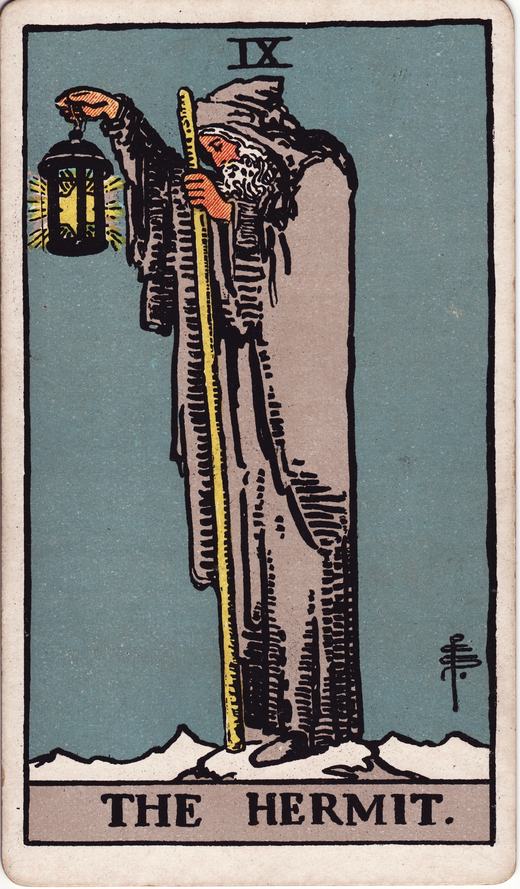
The Hermit withdraws while the rest of the world still asks for his presence, and precisely for that reason his solitude is a choice, not an exile. He is the card of the search for meaning, of the point where the journey outward stops and the one inward begins. After the Chariot's conquest and Strength's mastery, the ninth Arcanum asks: and now that you have won and learned to hold yourself up, what truly matters?
The symbolism of the card
In the Rider-Waite image an old man with a white beard stands on a rocky peak, wrapped in a grey cloak that almost makes him one with the desolate landscape. With one hand he raises a lantern, with the other he leans on a long pilgrim's staff. The lantern does not light the way ahead of him: it lights the exact spot where he stands, because the Hermit does not seek the road, he seeks the step.
Inside the lantern shines a six-pointed star, the seal of Solomon uniting the above and the below, reason and intuition. The staff is that of a traveller who has already walked far, but his wisdom is not a treasure to display: he carries it with discretion, knowing that certain teachings are received only in silence. The grey, horizonless background is not sadness: it is the cleared space in which one can finally think.
The The Hermit upright
Upright, the Hermit indicates fertile introspection. It is time to withdraw from the noise — from others' opinions, from the urgencies piling up, from the need to put on a show — to listen to the voice heard only when the rest falls silent. It is not a flight, it is a deepening: the solitude that heals because it is chosen.
The card rewards those who can be alone without filling up on distractions and who accept that certain answers come not from outside but from slow work within. Its light is low, lighting one step at a time, but it is the only one that does not deceive. When it appears, it suggests turning down the volume of the world and turning up that of inner listening.
The The Hermit reversed
Reversed, the Hermit loses the line between solitude and isolation. The cave that healed becomes the cage that imprisons, silence becomes avoidance, wisdom turns into loftiness toward those still out in the world. One has stopped seeking and begun hiding, mistaking the refuge for the destination.
There is also the opposite reading, often overlooked: the refusal to withdraw when withdrawal is exactly what is needed. The reversed Hermit can indicate someone afraid to be alone with themselves, who fills every moment with commitments and relationships so as not to hear the question that tolls in the emptiness. Here the invitation is paradoxical — not to go out, but to enter your own company at last.
The The Hermit in love
In love the upright Hermit is an ambivalent card: it indicates a phase in which the relationship needs breathing room, time for oneself within or outside the couple, or the meeting with a mature, self-sufficient person who is in no hurry. It is not the card of the great sweeping love, but of the bond that strengthens because each has first come to know themselves alone. Reversed, it signals emotional distances widening, communication withdrawn to the point of silence, or the fear of truly letting someone close. It asks you to tell the need for space apart from the will to flee.
The The Hermit in work and money
At work the upright Hermit indicates a period of study, strategic reflection, deep solitary work: the research that precedes the result, the project that ripens in silence. It favours those who work independently, who teach, who consult, who must make a complex decision and need to isolate themselves to do it. Reversed, it signals isolation that harms the career — the refusal to collaborate, the pride that pushes allies away, or a retreat into a niche that protects but limits. Wisdom without exchange dries up.
How to read the The Hermit in spreads
A card's meaning shifts with the position it occupies. Here is how the The Hermit behaves in the most common spreads.
In the Celtic Cross
| Position | What it indicates |
|---|---|
| present situation | There is a need to withdraw and listen: the answer comes not from outside but from inner work. |
| obstacle | Excessive isolation or the refusal to look within blocks the matter. |
| near future | A phase of reflection approaches, bringing clarity if you can stay in it without fleeing. |
In the Three Card spread (past · present · future)
| Position | What it indicates |
|---|---|
| past | A period of fertile solitude that forged your present wisdom. |
| present | You are called to take stock in silence, far from the noise of others' opinions. |
| future | The light you seek will kindle one step at a time, not in a flash: bend down to see it. |
Common mistakes in interpretation
The Hermit is often mistaken for a card of sad solitude, almost of relational mourning. It is not: his solitude is chosen and fertile, not endured. The mirror error is to read him as a perpetual invitation to isolate: his withdrawal is functional, it lasts as long as needed, then one returns to sharing. Finally, many reduce him to a generic 'card of spirituality', when he indicates a precise path — that of inner truth sought with patience.
Keywords
| Orientation | Meaning |
|---|---|
| Upright | introspection, solitude, inner search, wisdom, listening, inner guidance |
| Reversed | isolation, excessive withdrawal, endured solitude, alienation, avoidance, refusal to look within |
Frequently asked questions about The Hermit
Is the Hermit a positive or negative card?
Neither, in a simplistic sense: it is a card of depth. Upright it indicates a fertile, chosen, constructive solitude that brings clarity. Its 'positivity' depends on your willingness to stay in the silence: for those who accept to stop, it is a blessing; for those afraid to look within, it can weigh.
Does the Hermit in love mean a breakup?
Not necessarily. It indicates rather the need for space, for time to oneself, or a meeting with a mature, independent person. It can precede a temporary distance that strengthens the bond, but reversed it signals a real emotional withdrawal, not to be confused with the legitimate need to breathe.
Does the Hermit answer yes or no?
It leans toward no, or 'not now': it is a card that asks you to wait, reflect, and not act on impulse. More than a yes or a no, it offers a 'know before you decide' — it invites you to seek the answer within before seeking it outside.
Want to see the The Hermit in a full reading?
Try a free spread on Theurgos →