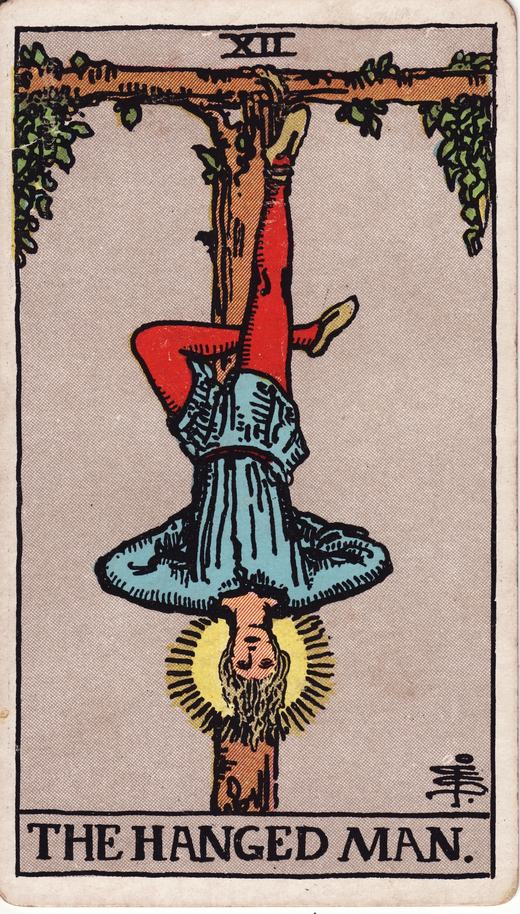
The Hanged Man is the card of the pause willed, not endured. After Justice's decided action and before Death's transformation, it asks for a time of suspension in which the mind stops pushing and finally sees. Its number, twelve, marks a completed cycle waiting to be understood before it descends again into form.
He is the figure of the reversal: the one who stays still and understands more than the one who runs. Seemingly passive, he is in fact one of the most active cards in the deck — because the true action, sometimes, is to stop fighting the current.
The symbolism of the card
In the classical image a man hangs upside down, suspended by a single foot from a horizontal beam held up by two tree trunks with their branches cut. His legs are crossed in a pose recalling the number four inverted, and his hair falls toward the ground to remind us that gravity, from this angle, pulls the body in another direction. The most surprising detail is the golden halo around his head: there is no torture here, there is illumination. The ordeal, if there is one, is chosen, and from the choice comes lucidity.
Below him the earth and a still pool of water, and in the background a light that seems to dawn. The six stubs on each trunk recall the twelve — the apostles, the months, the zodiac signs — and say that something complete has been severed so that it may be understood. The card does not invite you to suffer: it invites you to suspend what you thought certain.
The The Hanged Man upright
Upright, the Hanged Man is strategic surrender: stopping when pushing does not help, letting yourself be turned upside down to read the situation from another angle. It announces a necessary pause, a fertile sacrifice, the willingness to lose your position to gain understanding. It is not time to act, but to understand — and understanding comes precisely because you stop forcing it.
In practice it rewards those who accept to remain in doubt without resolving it in haste. It can indicate a period of depending on something or someone, in which a project is momentarily suspended, in which life asks you to let go of control. Its subtle message is that patience, here, is not passivity: it is the most sophisticated form of action.
The The Hanged Man reversed
Reversed, the Hanged Man loses his fertile quality and becomes sterile stalemate: waits that do not ripen, sacrifices that bring nothing, a suspension that has stopped teaching. One stays still not by choice but out of laziness or fear of climbing down from the beam. The card asks you to recognise when the pause has turned into avoidance.
There is, however, a second, less obvious reading: the reversal can signal the right end of a necessary suspension — the moment you have understood what you needed to and can finally set your feet back on the ground. Or, on the contrary, a resistance to surrender that masks itself as hyperactivity: you do a great deal, in order not to stop and look.
The The Hanged Man in love
In love the upright Hanged Man describes a relationship in which one of the two is going through a period of redefinition, and asks the other to wait, to offer space instead of demanding answers. It can indicate a bond in which one is willing to give up something of their own for love, or an encounter that changes perspective. Reversed, it warns of a couple stuck in an endless wait, in which one gives and the other stays suspended, or in which patience is confused with resignation: the question is whether you are truly waiting for something, or merely avoiding a decision.
The The Hanged Man in work and money
At work the card signals a project on pause, a phase of depending on others' decisions or on timing you cannot accelerate. It is the moment to observe rather than push, to gather perspectives, to accept that advancing passes through temporary renunciation. Reversed, it warns of the stalemate that wears you down, of positions held out of pride or fear, and of unrecognised sacrifices: if the suspension has become a deadlock, it is time to negotiate or climb down.
How to read the The Hanged Man in spreads
A card's meaning shifts with the position it occupies. Here is how the The Hanged Man behaves in the most common spreads.
In the Celtic Cross
| Position | What it indicates |
|---|---|
| present situation | A phase of willed or necessary suspension: the matter does not advance by pushing, but by turning over. |
| obstacle | The resistance to letting go, the fear of losing your position, the stalemate you confuse with patience. |
| near future | A pause that ripens into understanding: what now seems still will prove decisive. |
In the Three Card spread (past · present · future)
| Position | What it indicates |
|---|---|
| past | A halt or a sacrifice already made, from which a new perspective was born. |
| present | You are suspended, waiting for something to clarify: do not force it. |
| future | A surrender that opens the way: accepting not to know will bring the answer. |
Common mistakes in interpretation
The Hanged Man is read as the 'card of sacrifice' in a suffering sense, or as mere passive waiting. Both errors betray its heart: the sacrifice here is chosen and illuminating, the waiting is attentive, not resigned. Another misunderstanding is to think it a weak card — when in fact it is among the most radical, because it asks you to stand down the very impulse to master reality.
Keywords
| Orientation | Meaning |
|---|---|
| Upright | suspension, new perspective, fertile sacrifice, waiting, surrender, reversal |
| Reversed | sterile stalemate, indecision, resistance to surrender, delay, useless sacrifice, evasion |
Frequently asked questions about The Hanged Man
Is the Hanged Man a positive or negative card?
It is neither in the usual sense. It indicates a necessary time of suspension: positive if you welcome it as learning, wearing if you endure it as an obstacle. Its light is the halo, not the absence of pain — and what you learn upside down often counts more than what you win on your feet.
Does the Hanged Man mean I must give something up?
Often yes, but on one condition: that the renunciation serves to see better, not to punish you. The Hanged Man does not glorify pain; it asks you to let go of what, left as it is, will not let you grow. It is an oriented sacrifice, not a martyrdom.
Does the Hanged Man answer yes or no?
It leans toward no, or rather a 'not yet'. It is not a closure: it is an invitation to wait for the picture to turn over and clarify. To decide now would mean doing so from the wrong perspective.
Want to see the The Hanged Man in a full reading?
Try a free spread on Theurgos →