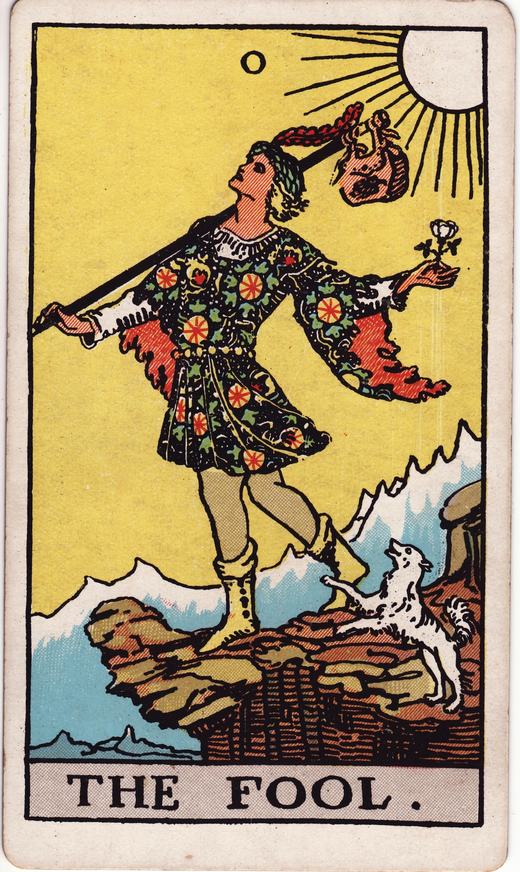
The Fool carries the number zero, and zero is not nothing: it is the circle, the potential before it takes shape, the point from which all counting begins. This is why it traditionally has no fixed place in the deck — it can open the journey of the Major Arcana or close it, because it is at once the one who sets out and the one who has already arrived without knowing it. It is the card of the soul that moves before it has a plan.
The symbolism of the card
In the classical image a young man walks carelessly toward the edge of a cliff, his face turned upward instead of toward the ground about to give way beneath his feet. Over his shoulder he carries a small bundle tied to a staff: everything he needs, or everything he does not yet know he carries with him. In one hand he holds a white rose — pure desire, not yet contaminated by calculation. At his feet a small white dog leaps: the instinct that accompanies him and, at the same time, the warning he chooses not to hear.
Behind him rise snow-capped mountains, the trials he has not yet faced, and above him shines a full sun that lights the scene without judging it. Every detail tells the same tension: a total trust in the journey and a total unawareness of the risk. The Fool is not naive because he is foolish; he is naive because he has nothing left to lose.
The The Fool upright
Upright, the Fool is the absolute beginning: a step into the unknown taken with lightness and trust. It announces new departures, spontaneity, the freedom of one not yet bound by the past. When it appears, something in you is ready to move before you know where it will go — and that is precisely its strength. The card invites you to trust the path even without knowing the destination, to say yes to an experience you cannot control in advance.
In practice, the upright Fool rewards those willing to be beginners. This is the moment to start without feeling ready, to follow a curiosity that seems unreasonable, to choose openness over safety. Its message is not "it will be easy" but "it is worth setting out all the same".
The The Fool reversed
Reversed, the Fool signals impulsiveness and leaps without a net: enthusiasm curdling into recklessness, naivety that exposes you to risk. The same energy that upright is freedom here turns into misplaced lightness — decisions made on impulse when a clear gaze is needed, promises made without weighing them. The card asks you to look where you set your feet before you jump.
There is, however, a second, less obvious reading: the reversed Fool can indicate a leap held back. Not recklessness, but the fear of being drawn in; freedom postponed because the risk is frightening. Here the invitation reverses — do not hold back, but find the courage to begin that you keep postponing.
The The Fool in love
In a love reading the upright Fool speaks of freshness: an unexpected encounter, a relationship reborn, the desire to be surprised without scripts. It invites lightness where you may have accumulated expectations. Reversed, it warns of the flip side — affairs begun on impulse and abandoned just as easily, or difficulty committing for fear of losing your freedom. The question it poses is simple: are you choosing flight, or are you running away?
The The Fool in work and money
On the professional plane the upright Fool is the card of the one who changes course, launches a project, accepts a calculated risk before having every guarantee. It favours departures and ideas that seem premature. Reversed, it cautions against hasty choices and casual money management: enthusiasm setting out without a plan, investments made on the wave of emotion. It does not extinguish courage, but asks you to pair it with a measure of prudence.
How to read the The Fool in spreads
A card's meaning shifts with the position it occupies. Here is how the The Fool behaves in the most common spreads.
In the Celtic Cross
| Position | What it indicates |
|---|---|
| present situation | It describes a phase of openness and beginning: the matter is yet to be invented, and the available energy is fresh, willing to risk. |
| obstacle | What holds you back is recklessness or a lack of direction: too much haste to depart and too little attention to where your feet land. |
| near future | It promises a departure on its way, a change that asks for trust more than certainty. |
In the Three Card spread (past · present · future)
| Position | What it indicates |
|---|---|
| past | It tells of a leap already taken, a courageous choice from which everything began. |
| present | It catches you on the edge of a decision, suspended between the step and the hesitation. |
| future | It signals that the right direction is the less travelled one, to be walked lightly. |
Common mistakes in interpretation
The Fool is often dismissed as the "card of madness" or, conversely, as a promise of easy fortune. It is both and neither. It does not announce that things will go well: it announces that it is time to move. Confusing it with a guarantee misreads it as much as fearing it as a bad omen. Its truth lies in the gesture, not the outcome.
Keywords
| Orientation | Meaning |
|---|---|
| Upright | beginning, spontaneity, freedom, trust, potential, openness |
| Reversed | impulsiveness, recklessness, naivety, risk, leap held back, chaos |
Frequently asked questions about The Fool
Is the Fool a positive card?
On its own, yes: upright it is one of the brightest cards in the deck, tied to new beginnings, freedom and trust. But its gift asks for awareness — the Fool is positive when you choose the leap, ambiguous when the leap happens to you without your watching where you land.
What does the reversed Fool mean in love?
Reversed in love it often signals a fear of commitment or, conversely, romantic recklessness: relationships begun on impulse, promises made without thinking. It invites you to tell true freedom apart from running away.
Does the Fool answer yes or no?
Generally yes, but it is a yes that asks for courage more than guarantees: the card encourages you to go forward, without promising it will be easy.
Want to see the The Fool in a full reading?
Try a free spread on Theurgos →