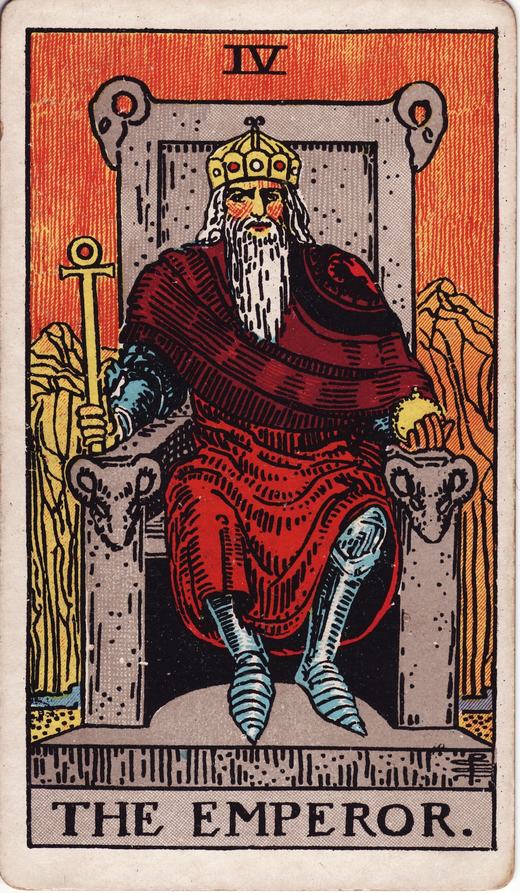
Where the Empress made things grow, the Emperor builds. He is the Arcanum of structure, of earned authority, of chaos brought back to rules and boundaries. His realm is not the field of wheat but worked rock: what lasts because it has been ordered.
He is not the biological father but the paternal principle in the broad sense — the function that sets limits, guarantees stability, turns impulse into edifice. His hallmark is responsibility taken seriously.
He is the first Arcanum to sit in a rigidly fixed position: after three figures in movement or in listening, here is the presence that does not shift.
The symbolism of the card
The Emperor sits on a stone throne decorated with four ram's heads, symbol of the zodiac sign dedicated to him, Aries, the cardinal fire principle: the impulse that founds. His posture is rigid, legs crossed, beard flowing: stability declared in the body itself. Beneath the robe you can make out armour — the sovereign who has not laid down his arms even in peacetime.
In his right hand he holds a sceptre ending in an ankh, the Egyptian symbol of life: power exercised to maintain, not to destroy. In his left, often hidden, the globe of dominion. Behind him rise bare mountains under an orange sky: a landscape tamed but not domesticated, because the Emperor's order does not erase the hardness of the real.
The The Emperor upright
Upright, the Emperor is structure, authority and hard-won stability: chaos has been put in order. He signals leadership, protection, the solidity of clear rules. It is time to build on firm foundations, to take responsibility for direction, to become — or to recognise — the authority the situation needs. His presence brings concreteness and duration.
In practice he asks you to stop wandering and choose a plan. The Emperor does not reward improvisation: he rewards the one who sets boundaries, establishes priorities, gives a frame within which others can operate. If the situation is confused, this card says someone must give the watchword — and that someone might be you.
The The Emperor reversed
Reversed, the Emperor becomes rigidity, excessive control or abuse of power — or its total absence: lack of discipline, boundaries collapsed, authority left to chance. Power needs rebalancing, but in opposite directions depending on the case: sometimes it must be loosened, sometimes finally exercised.
There is a less obvious reading: the reversed Emperor can indicate an internalised authority gone tyrannical — the harsh inner judge, the perfectionism that stifles, the rule imposed on oneself so rigid it paralyses. The despot is not always outside: sometimes we have installed him within, and the card asks us to review the constitution we have given ourselves.
The The Emperor in love
In love the upright Emperor indicates a bond seeking stability, shared rules, a clear pact: the will to build something that lasts, not just the fleeting. It can mark a phase of commitment taken seriously. Reversed, it warns of unbalanced relationships — the one who commands too much, the one who obeys without a word, the parent-child dynamic installed between adults. The card asks for equal strength, not submission dressed up as love.
The The Emperor in work and money
At work the upright Emperor is the card of recognised leadership, of solid organisational structure, of the moment to take direction or lean on a competent authority. It favours strategic decisions, long-term investments, the organising of chaos into a system. Reversed, it signals oppressive hierarchies, micromanagement, or the void of the one who does not lead and leaves the field to anarchy. Check which power is at work, and whether it serves the work or itself.
How to read the The Emperor in spreads
A card's meaning shifts with the position it occupies. Here is how the The Emperor behaves in the most common spreads.
In the Celtic Cross
| Position | What it indicates |
|---|---|
| present situation | A phase of structure and order: it calls for taking responsibility and setting clear boundaries. |
| obstacle | An excess of control — yours or another's — or on the contrary an absent authority that leaves everything to improvisation. |
| near future | A consolidation on its way: firmer foundations to build on over time. |
In the Three Card spread (past · present · future)
| Position | What it indicates |
|---|---|
| past | A structure or an authority that held: what gave you boundaries, for better or worse. |
| present | You are called to organise, decide, take direction firmly in hand. |
| future | A stability that consolidates, the fruit of clear choices and responsibility taken. |
Common mistakes in interpretation
The most common error is to read the Emperor only as "the father" in a literal sense, losing his scope: he is the principle of order, of law, of the frame within which life can unfold without scattering. A second misconception is to consider his authority always negative: his rigidity is a virtue when it sets healthy boundaries, a vice when it becomes a cage. Confusing the two functions leads to always fearing him or always obeying him — both errors strip him of meaning.
Keywords
| Orientation | Meaning |
|---|---|
| Upright | authority, structure, stability, responsibility, leadership, discipline |
| Reversed | domination, rigidity, excessive control, abuse of power, lack of discipline, absent authority |
Frequently asked questions about The Emperor
Does the Emperor always represent a male figure?
No. He represents the function of structuring authority — the paternal principle, not necessarily a man. He can describe a woman in command, an institution, a part of you that knows how to give rules. Reading him only as 'a man in your life' arbitrarily narrows his meaning.
Does the reversed Emperor indicate an abuse of power?
Often yes, but not only. It can indicate excess (the one who controls too much, who dominates), or the opposite lack: absent authority, missed discipline, boundaries collapsed. Sometimes — and here it is subtler — it signals an inner authority gone tyrannical, the harsh judge within you who needs bringing back to measure.
What does it mean for an important decision?
That the decision should be made with structural clarity: set the criteria before choosing, weigh the long-term consequences, take responsibility for the outcome. The Emperor advises against impulse-driven choices and favours those that build stability. If the situation is chaotic, his answer is: first give it an order, then decide.
Want to see the The Emperor in a full reading?
Try a free spread on Theurgos →