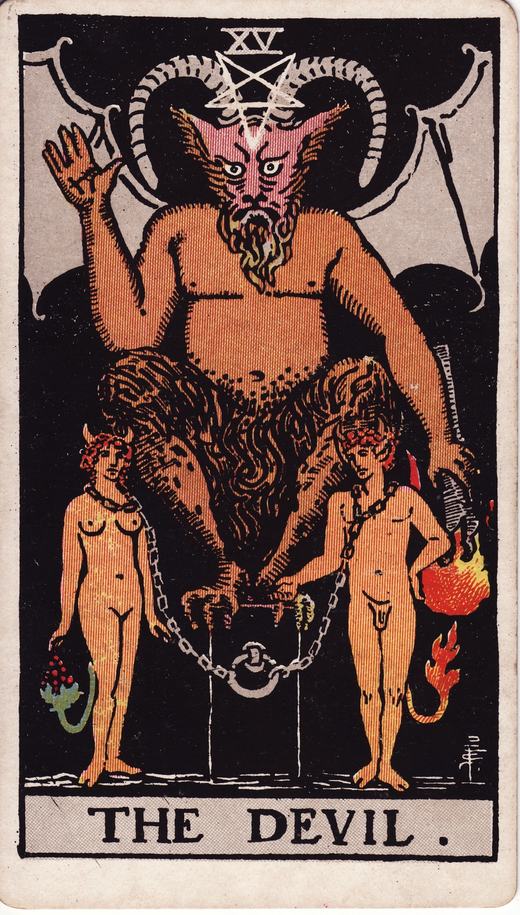
The Devil is the card of the shadow: what binds us, attracts us and dominates us through desire, attachment, fear. It does not represent an external evil, but the part of us that trades freedom for a comfortable cage — and that knows, somewhere, that it can get out. It is the card of bonds that seem imposed and that, looked at closely, prove to be chosen.
For this it is also the card of the most radical liberation, because the first gesture to break a chain is to admit you can. To look the Devil in the face is already half the work.
The symbolism of the card
In the classical image a horned figure sits on a black pedestal, bat wings spread and claws ready: a grotesque version of the goat, half beast and half demon. The right hand is raised in a gesture of dominion, the left holds a lit torch pointed downward. On the brow, in some variants, an inverted star stands out: the sign of reversal, of energy turned upside down.
At its feet, two naked human figures are chained to the pedestal, the chains loose around their necks. They have small horns and tails: they resemble their jailer, and this is the decisive detail — because the resemblance says the imprisonment is internal. The chains, looked at closely, are loose enough to be slipped off. The cage is real, but the key is already in the prisoner's hand.
The The Devil upright
Upright, the Devil shows the chains you have chosen: a dependence, an obsession, a bond that imprisons yet attracts, a materialism that commands. It can indicate a situation in which desire has taken the place of will, in which you confuse what you need with what you hoard, in which a part of you knows it is overdoing it and yet does not let go.
The card does not accuse: it illuminates. Its message, uncomfortable but freeing, is that looking in the face what dominates you is already half the liberation — because what you see, you discover, does not hold the absolute power you attributed to it. The chains were loose from the start.
The The Devil reversed
Reversed, it announces a detachment underway: the chains loosen, awareness returns, a dependence loses its grip. It is one of the most freeing readings in the deck, because it indicates the moment you stop being the object of your desire and begin again to be its subject. The choice to get out, once taken, begins to bear fruit.
The second, less obvious reading concerns the nature of the liberation: sometimes the reversal indicates not a freedom attained, but a flight disguised as freedom — changing chains instead of breaking them, replacing one dependence with another so as not to face what generated them. To leave the cage, then, takes more than mere flight: it asks you to understand why you entered it.
The The Devil in love
In love the upright Devil describes bonds charged with attraction but unbalanced: relationships in which desire dominates, in which one depends emotionally or sexually on the other, in which possession is confused with love. It can signal a toxic bond hard to leave precisely because it seduces. Reversed, it indicates the moment you become aware of it and begin to get out, or in which the relationship transforms by rebalancing; but it asks you to check whether you are truly breaking the chain or merely changing masters.
The The Devil in work and money
At work it signals dynamics of dependence or power: a tyrannical boss, an exploitative environment, a situation in which money or status commands at the expense of wellbeing. It can also indicate an obsession of your own with success or control, or practical dependencies (debts, contractual bonds). Reversed, it speaks of the grip loosening, of recovered lucidity, of choices that restore autonomy — provided it is not a flight that will leave the problem intact elsewhere.
How to read the The Devil in spreads
A card's meaning shifts with the position it occupies. Here is how the The Devil behaves in the most common spreads.
In the Celtic Cross
| Position | What it indicates |
|---|---|
| present situation | A bond that dominates: dependence, obsession, an attraction that takes away freedom. |
| obstacle | The illusion that the chain is inescapable: the real obstacle is denying you can slip it off. |
| near future | A dawning awareness that loosens the yoke: the liberation begins with the gaze. |
In the Three Card spread (past · present · future)
| Position | What it indicates |
|---|---|
| past | A bond or a habit that dominated, and from which part of the present derives. |
| present | You are inside a bond: admit it, instead of denying it. |
| future | A liberation on its way — true if understood, fleeting if it is only flight. |
Common mistakes in interpretation
The Devil is demonised as an omen of misfortune or, at the opposite pole, reduced to a symbol of sexuality and nothing else. Both are partial readings. The card speaks of everything that binds through desire and fear — not only sex — and its message is never condemnation, but the awareness that imprisonment is in large part chosen, and therefore revocable. Whoever fears it as bad luck loses its greatest gift: the map for getting out.
Keywords
| Orientation | Meaning |
|---|---|
| Upright | attachment, dependence, shadow, bondage, materialism, obsession |
| Reversed | liberation, awareness, taking back control, chains loosened, detachment, redemption |
Frequently asked questions about The Devil
Is the Devil a negative card?
Not in itself, though it is uncomfortable: it indicates the chains we choose — dependencies, obsessions, attachments. Its harshness is a service, because it shows what dominates so we can see it. And its good news is hidden in the image: the chains are loose, you need only decide to slip them off.
Does the Devil in love spreads mean betrayal?
Not directly. More often it indicates a bond dominated by desire or by an imbalance of power, a toxic relationship hard to leave, or an emotional dependence. It can concern possessive jealousy more than betrayal, and in any case invites you to look honestly at the nature of the bond.
Does the Devil answer yes or no?
It leans toward no, because it signals a situation in which you are not free to choose well: what seems a yes would be dictated by desire or fear, not by will. Its invitation is first to disenchant the chain, then to decide.
Want to see the The Devil in a full reading?
Try a free spread on Theurgos →