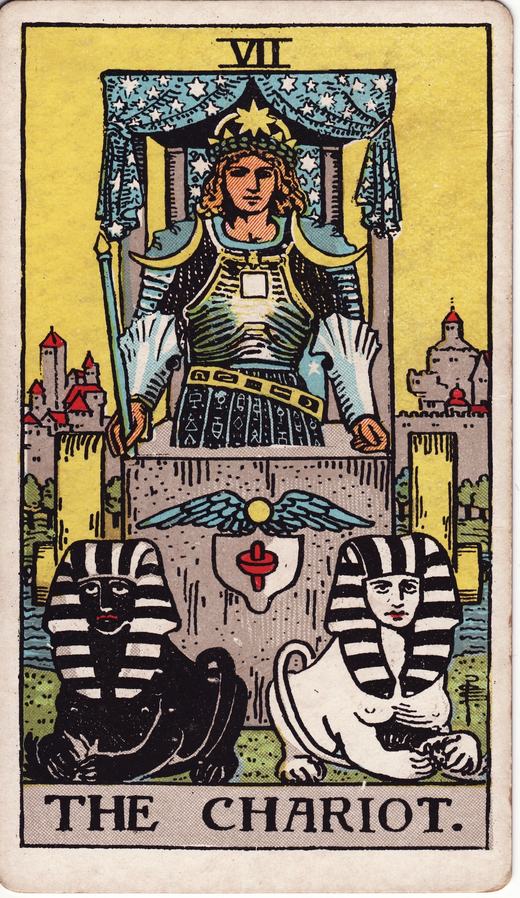
The Chariot is the first true test of will in the journey of the Major Arcana. The Lovers' choice is already behind: now it is a matter of turning a decision taken in the heart into concrete advance, and its number, seven, is that of goals won rather than received. It is a kinetic card — everything in it is movement barely held back, energy asking to be directed before it explodes.
The symbolism of the card
In the Rider-Waite image a young charioteer stands upright on a cubic chariot, covered by a canopy dotted with stars: the night sky carried along, the mind that holds the universe even while it races. He wears armour beneath an embroidered robe and a laurel crown, sign of a victory already within him, not ahead. On his chest he bears a square, symbol of the earth he is about to conquer with his resolve.
Before him there are no reins: two sphinxes — one dark and one light — pull in opposite directions, and yet the chariot moves straight ahead. It is the detail that fixes the card's meaning. Those beasts are the dual forces of human nature, instinct and reason, shadow and light, which the charioteer does not break by force but holds together by the pressure of will alone. Behind him a city recedes: the known has already been left, and there is no return.
The The Chariot upright
Upright, the Chariot is victory won over inner chaos. It does not promise a smooth road, but that you know where you are going and will keep the forces in line long enough to get there. It is the card of the one who has moved past the idea and must now carry it onto the ground, who gathers the scattered elements of their life and turns them in a single direction.
Its strength is control, not speed: the horses pull opposite ways, and precisely for that reason advance is possible only with a steady hand. When it appears, it asks you to choose a goal and defend it from distraction. Determination, here, is not stubbornness: it is the ability not to loosen your grip until the goal is reached.
The The Chariot reversed
Reversed, the Chariot loses its direction: the horses each pull their own way and the chariot swerves. It is drive without a course, ambition racing before it knows where it goes, aggression taking the place of control. It often indicates a situation where you are flooring the accelerator while the steering is dead — the more force you add, the further off you go.
There is a less obvious reading, though: the reversed Chariot can signal a victory already won at a price you had not reckoned. The goal is there, but you reached it by crushing something — a relationship, your health, a principle — and now the echo of that cost catches up with you. Here the card asks you not to set off again, but to stop and measure what you invested to win.
The The Chariot in love
In love the upright Chariot is momentum: a relationship that accelerates, a shared project taking shape, the decision to commit to a person after feeling long divided. It favours couples who choose a common direction and defend it from outside tension. Reversed, it reveals forces pulling opposite ways — irreconcilable desires, a partner pushing where the other does not want to go, or the sense of steering the relationship alone while the other is merely carried along. The question is simple: are you pulling the same chariot, or each your own?
The The Chariot in work and money
On the professional plane the upright Chariot is rapid advance: a promotion, a winning project, a relocation, a goal won through resolve. It is one of the most favourable cards for those who compete and for those who need their effort recognised. Reversed, it warns of badly managed competition, of sprints that empty you out, of goals chosen to prove something to someone rather than for yourself. Before pushing harder at work, ask whether the direction is truly yours or whether you are driving someone else's chariot.
How to read the The Chariot in spreads
A card's meaning shifts with the position it occupies. Here is how the The Chariot behaves in the most common spreads.
In the Celtic Cross
| Position | What it indicates |
|---|---|
| present situation | You are steering powerful forces: the matter progresses insofar as you can keep them in line. |
| obstacle | Too many competing goals, or drive without a course: the problem is not the force, but the direction. |
| near future | A decisive advance is approaching, provided you do not loosen your grip halfway. |
In the Three Card spread (past · present · future)
| Position | What it indicates |
|---|---|
| past | A victory or a choice of course that set in motion everything you live now. |
| present | You are in full pursuit of a goal: determination is high, the horses are pulling. |
| future | It rewards constancy: the one who holds the reins to the end arrives where they set out to. |
Common mistakes in interpretation
The Chariot is often mistaken for an automatic promise of success, a kind of green light. It is not: it is the card of victory won, not gifted, and its condition is control. Whoever reads it as 'all will be well' without asking which forces they are trying to steer ends up with the horses each pulling their own way. Others reduce it to a card of travel: it can indicate that, but the journey is inner before it is geographical.
Keywords
| Orientation | Meaning |
|---|---|
| Upright | victory, will, control, success, determination, advance |
| Reversed | lack of control, defeat, aggression, scattering, lost direction, forces in conflict |
Frequently asked questions about The Chariot
Is the Chariot a positive card?
Yes, but on one condition: its yes is not a gift, it is the fruit of a direction held firmly. It is positive when you know what you want and are willing to hold contrasting forces together to get it; it becomes problematic if you mistake it for a goal already guaranteed.
What does the Chariot indicate in a work question?
It confirms an advance — promotion, project won, goal reached — but remember that success depends on control, not haste. It indicates that the effort is about to be recognised, provided you do not lose the course through excess of ambition.
Does the reversed Chariot always mean failure?
Not necessarily. Beyond defeat or drive without direction, it can indicate a victory reached at a hidden cost: you won, but by crushing something that now asks to be acknowledged. Sometimes the reversal asks you to stop and reckon, not to set off again.
Want to see the The Chariot in a full reading?
Try a free spread on Theurgos →