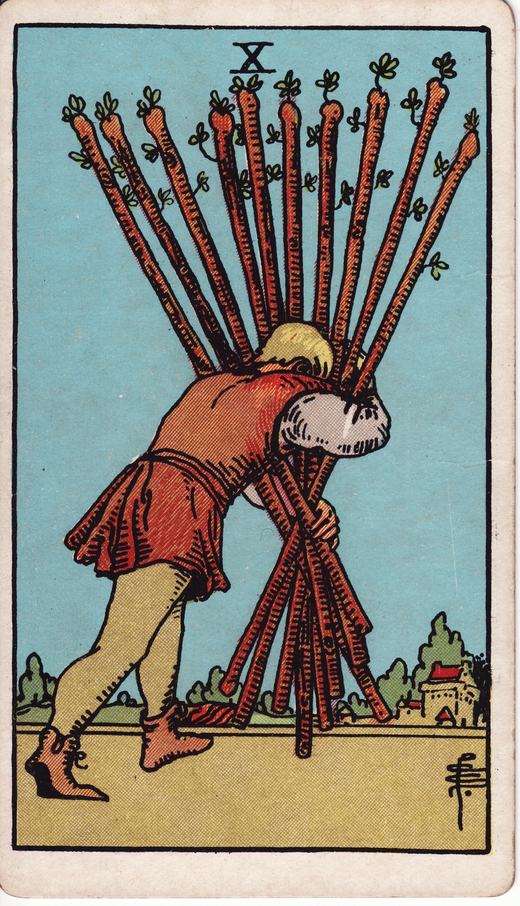
The Ten of Wands is the card of excessive weight. After the resistance of the Nine, the fire has consumed the strength and now too many wands are carried at once: accumulated responsibilities, overlapping projects, burdens taken on out of duty or ambition. The card doesn't speak of failure, but of overload: the destination is near, but the load risks breaking whoever carries it.
Its signature is the fatigue of too much. The number ten closes the cycle of the numbered Wands, and does it with an image of exhaustion: not defeat, but the weight you chose to carry and that now asks to be lightened.
The symbolism of the card
A bent man, dressed in red, walks toward a town visible in the distance, and on his shoulders he carries a bundle of ten wands tied together, laid horizontally and dragged with evident effort. The posture is hunched, the gaze on the ground, the step heavy: the whole body tells the load.
The town ahead is the destination — houses, towers, an inhabited place — and it isn't far. The detail is crucial: the goal is there, but the weight risks making you collapse before you reach it. The background is open and bright, a sign the problem isn't the territory but the load the man chose to carry. The wands aren't wrong: it's the amount he insisted on piling up.
The Ten of Wands upright
Upright, the Ten of Wands is burden, responsibility and overload: you carry too much on your shoulders, you've accumulated commitments, projects, duties that now weigh more than you can bear. The card doesn't say you're on the wrong road — the destination is near — but that the load must be lightened if you want to arrive on your feet.
The card invites you to distinguish what's truly yours from what you've taken on out of habit, excessive duty, or an inability to delegate. The Ten of Wands rewards whoever can drop, delegate, let fall the wands that aren't essential. It isn't weakness to recognize the too-much: it's intelligence. The destination doesn't change if you carry less weight.
The Ten of Wands reversed
Reversed, the Ten of Wands can point to two opposite movements. On one hand, release: you drop the load, you delegate, you finally recognize the too-much and let it fall. It's one of the happiest reversals in the deck, because it marks the end of overload. On the other hand, collapse: the weight breaks whoever carries it, and the destination slips away because you couldn't lighten in time.
A less obvious reading concerns refusing responsibility: you don't carry too many wands, but too few. You avoid the load out of fear, you shift your duties onto others, you mistake freedom for irresponsibility. Here the invitation is the opposite of the usual — stop offloading, take your share of the weight, because freedom without responsibility is only evasion.
The Ten of Wands in love
In love, the Ten of Wands upright signals a relationship that weighs: too many responsibilities on one partner, someone carrying the load for both, a story that has become a burden. It isn't a card of rupture, but of overload to recognize and lighten. Reversed, it points to release from the weight — the couple rebalances, what didn't belong to one is dropped — or to the collapse of the bond under the load. Check who's carrying what, and whether the load is truly shared.
The Ten of Wands in work and money
At work, the Ten of Wands upright is explicit overload: too many projects, too many responsibilities, the sense of not making it — not from inability but from sheer quantity. The destination is near, but the weight risks breaking you. Reversed, it signals the need to delegate and lighten, or collapse for not having dropped the load in time. Before going on dragging, ask which wands you can truly let fall without the destination changing.
How to read the Ten of Wands in spreads
A card's meaning shifts with the position it occupies. Here is how the Ten of Wands behaves in the most common spreads.
In the Celtic Cross
| Position | What it indicates |
|---|---|
| present situation | You're carrying an excessive load: the destination is near, but the weight risks making you give out before you arrive. |
| obstacle | The inability to delegate or to drop the superfluous is what's crushing you. |
| near future | Announces a phase of release or completion, where you'll finally be able to lighten the load. |
In the Three Card spread (past · present · future)
| Position | What it indicates |
|---|---|
| past | A period of overload you moved through, from which come the tiredness and the wisdom you carry today. |
| present | You're under weight: recognize the too-much and drop what isn't essential before you collapse. |
| future | Points to the destination arriving, on condition you can lighten the load along the way. |
Common mistakes in interpretation
The most common mistake is reading the Ten of Wands as a card of pure bad luck or failure. It isn't — it describes an excessive load taken on voluntarily, and the destination is near. The card doesn't speak of defeat but of weight management. A second misunderstanding is treating it as always negative: reversed, it often indicates exactly the release from the load, the end of overload. Reading it as only 'fatigue' means losing its dimension of completion and possible release.
Keywords
| Orientation | Meaning |
|---|---|
| Upright | burden, responsibility, overload, effort, excessive load, destination near |
| Reversed | release, liberation, delegation, rest, collapse, refusal of responsibility |
Frequently asked questions about Ten of Wands
Is the Ten of Wands a negative card?
It's tiring, yes, but not catastrophic. It describes an overload taken on voluntarily, and the destination is near. The card doesn't speak of failure but of weight management: it acknowledges fatigue and suggests lightening. Reversed, it often indicates exactly the release from the load — one of the happiest reversals in the deck.
What should I do when the Ten of Wands comes up?
Look at what you're carrying and why. Distinguish what's truly yours from what you've taken on out of habit, excessive duty, or an inability to delegate. The card suggests dropping the superfluous: the destination doesn't change if you carry less weight, but the odds of arriving on your feet go up.
Is the Ten of Wands reversed positive?
Often yes: it signals release from the load, the end of overload, the recovered capacity to delegate and rest. But it can also point to collapse for not having lightened in time, or — conversely — to a refusal to take on your responsibilities. Context orients which reading is the right one.
Want to see the Ten of Wands in a full reading?
Try a free spread on Theurgos →