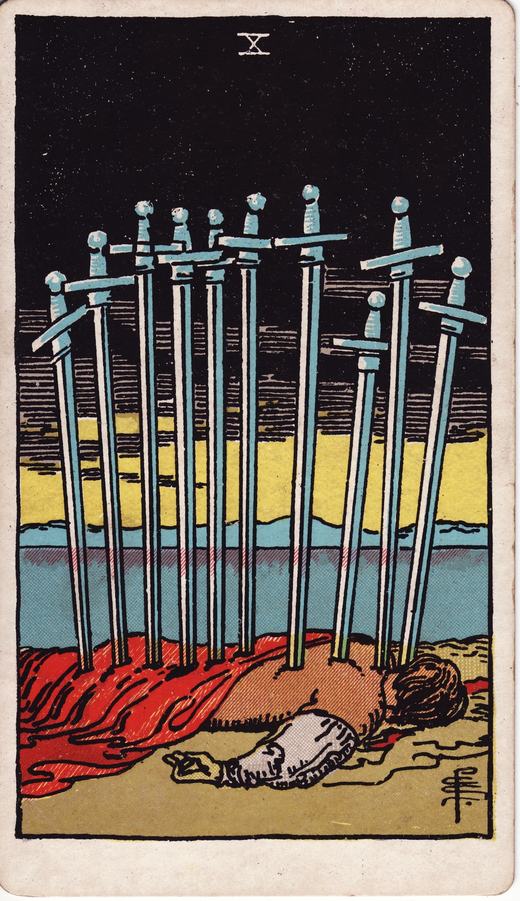
The Ten of Swords is the card of total ending. It looks like the cruellest card in the deck, yet its truth is gentler than it appears: once the worst has happened, there is nothing left but to rise. The card does not announce an ending to come — it announces the ending has already taken place, and from there you start over.
The symbolism of the card
A figure lies face down on the ground, prone, with ten swords driven into its back arranged in a fan. The face is turned to the side, and the body gives no reaction: the blow has already landed. Behind it a black sky yields to a yellow-orange dawn on the horizon, and a stretch of calm water reflects the new light. In the distance dark mountains close the scene.
The decisive detail is the dawn: it is there, and it is bright. The ten swords have already struck, there are no more — you cannot be worse off than this. The death is symbolic, not literal: it is the end of a cycle, of a situation, of a version of yourself. The rising sun promises that after the bottom there is by definition a climb back up, because the bottom, by definition, is touched only once.
The Ten of Swords upright
Upright, the Ten of Swords signals that something has ended — and painfully so. An abrupt rupture, a sudden collapse, the moment you hit the floor. The card does not sweeten it: the pain is real, the loss is real. But its gift, uncomfortable but true, is that the worst has already happened. The ten swords are driven in, the eleventh does not exist.
From here you cannot descend further: you rise. The Ten of Swords invites you to accept the ending rather than fight it, because acceptance is the first step of rebuilding. The acute phase is over. Now you can begin to look at the dawn on the horizon, even if the back still aches. An ending, when it is truly an ending, frees you: it removes the dread of what might have happened, because it has already happened.
The Ten of Swords reversed
Reversed, the Ten of Swords speaks of survival: the worst is over, you are getting up again, the dawn has already broken. It is the clearest reading of the reversal: the end is behind you and recovery begins. The wounds are still visible, but the direction is upward.
A second reading is more insidious: the reversal can mark an ending that refuses to complete, a bottom that is never quite touched because something holds it in mid-air. You live in a limbo, neither ended nor begun again, waiting for the coup de grâce that would let you turn the page. Here the card grants no quarter: it asks you to let the ending be an ending, because postponing it only prolongs the suffering.
The Ten of Swords in love
In love the upright Ten of Swords marks the painful end of a relationship: the break-up already consummated, the conclusive betrayal, the realisation there is nothing left to save. The card offers no comfort, but promises that from that floor you start over. Reversed, it points to recovery: you come out of the mourning, find the will to live again, the dawn has broken. Mind the relationships kept alive artificially, though — sometimes letting it truly end is the kinder act.
The Ten of Swords in work and money
At work the upright card describes a collapse: the lay-off, the failed project, the shuttered business, the blunt news that closes a chapter. The pain is real, but the card reminds you the worst has already happened — from here you climb. Reversed, it points to recovery and rebuilding: you stand up, find a new way, start again on different ground. The ending, when accepted, always opens a beginning.
How to read the Ten of Swords in spreads
A card's meaning shifts with the position it occupies. Here is how the Ten of Swords behaves in the most common spreads.
In the Celtic Cross
| Position | What it indicates |
|---|---|
| present situation | An ending has already taken place, or is completing: the pain is real, but the worst is over. |
| obstacle | What holds you back is the refusal to accept the ending: fighting what already is only prolongs the suffering. |
| near future | Recovery is forming: the dawn has broken, and from that floor you start to climb. |
In the Three Card spread (past · present · future)
| Position | What it indicates |
|---|---|
| past | It tells of an ending already lived, a collapse you then recovered from. |
| present | It catches you at the bottom of the situation: the card reassures you there is no lower to go, and the dawn is close. |
| future | It signals that rebuilding is possible, indeed necessary: from the accepted ending a new beginning is born. |
Common mistakes in interpretation
The Ten of Swords is often feared as the most ill-omened card in the deck, as if it announced imminent catastrophe. But its message is the opposite: the ending has already happened, and there is a dawn on the horizon. To read it as a foreboding of woe to come is to ignore the very sun that is rising — the most important detail in the image.
Keywords
| Orientation | Meaning |
|---|---|
| Upright | painful ending, collapse, rock bottom, extreme transition, definitive rupture, worst already done |
| Reversed | waking, survival, worst over, recovery, climb back, deferred ending |
Frequently asked questions about Ten of Swords
Is the Ten of Swords a negative card?
It is a card of painful ending, and so felt as the harshest in the deck. But its gift is that the worst has already happened: the dawn on the horizon promises a fresh start. It is not a threat, it is a threshold.
Does the reversed Ten of Swords mean you survive?
Yes, often it points to exactly that: the worst is over, you stand up again, the dawn has broken. It can also flag an ending that refuses to complete, a suspended situation that prolongs the pain.
Does the Ten of Swords answer yes or no?
It leans toward no: an ending, a collapse, a closing. But it is a final no — not the prelude to another fall, but the floor from which you can only climb.
Want to see the Ten of Swords in a full reading?
Try a free spread on Theurgos →