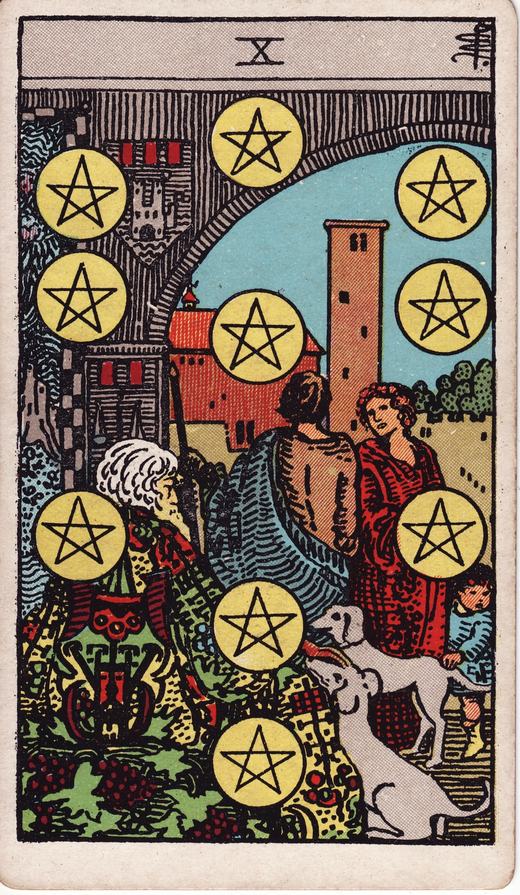
The Ten of Pentacles is the card of material culmination: wealth no longer merely individual but become patrimony, family, inheritance. Here money has turned into lasting stability, something transmitted, something that roots. Not sudden gold but a house built over time.
It's one of the fullest cards in the deck because it speaks of what outlasts a single life: family, traditions, deep roots, the security you leave behind. Wealth here is a sense of belonging, not only a bank balance.
The symbolism of the card
The scene plays out before the stone arch of a stately home, beneath which three generations of a family gather. A white-bearded elder, seated and wrapped in a mantle embroidered with flowers and symbols, is surrounded by dogs; beside him a young couple affectionately exchange a child who turns to play with one of the dogs.
Beyond the arch a courtyard opens with other figures and rich hangings. The ten pentacles are arranged to form a design, almost a family-tree map or a constellation, along the building's side. The dogs are fidelity and continuity; the child is the future; the elder is the root. The message lives in the composition: everything holds together, crossing time.
The Ten of Pentacles upright
Upright, the Ten of Pentacles indicates a phase of lasting stability, consolidated wealth, family belonging. It can concern the literal family, a community, a firm, a tradition. The card celebrates what you've built and that now gives roots: patrimony, security, continuity between generations.
Its invitation is to honour this stability without taking it for granted. Roots need care, family relations need cultivation, the inheritance — material or of values — needs to be handed down with care. It's a card of the long view: what truly matters outlasts you.
The Ten of Pentacles reversed
Reversed, the Ten of Pentacles speaks of cracks in the foundations: family disputes, contested inheritance, financial loss that eats into the stability you built. It can point to breaks with the roots — separation from family, rupture of traditions, loss of belonging.
The second reading concerns excess: patrimony become chain, family that suffocates, traditions that imprison instead of feeding. Reversed, the Ten asks you to tell apart the roots that support from those that bind. Sometimes growing up means stepping back from a stability turned cage.
The Ten of Pentacles in love
In love the Ten of Pentacles upright describes a stable, lasting relationship, often tied to family, home, a long-term project: marriage, children, shared roots. It's the card of the bond that becomes an emotional dynasty. Reversed, it signals family tensions, inheritance or money questions weighing on the couple, or the risk of staying together out of inertia or context pressure rather than choice.
The Ten of Pentacles in work and money
At work and with money it indicates long-term stability: established firms, family businesses, safe investments, patrimony accumulated over time. It's a card that rewards patience and long-term vision. Reversed, it warns of disputes over inheritance or company assets, losses that bite into the foundations, or toxic family dynamics inside the work.
How to read the Ten of Pentacles in spreads
A card's meaning shifts with the position it occupies. Here is how the Ten of Pentacles behaves in the most common spreads.
In the Celtic Cross
| Position | What it indicates |
|---|---|
| present situation | You're in a phase of lasting stability: solid roots, consolidated patrimony, a sense of belonging. |
| obstacle | What holds you back are hidden tensions: family matters, inheritance, or roots that have stopped feeding. |
| near future | A consolidation is approaching, but it asks you to care for the relationships and the patrimony if it's to last. |
In the Three Card spread (past · present · future)
| Position | What it indicates |
|---|---|
| past | It points to a stability built over time, a family or patrimony that is your base today. |
| present | You stand at the material peak: home, roots, continuity. Honour what you've built. |
| future | It promises continuity and lasting prosperity, provided you tend what connects the generations. |
Common mistakes in interpretation
The Ten of Pentacles is reduced to a "wealth card" plain and simple, losing the key theme: continuity between generations. The opposite mistake is seeing it only in a narrow family sense, forgetting that family can mean community, firm, team. The card speaks of what lasts because it's handed down, not of gold to be spent.
Keywords
| Orientation | Meaning |
|---|---|
| Upright | wealth, family, inheritance, lasting stability, roots, continuity |
| Reversed | financial loss, family disputes, rupture of roots, instability, suffocating traditions, contested patrimony |
Frequently asked questions about Ten of Pentacles
Is the Ten of Pentacles a good card?
Yes — upright it is one of the fullest cards in the deck: consolidated wealth, family, long-term stability. Reversed it signals disputes, losses, or breaks in the family or financial foundations.
Is it always about family?
Often, but family should be read broadly: also community, family firm, long-standing team, traditions. The common thread is continuity and a sense of belonging across time.
What does it say about money and inheritance?
It indicates consolidated patrimony, long-term investments, assets handed down. Reversed it can point to contested inheritance, losses that bite into stability, or tense family money dynamics.
Want to see the Ten of Pentacles in a full reading?
Try a free spread on Theurgos →