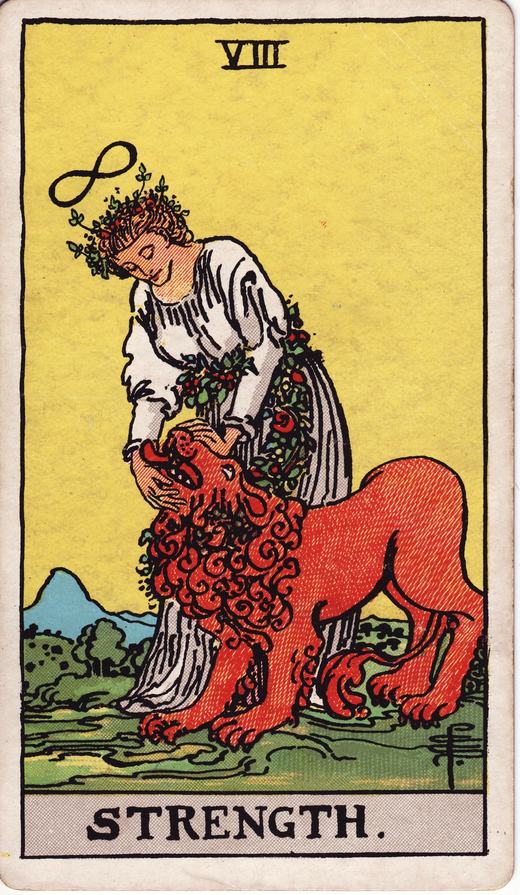
Strength carries a deceptive name. Whoever expects muscle and coercion finds instead a woman who caresses a lion's jaws and comes away victorious without raising her voice. It is the card of gentle mastery, of power that shows itself as calm: it does not break what it tames, it recognises it and brings it into right measure. After the Chariot's race, the eighth Arcanum asks you to stop and learn the art that truly holds over the long run.
The symbolism of the card
In the Rider-Waite image a woman dressed in white, crowned with flowers and belted with a garland at the waist, serenely brings her hands to the muzzle of a full-grown lion. Her fingers do not grip and do not strike: they graze. Above her head floats the sign of infinity, a horizontal eight — the same endless energy found hovering over the Magician, but here in a soft key, sovereignty that flows instead of commanding.
The lion, beast of fire and instinct, does not attack: its tail is between its legs, its tongue out, its gaze tamed. It has not been defeated, it has been heard. In the background, dry yellow mountains and a lone tree: the landscape of the inner desert where the true trial is won without weapons. There is no violence in this scene, and precisely for that reason it is the most powerful in the deck.
The Strength upright
Upright, Strength is courage that makes no noise. It indicates self-control, patience, the ability to hold a difficult situation without being dragged by anger or fear. It is not the card of one who wins by eliminating the opponent, but of one who includes and transforms it: instinct is not to be castrated, but recognised and directed.
Hers is an active strength, not passive: the woman acts, but her instrument is presence, not pressure. When it appears, it suggests the situation will resolve not for whoever pushes hardest, but for whoever can keep calm the longest. Compassion, here, is not weakness: it is the true name of inner strength.
The Strength reversed
Reversed, Strength reveals a giving-way at the centre: insecurity, self-doubt, or instinct taking over. The inner lion has not been tamed and now roars where it should not — in sudden outbursts, in the fear that governs decisions, in the desires that drag you along. It is the sense of not being enough, of being smaller than the situation to be faced.
The less immediate reading is the opposite: reversed Strength can signal a control too rigid, repression that has replaced mastery. You have caged the lion instead of understanding it, and the cage now holds you too. The remedy is not more force, but an allowing — letting your own instinct exist without being commanded by it.
The Strength in love
In love upright Strength is the tenderness that holds a bond through hard times: patience with the other's flaws, the ability not to react to provocation, the warmth that softens conflict. It is a card of mature affection, where love proves itself in constancy more than in grand gestures. Reversed, it indicates insecurity that poisons the couple — jealousy, repeated doubts, the fear of not being enough — or, at the opposite extreme, a repression of one's desires that will sooner or later explode. Tame the lion of anxiety, but without denying that it exists.
The Strength in work and money
At work upright Strength rewards calm perseverance: the one who holds firm without exploding, who handles conflict with diplomacy, who can wait for the right moment instead of forcing it. It is the card of one who overcomes resistance through consistency. Reversed, it signals a collapse of self-esteem, a struggle with an environment or a superior felt to be stronger, or held-in tension that risks bursting out. Remember that to master here does not mean to bend the situation, but to stay centred within it.
How to read the Strength in spreads
A card's meaning shifts with the position it occupies. Here is how the Strength behaves in the most common spreads.
In the Celtic Cross
| Position | What it indicates |
|---|---|
| present situation | One wins with calm more than with push: the matter asks for presence, not brute force. |
| obstacle | Insecurity or an unacknowledged instinct is weakening you: the inner lion must be understood, not denied. |
| near future | A test of patience approaches, but if you hold it with serenity it becomes a silent victory. |
In the Three Card spread (past · present · future)
| Position | What it indicates |
|---|---|
| past | A trial passed with self-control that made you steadier than you think. |
| present | You are called to handle a tension without being overwhelmed: patience is your weapon. |
| future | Constancy pays: what now resists will be tamed in time. |
Common mistakes in interpretation
The most common error is to read Strength as a card of physical vitality or muscular victory. It is the opposite: it speaks of inner mastery, not outer prowess, and its victory is always silent. Just as frequent is to confuse it with passivity or submission: the woman does not endure the lion, she guides it — hers is an action, only in the register of gentleness. Whoever mistakes it for surrender misses its deepest meaning.
Keywords
| Orientation | Meaning |
|---|---|
| Upright | courage, patience, inner mastery, compassion, self-control, calm |
| Reversed | weakness, insecurity, anger, lack of faith, uncontrolled instinct, repression |
Frequently asked questions about Strength
Is Strength a positive card?
Yes, and it is among the most constructive in the deck: it indicates the situation will resolve through calm and constancy, not brute force. It is positive because it proposes a victory that destroys neither the opponent nor the victor, but integrates what was in conflict.
Does Strength always speak of physical force?
No, almost never. Its strength is inner: self-control, patience, moral courage. The scene of the tamed lion is a metaphor for mastery over instinct, not physical prowess. Whoever reads it as athletic vigour misses its meaning.
What does reversed Strength indicate in a reading?
It indicates a giving-way at the centre: insecurity, anger breaking out of control, or — at the opposite extreme — an excessive repression that has replaced true mastery. The inner lion asks to be recognised, neither denied nor left free to command.
Want to see the Strength in a full reading?
Try a free spread on Theurgos →