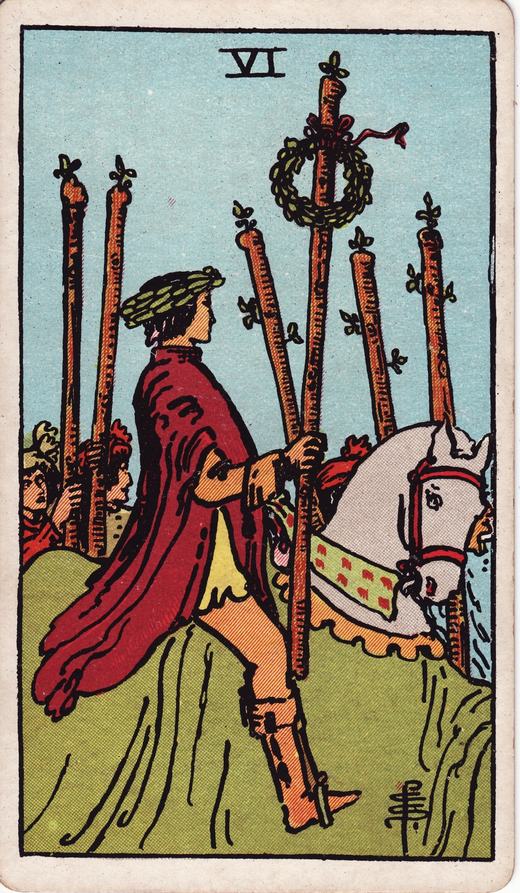
The Six of Wands is the card of recognized triumph. After the scuffle of the Five, someone has emerged, and now the crowd acclaims him. It isn't a solitary or secret victory — it's public, visible, confirmed by consensus. The number six brings harmony and success, and in Wands it reads as glory earned, the moment effort is seen and rewarded.
Its signature is recognition. The fire that fought now shines, and others point to it as a model. But glory is delicate: it carries the seed of pride and of dependence on approval, and the card knows it.
The symbolism of the card
A rider sits a white horse — the color of purity and victory — at a triumphal pace through an acclaiming crowd. On his head he wears a wreath of laurel, the ancient prize of victors, and in his right hand he holds a wand from which another laurel garland hangs, identical to the one on his head. The horse moves proud, head high.
The crowd around walks on foot, and some carry other wands decorated with leaves, raised in homage. The figures are dressed in vivid colors, and the atmosphere is one of collective celebration. The rider doesn't look down at the crowd: he keeps his gaze forward, toward the goal or the horizon. The detail matters — the victory is recognized, but the one who wins stays oriented to the path, not to his own image.
The Six of Wands upright
Upright, the Six of Wands is victory, success and public recognition. It signals a goal achieved and visible to all, the moment your effort is rewarded and others acknowledge it. It can be a promotion, an award, a project that imposes itself, a moment of glory — in every case, it's the card of 'well done' declared by the world.
The card invites you to welcome recognition without being ruled by it. The Six of Wands rewards the active humility of someone who wins and stays oriented to the path, not the arrogance of someone who stops to admire himself. Enjoy the victory, but remember the laurel wreath is a passage, not a settlement: after the triumph there's still road.
The Six of Wands reversed
Reversed, the Six of Wands speaks of defeat, of recognition missed, or of success that arrives but tastes bitter. It can signal that the effort wasn't seen, that someone else took the credit, or that the goal slipped away at the last moment. The collapse of an ego that expected applause can hurt as much as a material loss.
A less obvious reading concerns toxic victory: you win, but at a hidden cost, or unfairly, or receiving applause you don't deserve. The ego feeds on glory, and glory becomes a prison. Here the invitation is severe: ask yourself whether the victory is real, or whether you're chasing only the appearance of success.
The Six of Wands in love
In love, the Six of Wands upright signals a relationship receiving outside approval and recognition: an admired couple, a bond that consolidates also in others' eyes, a moment of shared pride. It favors bonds lived in the open. Reversed, it signals the opposite — a relationship not recognized, a romantic success others obstruct, or an ego too heavy that puts itself above the bond. The question is whether the love is real or only serves to feed your image.
The Six of Wands in work and money
At work, the Six of Wands upright is the card of explicit success: a promotion, a prize, a project won, public recognition of your abilities. It's one of the most favorable cards for career. Reversed, it signals a slipped goal, credit given to others, or a success obtained in dubious ways. Before enjoying the applause, ask whether the victory is deserved and whether you can carry it without it going to your head.
How to read the Six of Wands in spreads
A card's meaning shifts with the position it occupies. Here is how the Six of Wands behaves in the most common spreads.
In the Celtic Cross
| Position | What it indicates |
|---|---|
| present situation | You're living or about to live a moment of public recognition: the effort is seen and rewarded. |
| obstacle | The risk is pride — the ego swelling and losing contact with the substance of the path. |
| near future | Promises a visible success coming, a milestone others will recognize. |
In the Three Card spread (past · present · future)
| Position | What it indicates |
|---|---|
| past | A victory or a recognition that confirmed your abilities in front of everyone. |
| present | You're in a phase of triumph or visibility: welcome the recognition while staying oriented to the path. |
| future | Points to a success that will arrive, fruit of effort and right timing, to be welcomed with measure. |
Common mistakes in interpretation
The most common mistake is reading the Six of Wands as a guarantee of success without conditions. The card describes triumph earned, not gifted, and presupposes effort and a competition won. A second misunderstanding is treating it as always positive without nuance — reversed, or next to difficult cards, it signals exactly the defeat, the missed recognition, or the toxic success. Glory is a subtle card, not a simple 'yes'.
Keywords
| Orientation | Meaning |
|---|---|
| Upright | victory, recognition, success, triumph, glory, admiration |
| Reversed | defeat, lack of recognition, ego collapse, credit to others, bitter success, toxic victory |
Frequently asked questions about Six of Wands
Is the Six of Wands a positive card?
Yes — upright it's one of the most clearly favorable cards in the deck: it speaks of victory, success, and earned recognition. But its positivity asks for measure — whoever lets pride take over turns triumph into a trap. Glory should be welcomed with gratitude, not arrogance.
Does the Six of Wands reversed mean failure?
Often yes: defeat, missed recognition, credit gone to others. But it can also point to a success obtained in dubious or unfair ways, or to applause you don't deserve. It isn't always material failure: sometimes it's the collapse of an ego that expected glory and didn't receive it.
Does the Six of Wands always concern work?
No. It concerns every form of public recognition and visible success: a sports victory, a celebrated personal milestone, an admired relationship, a praised work. The logic is the same — effort rewarded by consensus — but the field of application is far wider than work alone.
Want to see the Six of Wands in a full reading?
Try a free spread on Theurgos →