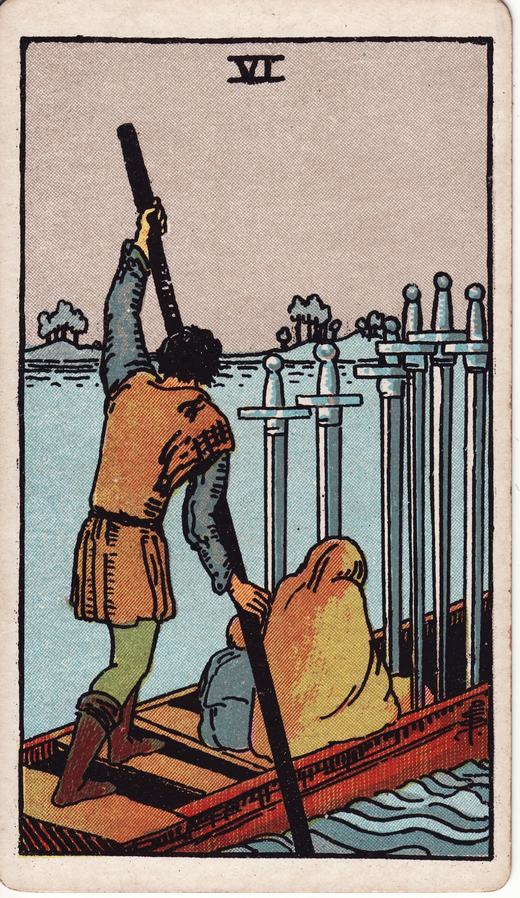
The Six of Swords is the card of passage. After the troubles of the earlier numbers, it marks a transition toward something steadier — not a triumphant arrival, but a quiet transfer, a moving away from rough water toward a safer shore.
The symbolism of the card
A woman wrapped in a dark cloak sits in a boat, and beside her a small child, also covered. At the stern a man poles the boat forward with a long pole. The boat carries six swords stood upright, their blades dipping into the water among the passengers. The craft is leaving a choppy shore with rough, crested water and heading toward a calmer bank where the surface lies smooth.
The six upright swords form a kind of cage among the travellers, but they do not imprison them: they shield, enclosing their story as they carry it away. The movement runs from left (the turbulent waters of the past) to right (the calm of the future). It is a crossing in progress: not arrived yet, but going the right way.
The Six of Swords upright
Upright, the Six of Swords marks a transition: you are moving from a hard situation toward a steadier one. It can be a relocation, a job change, the end of a crisis. The card does not promise the destination is reached at once — the boat is still on the water — but that the direction is the right one, and that the worst is behind you.
The key symbol is that you set off: you do not stay in the tumult. There is a cost, because every passage asks you to leave something behind — people, habits, a version of yourself. But the calm you are heading for is worth the letting go. The card invites you to accept the movement, even slow, even incomplete, because standing still in rough water is no alternative: it is only postponement.
The Six of Swords reversed
Reversed, the movement stalls or is refused. You may know you have to leave and yet resist the change — clinging to the familiar shore, even a turbulent one, because the known scares you less than the unknown. The boat is in the water but does not move, or the boatman cannot find the push to depart.
A second reading concerns delay: the transition happens, but slowly, weighed down by unfinished business dragged along. The swords on the boat are too many, too heavy. In both cases the invitation is neither to force nor to resist: name what still holds you, drop the useless baggage, and let the boat resume its course.
The Six of Swords in love
In love the upright Six of Swords marks a transition: a couple rebuilding after a crisis, a relationship maturing into a new phase, or the necessary departure from a bond that has grown painful. Calm is on its way. Reversed, it flags resistance to change — staying in a familiar situation even when it does not work, out of fear of setting out again — or a transition that drags on without completing. The card invites you to truly set off, not to call departure what is only suspension.
The Six of Swords in work and money
At work the upright card speaks of a change in progress: a new role, a new office, a relocation, or the exit from a toxic situation toward a healthier one. The direction is good even if the destination is far. Reversed, it flags refusal to change when change is needed, or a transition hampered by loose ends. Sometimes staying is harder than leaving: it pays to admit that before the boat runs aground.
How to read the Six of Swords in spreads
A card's meaning shifts with the position it occupies. Here is how the Six of Swords behaves in the most common spreads.
In the Celtic Cross
| Position | What it indicates |
|---|---|
| present situation | You are in a phase of passage: leaving turbulence behind and steering toward calmer water. |
| obstacle | What holds you back is resistance to change, or the baggage of the past that weighs the crossing down. |
| near future | A quieter shore is shaping up: the worst will be behind you, even if the destination is not yet reached. |
In the Three Card spread (past · present · future)
| Position | What it indicates |
|---|---|
| past | It tells of a passage already lived, a transition that brought you to where you are today. |
| present | It catches you mid-crossing, suspended between a shore left and one to reach. |
| future | It signals that the right way is to let the past go and keep moving, even slowly. |
Common mistakes in interpretation
The Six of Swords is often read as solely a card of physical travel. It can be, but its real theme is inner transition — leaving a difficult condition behind for a steadier one. Reducing it to a move or a journey mutes its meaning, which is about the soul's movement before the body's.
Keywords
| Orientation | Meaning |
|---|---|
| Upright | transition, relocation, moving past, return to calm, passage, leaving behind |
| Reversed | resistance to change, delay, refusal to leave, baggage of the past, blocked transition, slowed transition |
Frequently asked questions about Six of Swords
Is the Six of Swords a positive card?
Yes, with caution: it marks a transition toward a steadier situation. It does not promise instant arrival, but a good direction — the worst is behind you, even if the crossing is not yet over.
Does the reversed Six of Swords mean you do not leave?
It can flag resistance to change, or a transition slowed by unfinished business. The boat is there, but it is not moving as it should: it pays to see what is holding it back.
Does the Six of Swords answer yes or no?
It leans toward yes, but a yes of movement: it signals that setting off is the right road, even if the destination will be reached gradually.
Want to see the Six of Swords in a full reading?
Try a free spread on Theurgos →