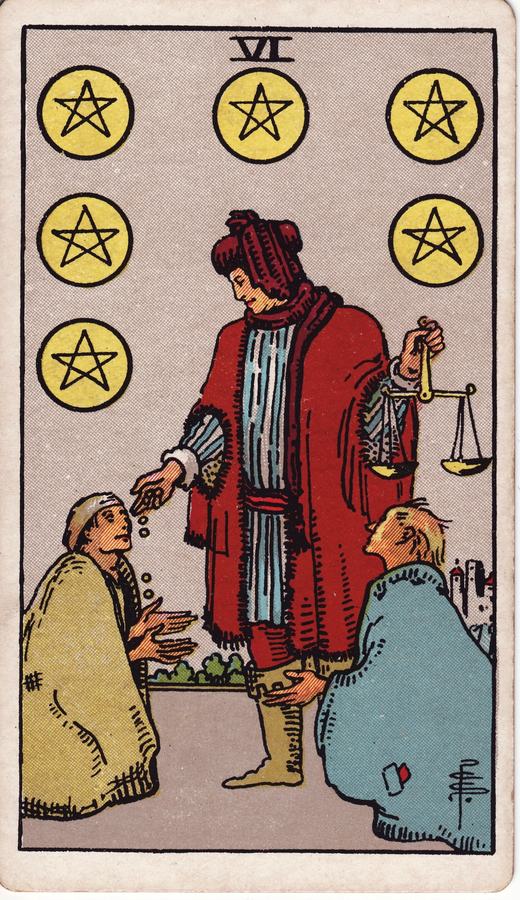
The Six of Pentacles is the card of exchange, generosity, and the balance between those who have and those who don't. One hand gives, another receives, and a pair of scales weighs it out. It looks simple, but the card hides a thorny question: is the generosity free, or is it a way to keep power?
It's a card that invites you to look at both the gesture and the hierarchy beneath it. Giving well is an art; giving to keep the other in your grip is a cage dressed up as a gift.
The symbolism of the card
The scene shows a richly dressed merchant, red cloak on his shoulders and a pair of scales in his hand, standing before two beggars kneeling. With his right hand he tips coins into one's bowl while the scales carefully weigh how much to give. The other beggar stretches out a hand: he'll receive his share too.
The detail of the scales is central: he doesn't hand out at random, he calibrates. It's almost accounting-book charity. The two kneeling figures establish an evident hierarchy — the one standing holds the power, the ones below depend on him. The scene raises the very question the card carries: is this giving pure generosity, or also a way of keeping the difference firmly in place?
The Six of Pentacles upright
Upright, the Six of Pentacles indicates a phase of generosity, sharing, and balanced exchange. You might be the giver — of time, money, help, opportunity — or the receiver, and in both cases the card signals flow. Resources circulate, and whoever has shares with whoever needs.
The point is fairness. The scales don't give at random: they give according to need and just measure. The card encourages conscious generosity, one that recognises what's enough without humiliating or overdoing it. To give well is to respect the one who receives.
The Six of Pentacles reversed
Reversed, the Six of Pentacles signals an imbalance in the exchange: unrepaid debts, help that breeds dependence, gifts that bind whoever receives them. It can point to interested generosity, giving in order to receive something in return — gratitude, obedience, power.
The second reading concerns whoever receives: the feeling of being in debt, of having to give back more than you got, of never being able to shake off a state of subordination. Reversed, the Six asks you to rethink the terms of the exchange, because something in the scales doesn't add up.
The Six of Pentacles in love
In love the Six of Pentacles upright describes a balanced relationship where giving and taking even out and neither partner feels in debt or in credit. It's the card of the generous couple. Reversed, it signals a concrete imbalance: one always gives and the other takes, or the bond rests on a power dynamic where the "gift" becomes a chain. The question is who really stands above.
The Six of Pentacles in work and money
At work and with money it indicates help given or received: loans, funding, bonuses, mentors who invest in you. It's a favourable stretch for fair exchanges and professional generosity. Reversed, it warns of hidden debts, interested help, concealed pay disparities, or power dynamics dressed up as the employer's generosity.
How to read the Six of Pentacles in spreads
A card's meaning shifts with the position it occupies. Here is how the Six of Pentacles behaves in the most common spreads.
In the Celtic Cross
| Position | What it indicates |
|---|---|
| present situation | You're in a phase of exchange: you give or receive help, and the scales look for the right balance. |
| obstacle | What holds you back is a hidden imbalance: one gives too much, the other takes without returning, or the gift hides power. |
| near future | A chance for fair exchange is coming, but it demands clarity about the real terms of give and take. |
In the Three Card spread (past · present · future)
| Position | What it indicates |
|---|---|
| past | It points to help received or given that balanced a situation and set exchanges back on their feet. |
| present | You're inside an exchange that needs weighing: is the generosity genuine, or does it hide a hierarchy? |
| future | It promises a possible balance, provided the scales are recalibrated and made genuinely fair. |
Common mistakes in interpretation
The Six of Pentacles gets reduced to a "charity card" in a moralistic sense. It's a neutral card about giving: it evaluates it, it doesn't sanctify it. The opposite mistake is reading it only as good generosity, ignoring that the scene itself shows a hierarchy. The real question is always: is this exchange free, or does it bind?
Keywords
| Orientation | Meaning |
|---|---|
| Upright | generosity, charity, balance, sharing, fairness, exchange |
| Reversed | greed, debts, power imbalance, condescension, interested help, dependence |
Frequently asked questions about Six of Pentacles
Is the Six of Pentacles a positive card?
Generally yes — upright it indicates generosity and fair exchanges, giving and receiving in just measure. Reversed it warns of imbalances, debts, and power dynamics hidden beneath the appearance of the gift.
What does it say about money?
It signals a flow of resources: loans, gifts, funding, fair wages. The scales weigh how much to give and to whom. Reversed, it points to debts or to help that binds whoever receives it.
Does it speak of power too?
Yes, and it's the less obvious theme. The scene shows a hierarchy: the standing one gives, the kneeling ones receive. The card asks whether the giving is free or whether it preserves a difference of power.
Want to see the Six of Pentacles in a full reading?
Try a free spread on Theurgos →