The Six of Cups is the card of nostalgia — not the bitter regret of the Five, but the sweetened memory, the childhood that resurfaces, the return to places and people of your past. It is water running backwards, toward the springs — and like all water, it can refresh or deceive.
The symbolism of the card
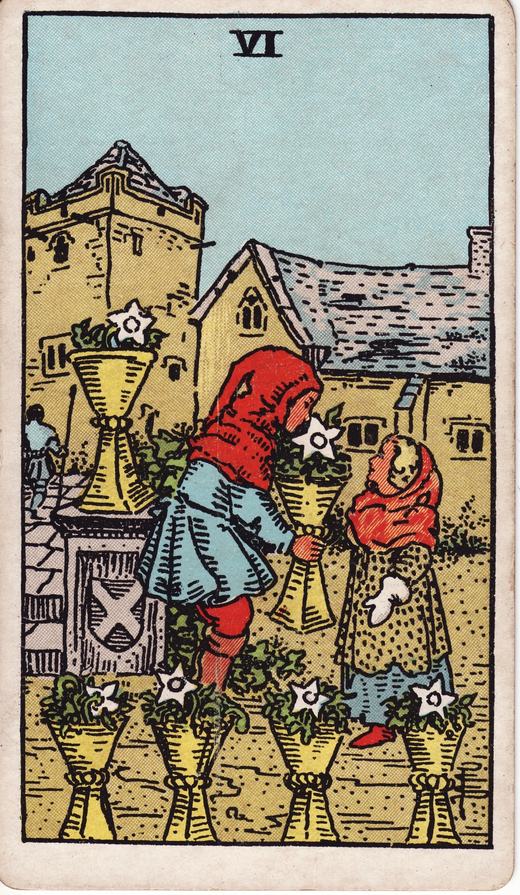
In a village courtyard, an older child hands a younger girl a cup filled with white flowers; she receives it carefully. On the ground grow tall-stemmed flowers and other flowering cups. In the background, a figure armed with a staff walks away, and a house with decorated windows closes the scene.
The giving child stands for the past offering its flowers; the receiving girl, for the part of us that takes in the memory. The white flowers speak of innocence and purity; the courtyard, of a known domestic origin. The armed figure in the background, finally, hints that the innocence of the memory is not the whole story: an adult has walked away, a history the picture does not tell.
The Six of Cups upright
Upright, the Six of Cups signals nostalgia, memories returning, a return to the roots — a place, a person, a part of yourself you thought lost. It can announce someone from the past coming back, the rediscovery of a childhood friend, or the need to draw near again to your own most spontaneous self.
It is the card of regained innocence: the capacity to wonder, to trust without calculating, to be simple again. Its energy is sweet, restorative: sometimes it heals precisely because, for a moment, it lets you lean on what once was.
The Six of Cups reversed
Reversed, the Six of Cups signals the shadow side of nostalgia: stuck in the past, refusing to grow up, confusing the idealised memory with reality. You live off what was and build nothing of what will be.
A less obvious reading concerns memories that return to be seen at last for what they were: nostalgia breaks, the golden childhood reveals itself as less perfect than remembered, and this — painful as it is — sets you free. Sometimes it also points to a present that repeats childhood patterns without noticing: love styles, reactions, inherited fears that ask to be recognised and no longer re-enacted.
The Six of Cups in love
In love it can signal the return of a past love, or a relationship lived with the tenderness of a childhood bond, made of small mutual gestures. Reversed, it warns against romantic illusion, against constant comparison with an idealised past, or against staying tied to a childish emotional pattern that no longer serves.
The Six of Cups in work and money
At work it can point to a return to an activity or a place of your past, or a project tied to memories, childhood, family. Reversed, it warns against re-proposing old patterns that no longer work, or against taking refuge in a familiar field for fear of the new.
How to read the Six of Cups in spreads
A card's meaning shifts with the position it occupies. Here is how the Six of Cups behaves in the most common spreads.
In the Celtic Cross
| Position | What it indicates |
|---|---|
| present situation | A situation coloured by nostalgia or by a return to the past: you are drawing on the roots, sweetly or restoratively. |
| obstacle | What holds you back is fixation on the past: a refusal to grow, or the tendency to confuse memory with reality. |
| near future | It promises a return — of a person, a place, an affinity — that will rekindle sweetness. |
In the Three Card spread (past · present · future)
| Position | What it indicates |
|---|---|
| past | It tells of an origin or a memory still feeding the present, constructively or cumbersomely. |
| present | It catches you in touch with nostalgia: let it flow, but do not live in it. |
| future | It signals a sweet reunion or return, to be welcomed without confusing memory and reality. |
Common mistakes in interpretation
It is read almost only as a “nostalgia card” in a sweet, reassuring sense, forgetting that its water can deceive too. Nostalgia is not always healthy: sometimes it is an escape from the present, an idealisation of the past, a repetition of childhood patterns. The armed figure in the background reminds you that this innocence holds shadows as well.
Keywords
| Orientation | Meaning |
|---|---|
| Upright | nostalgia, memories, childhood, innocence, return to roots, tenderness |
| Reversed | stuck in the past, immaturity, romantic illusion, idealised memory, childish pattern, refusal to grow |
Frequently asked questions about Six of Cups
Does the Six of Cups mean someone is coming back?
Often yes: it can announce the return of someone from the past, or the rediscovery of an old bond. It does not guarantee that the return is wholesome, though: sometimes it re-proposes outdated patterns and should be welcomed with discernment.
Is the Six of Cups positive in love?
Generally yes: it points to tenderness, sweetness, a bond that feels like home. Reversed, though, it warns against romantic illusion and against comparison with an idealised past that blocks you from living the present.
What does it mean reversed?
It signals excess nostalgia, a refusal to grow up, or the tendency to idealise what was. Sometimes, conversely, it points to the moment when memories break and you see the past as it truly was — painful, but liberating.
Want to see the Six of Cups in a full reading?
Try a free spread on Theurgos →