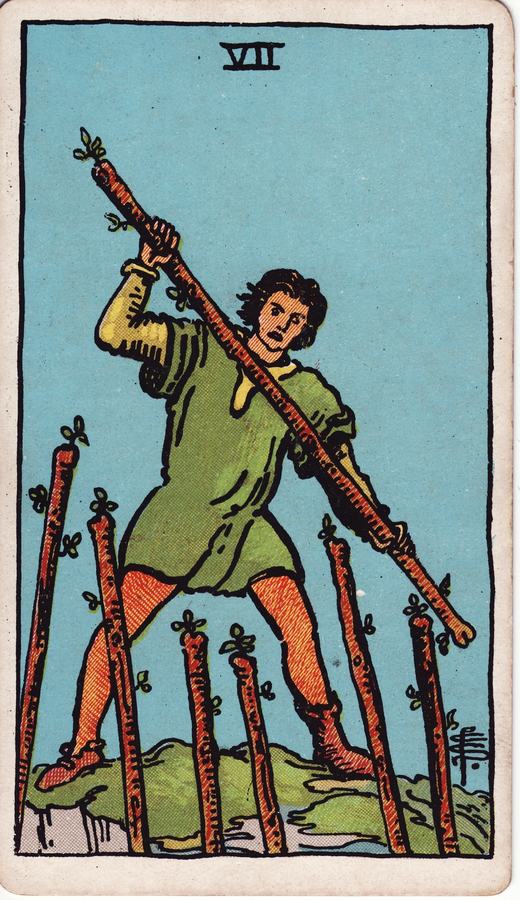
The Seven of Wands is the card of active defense. After the triumph of the Six, someone — or something — comes to contest the position reached, and you have to defend it. It's no longer horizontal competition like the Five: it's an uphill fight, where you stand above and the others push from below. The number seven brings the trial, the challenge that tempers, and in Wands it reads as the struggle to hold what you've conquered.
Its signature is resistance. The fire that burned to conquer now has to burn not to yield. The card doesn't ask you to advance, but to hold: defend your position, your idea, your dignity against those who question it.
The symbolism of the card
A figure stands on a rise in the ground — a kind of small promontory — and grips a wand with both hands, raising it in a defensive position against six wands rising from below toward him. The six staves come from as many figures, of whom only the wands and partly the bodies are visible, set lower down.
The elevated position is the decisive detail: whoever defends has an advantage, but is clearly outnumbered. The posture is tense but not desperate — there's determination in the effort to repel the attack. The background is yellow and bright, a sign the challenge unfolds in the open and that visibility is part of the confrontation: it isn't an ambush, it's a declared battle.
The Seven of Wands upright
Upright, the Seven of Wands is defense, resistance and holding position: you find yourself having to defend something you've conquered or consider yours — an idea, a role, a choice, a boundary — against those who contest it. You have the advantage, because you hold a position, but you're outnumbered, and the fight takes energy and determination.
The card invites you not to yield. The Seven of Wands rewards whoever holds firm, who can defend with strength but without malice, who holds the right position even when it's unpopular. This isn't the moment to back down for a quiet life: the challenge is real, and yielding means losing what you've conquered. Your position is right — defend it.
The Seven of Wands reversed
Reversed, the Seven of Wands speaks of yielding: you're overwhelmed by pressure, you give ground, you lose the position you'd conquered. It can signal exhaustion, the sense of not making it anymore, or the recognition that the fight wasn't worth the effort and that retreating is the wiser choice. Yielding isn't always defeat: sometimes it's lucidity.
A less obvious reading concerns the wrong defense: you hold a position that's no longer worth defending, out of pride or habit, wasting energy on a battle that's passed. Here the invitation is paradoxical — stop fighting for something that isn't yours anymore, and use that energy to find a new position.
The Seven of Wands in love
In love, the Seven of Wands upright signals a relationship that has to defend itself from outside pressure — family interference, judgments, rivals — or a phase where one partner is defending their boundaries inside the couple. It isn't a card of rupture, but of holding. Reversed, it points to yielding under pressure, or the stubborn defense of a position that no longer makes sense. Ask yourself whether the fight you're waging for the relationship is truly worth it, or whether you're only resisting out of pride.
The Seven of Wands in work and money
At work, the Seven of Wands upright is defense of your position: standing up to criticism, to competitors, to changes that threaten your role. It favors whoever can hold their line under pressure. Reversed, it signals yielding, overload, or the sense of not keeping up. Before retreating, weigh whether the position you're defending is still the right one, or whether it's time to seek a new one.
How to read the Seven of Wands in spreads
A card's meaning shifts with the position it occupies. Here is how the Seven of Wands behaves in the most common spreads.
In the Celtic Cross
| Position | What it indicates |
|---|---|
| present situation | You're called to defend a conquered position: you have the advantage, but the pressure is strong. |
| obstacle | Exhaustion or attrition threatens to make you yield just when you should hold. |
| near future | Announces a challenge coming, where your determination to hold position will make the difference. |
In the Three Card spread (past · present · future)
| Position | What it indicates |
|---|---|
| past | A defensive battle fought and won, which consolidated your positions. |
| present | You're under pressure but advantaged: defend what's yours without yielding for a quiet life. |
| future | Points to a trial of endurance, where the ability not to retreat will let you hold your ground. |
Common mistakes in interpretation
The most common mistake is reading the Seven of Wands as a card of attack or aggression. It isn't — it's defense, and describes someone on higher ground bearing pressure from below. Confusing it with attack means losing the sense of legitimate resistance. A second misunderstanding is treating it as always positive because 'you win': the card describes the effort, not the outcome, and sometimes yielding is the wiser choice.
Keywords
| Orientation | Meaning |
|---|---|
| Upright | defense, resistance, holding position, challenge, protection, determination |
| Reversed | yielding, overwhelmed, surrender, overload, lost position, wrong defense |
Frequently asked questions about Seven of Wands
Does the Seven of Wands point to conflict?
Yes, but of a defensive kind: it describes someone who has to hold a position against more numerous opponents. It isn't an attack you launch, it's a resistance you sustain. The card says you have an advantage — a position, a right idea, a right — but that it takes energy to defend it.
Does the Seven of Wands reversed mean I lose?
It can: yielding, being overwhelmed, losing the position. But it isn't always negative: sometimes yielding is the wiser choice, when the fight is no longer worth the effort. Other times it signals a stubborn defense of a position that's been surpassed, which would be better abandoned. Context orients the reading.
Is the Seven of Wands positive or negative?
It depends on the angle. Upright it's the card of whoever resists and holds, so favorable for someone defending a right position. But it describes effort and friction, not rest. It isn't a card of harmony: it speaks of effort, of a minority standing up to a majority, of boundaries to protect.
Want to see the Seven of Wands in a full reading?
Try a free spread on Theurgos →