The Seven of Swords is the card of cunning and stealth. Not the frontal betrayal of the Three, but the sideways move: taking or leaving unseen, sidestepping the direct clash, working the situation with strategy rather than loyalty. Sometimes it is necessary, sometimes it is sharp practice — almost always it is ambiguous.
The symbolism of the card
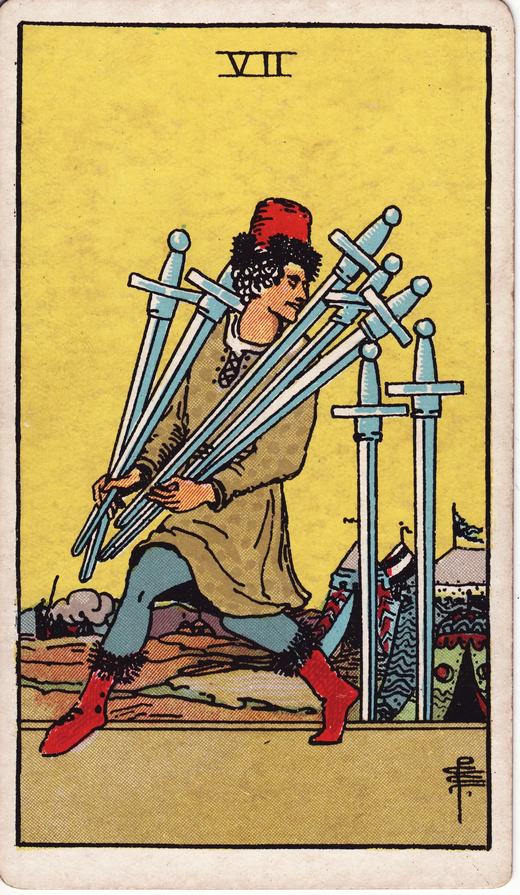
A man in a red hat and bright livery steals away from a camp. He carries five swords gathered under his arm, held carefully so they will not clink. Two more swords remain driven into the ground, in front of a tent in the background, left behind. He turns to glance over his shoulder with a sly smile, finger pressed to his lips in a gesture of silence.
The gesture is the point: he is not fighting, he is gathering unseen. The swords taken are five — more than half — and the two left behind suggest a calculated choice, not a full sweep. The stealth says the action would not bear the light. The sly smile is the awareness of doing something not wholly transparent.
The Seven of Swords upright
Upright, the Seven of Swords points to strategy and secrecy. You may need to move with care, gather information without showing your hand, take the lateral route instead of the frontal clash. It is not always dishonest: sometimes it is prudence, tactical intelligence, the awareness that not every opponent should be met in the open.
But the card carries a moral warning: the line between legitimate cleverness and sharp practice is thin. If you use the Seven of Swords to dodge a duty or to take something that is not yours, the cost comes back in trust and reputation. The card asks for honesty with yourself: would you do what you are doing in plain sight?
The Seven of Swords reversed
Reversed, the deception comes to light: secrets surface, hidden strategies are discovered, half-truths collapse. It can mark the moment to confess, to take a more honest road again, to bring into the open what was kept hidden. Stealth loses its use once the curtain rises.
A second reading concerns the one deceived rather than the deceiver: the reversal can warn that someone is hiding something from you, or that the situation is not as presented. In that case the card counsels prudence, verification, attention to details that do not add up. The finger on the lips, reversed, becomes an invitation to ask the awkward questions.
The Seven of Swords in love
In love the upright Seven of Swords points to secrets: a half-truth, a fact withheld, a relationship conducted less than transparently. Sometimes it is necessary protection, more often it is dodging the conversation. Reversed, the secrets come out — better to find and face them, or to confess before someone else does. The card asks for candour: love does not long survive hidden strategy.
The Seven of Swords in work and money
At work the upright card can mark political manoeuvring, managed information, tactical play for a result. When legitimate, it is intelligence; when it hides sharp practice, it is mined ground. Reversed, it signals a secret about to surface, or someone not playing straight — toward you or with you. It pays to verify the cards on the table before trusting appearances.
How to read the Seven of Swords in spreads
A card's meaning shifts with the position it occupies. Here is how the Seven of Swords behaves in the most common spreads.
In the Celtic Cross
| Position | What it indicates |
|---|---|
| present situation | A lateral move is in play: strategy, secrecy, something not being said in full daylight. |
| obstacle | What holds you back is a lack of transparency — yours or another's — that undermines the trust at the root of the matter. |
| near future | A moment of truth is approaching: what was hidden comes to light, and stealth loses its edge. |
In the Three Card spread (past · present · future)
| Position | What it indicates |
|---|---|
| past | It tells of an action carried out in hiding, a lateral strategy that shaped the path. |
| present | It catches you moving with care, choosing silence over open confrontation. |
| future | It signals that the better path is transparency: what is hidden now will soon ask to be said. |
Common mistakes in interpretation
The Seven of Swords is often slapped with the simple label of “thief” or “traitor”. But its theme is broader: cunning, lateral strategy, less-than-transparent handling. Sometimes it is necessary defence; reducing it to dishonesty loses the nuance — the card asks you to judge case by case the use being made of the shadow.
Keywords
| Orientation | Meaning |
|---|---|
| Upright | deception, strategy, secrets, stealth, cunning, tactical prudence |
| Reversed | confession, getting back on track, honesty, secret exposed, discovered deception, watching for deceivers |
Frequently asked questions about Seven of Swords
Is the Seven of Swords a negative card?
It is an ambiguous card: cunning, secrecy, lateral strategy. Not always dishonest — it can be legitimate prudence — but it carries the question of how transparent your actions are.
Does the reversed Seven of Swords mean the deception is found out?
Often yes: secrets surface, hidden strategies lose their force. It can mark the moment to confess, or warn that someone is hiding something from you.
Does the Seven of Swords answer yes or no?
It is not a clean yes: it suggests prudence, shadow, omissions. It leans toward no because something is not transparent — better to verify before proceeding.
Want to see the Seven of Swords in a full reading?
Try a free spread on Theurgos →