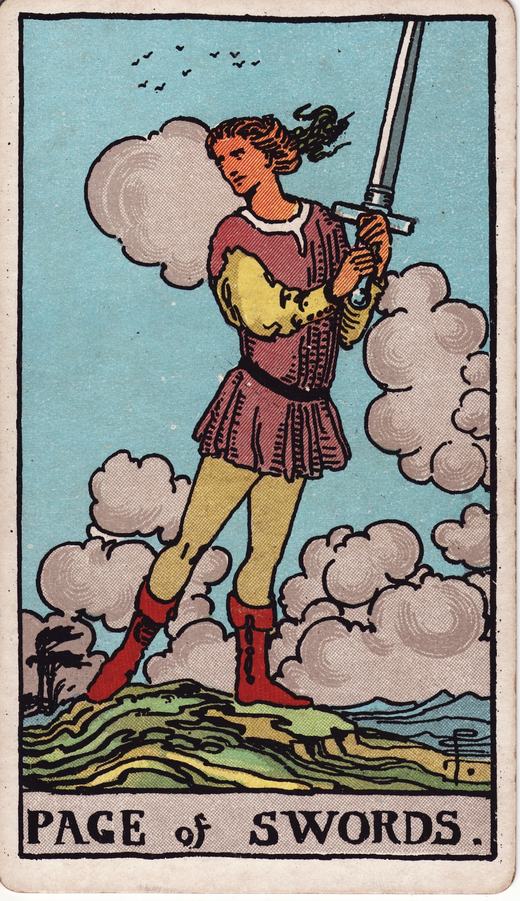
The Page of Swords is the person of intellectual curiosity: a sharp mind, a ready tongue, eyes that miss nothing. Like every court figure, it represents a person or an attitude — here the attitude of one who observes, asks, communicates, and keeps the sword raised because they know the truth has to be defended.
The symbolism of the card
A youth stands on grassy ground, arms lifted, holding a sword vertically with both hands, the blade pointed at the sky. He wears a blue tunic and a red cap, and his hair and clothes are stirred by the wind. In the background the sky is streaked with running clouds, and birds in flight and an uneven terrain are visible in the distance.
The raised sword is readiness, not attack: the Page does not strike, he prepares. The wind and the racing clouds speak of air on the move — the suit's element, mental activity, the flow of ideas. The birds suggest messengers, news arriving. The youth is alert because he senses something stirring, and wants to be ready to catch it.
The Page of Swords upright
Upright, the Page of Swords is curiosity, vigilance, a new idea. It can point to a young person — or young in spirit — who brings fresh intellectual energy, asks awkward questions, gathers information, communicates candidly. It is the passionate student, the curious journalist, the friend who tells it like it is.
Sometimes the card marks an incoming message: news, a communication, information that needs attention. The Page is not the master yet — his skill is still forming — but he has the one quality that matters for learning: the hunger to understand. The card invites you to honour your curiosity, to ask the questions you avoid, to stay alert without tipping into anxiety.
The Page of Swords reversed
Reversed, the Page's qualities warp. Curiosity turns to gossip, candour to rudeness, vigilance to suspicion. It can mark dishonest communication — half-truths, repeated rumours, information used to wound rather than to clarify. The Page's sharp tongue, poorly governed, cuts without purpose.
A second reading concerns impulsiveness: speaking before thinking, communicating without having understood, asking before having listened. The sword is raised, but the youth cannot yet handle it. The reversal invites you to bridle the tongue, verify information before spreading it, cultivate curiosity without letting it slide into intrusiveness or malice.
The Page of Swords in love
In love the upright Page of Swords marks fresh, direct communication: someone who says what they think, a relationship that grows on dialogue, an important message coming in. It favours honest exchanges and the questions that clarify. Reversed, it warns of gossip, half-truths or conversations used to wound: when communication becomes a weapon, the relationship is consumed by misunderstanding. The card asks for sincerity, not fake diplomacy.
The Page of Swords in work and money
At work the upright Page is a resource of ideas and communication: a promising apprentice, a colleague who brings useful questions, a phase of study and information-gathering. It favours roles tied to writing, research, journalism, learning. Reversed, it signals disorganisation, office gossip, muddled messaging. Before spreading a piece of information, it always pays to verify it: the Page's tongue, badly handled, cuts where it should not.
How to read the Page of Swords in spreads
A card's meaning shifts with the position it occupies. Here is how the Page of Swords behaves in the most common spreads.
In the Celtic Cross
| Position | What it indicates |
|---|---|
| present situation | There is energy of curiosity and vigilance: a new idea, a message, a question to carry forward. |
| obstacle | What holds you back is dishonest or impulsive communication: gossip, half-truths, questions asked badly. |
| near future | News or a fresh idea is approaching: someone or something will bring information that asks for attention. |
In the Three Card spread (past · present · future)
| Position | What it indicates |
|---|---|
| past | It tells of a stretch of curiosity or an important message that shaped the path. |
| present | It catches you in question mode: the card invites you to honour the urge to understand, with sincerity. |
| future | It signals that the way runs through candid, curious communication, not suspicion or chatter. |
Common mistakes in interpretation
The Page of Swords is often reduced to “messenger” or “young man”. But as a court figure it represents above all an attitude — vigilant intellectual curiosity — that can belong to anyone. Reading it only as a physical person mutes its meaning, which is about the quality of the mind before age or gender.
Keywords
| Orientation | Meaning |
|---|---|
| Upright | curiosity, new idea, communication, vigilance, incoming message, sharp mind |
| Reversed | impulsiveness, gossip, dishonesty, rudeness, repeated rumours, poorly governed communication |
Frequently asked questions about Page of Swords
Is the Page of Swords a positive card?
Generally yes: curiosity, a new idea, candid communication. It is fresh energy, to be cultivated with sincerity so it does not slide into gossip or impulsiveness.
Does the Page of Swords represent a person?
It can point to a person — often young, curious, communicative — but above all an attitude: the alert mind that asks and observes. Read it as a quality before an individual.
Does the reversed Page of Swords mean lies?
It can flag dishonest communication, gossip or half-truths. More broadly it signals a curious mind poorly governed: a sharp tongue that wounds, unverified information, questions asked without listening.
Want to see the Page of Swords in a full reading?
Try a free spread on Theurgos →