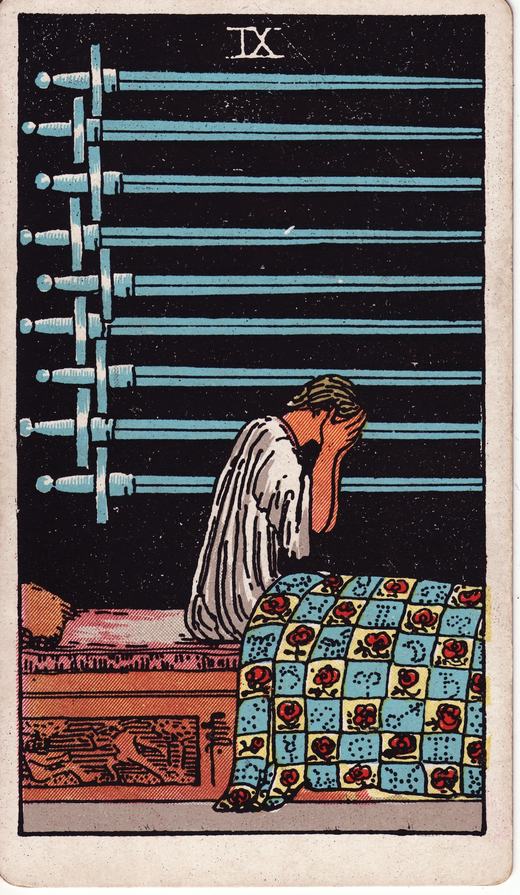
The Nine of Swords is the card of night anguish. The pain of the Three was sharp; here it is oppressive: the mind churning when everything is quiet, the nightmares, the worries that swell in the hours when no distraction holds them back. The card names mental suffering in order to walk you through it.
The symbolism of the card
A figure sits upright in a bed, hands pressed to the face in a gesture of despair. Above it, along the headboard, nine swords hang in a horizontal row, blades pointing down like a suspended threat. The covers are embroidered with flowers and zodiac signs, and in the background a night sky studded with stars is visible.
The figure is not wounded: it suffers with the mind. The swords do not touch her, they are above her — the pain is not in the body but in the thought inhabiting it. The bed, place of rest, has become the place of insomnia: the space where you cannot escape what you carry inside. The stars in the background say the night, however long, is not endless — there is a light, even if you cannot see it from where you sit.
The Nine of Swords upright
Upright, the Nine of Swords points to anguish, anxiety, sleepless nights. It is the card of the mind that will not settle: worries swelling in the dark, catastrophic scenarios that feel inevitable, thoughts returning on a loop without rest. It can accompany a genuinely hard stretch, or turn out, in daylight, to be far more manageable than the night led you to fear.
The card invites you to name the fear to dilute its power. Often what terrifies us at night loses force when said aloud, written down, shared. The Nine of Swords does not ask you to suppress the anguish but to not leave it alone with itself: anguish grows in silence, and shrinks when it meets a gaze — your own or another's.
The Nine of Swords reversed
Reversed, the anguish eases: a glimmer appears, the worries begin to resolve, the night gives way to concrete hope. It can mark the moment the nightmare lifts and you realise reality was less dire than feared. The swords on the wall grow lighter.
A second reading deserves attention: the reversal can point to anguish held back, denied, hidden behind a front of normality. You pretend to be fine while inside the suffering continues. Here the card offers no relief but a warning: suppressing mental pain does not dissolve it, it only sets it to work in silence. Better to name it aloud, before it becomes unbearable.
The Nine of Swords in love
In love the upright Nine of Swords points to romantic anguish: nights spent turning a relationship over, fears of abandonment, jealousy gnawing. The mind builds scenarios the facts do not confirm. Reversed, the anxiety eases — hope returns, a misunderstanding clears, you step out of the loop of dark thoughts. Mind the anguish you deny, though: if the suffering is papered over with a serene front, sooner or later it will ask to be heard.
The Nine of Swords in work and money
At work the upright card describes oppressive worry: anxiety over a deadline, fear of a decision, a sense of inadequacy that steals sleep. Often the reality is less grave than the mind paints. Reversed, the anxiety recedes — a solution is found, a reassuring answer arrives, lucidity returns. The remedy, while the night lasts, is not to stay alone with the thoughts: speak them, write them, check them against the facts.
How to read the Nine of Swords in spreads
A card's meaning shifts with the position it occupies. Here is how the Nine of Swords behaves in the most common spreads.
In the Celtic Cross
| Position | What it indicates |
|---|---|
| present situation | Anguish dominates the scene: the mind churns and the worries weigh more than they should. |
| obstacle | What holds you back is unspoken anxiety: the loop of dark thoughts swelling in silence. |
| near future | Relief is forming: daylight will bring a less grim perspective than the night did. |
In the Three Card spread (past · present · future)
| Position | What it indicates |
|---|---|
| past | It tells of a stretch of anguish already crossed, a phase of sleepless nights left behind. |
| present | It catches you in the thick of anxiety: the card invites you to name it to weaken its grip. |
| future | It signals that the worries will ease: what looked insurmountable will prove more manageable. |
Common mistakes in interpretation
The Nine of Swords is often mistaken for a forecast of disaster, as if it announced terrible events to come. In fact it describes a state of mind, not a destiny: the anguish often precedes a much milder reality. To read it as a prophecy is to reinforce the very fear the card wants to name and so drain.
Keywords
| Orientation | Meaning |
|---|---|
| Upright | anxiety, nightmares, worry, mental pain, insomnia, night anguish |
| Reversed | hope, resolution, release from anxiety, glimmer, end of the nightmare, denied anguish |
Frequently asked questions about Nine of Swords
Is the Nine of Swords a negative card?
It describes a moment of anguish and mental pain, so it is felt as harsh. But its theme is not adverse fate: it is anxiety often out of proportion to reality, which eases when looked in the face.
Does the reversed Nine of Swords mean the anxiety is gone?
Often yes: hope, relief, resolution. But it can also flag denied anguish, papered over behind a serene front, that keeps working beneath the surface until it is acknowledged.
Does the Nine of Swords answer yes or no?
It leans toward no: worry, anguish, dark scenarios conjured by the mind. But it is a no that often dissolves in daylight, when reality proves milder than the nightmare.
Want to see the Nine of Swords in a full reading?
Try a free spread on Theurgos →