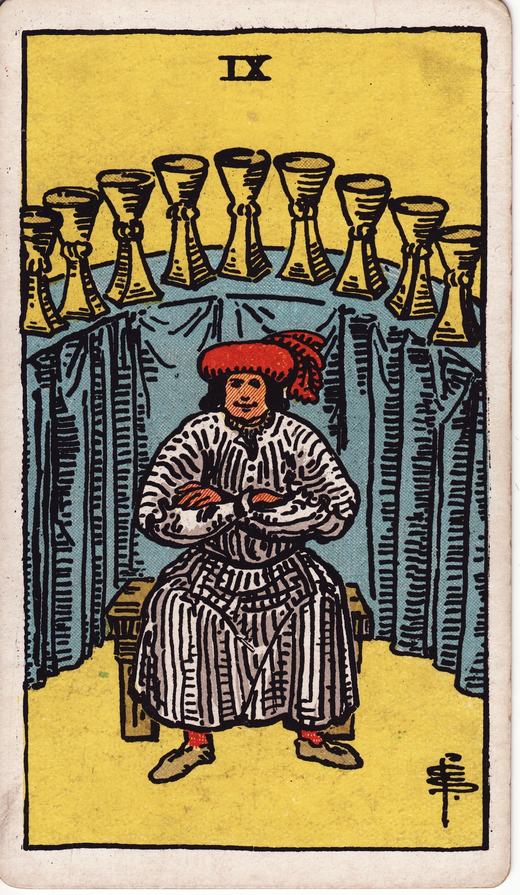
The Nine of Cups is called the “card of contentment”: the man seated before his cups has got what he wanted. It is pleasure, fulfilment, the satisfaction of desire. But precisely because it touches the apex of personal pleasure, it also holds the question: once reached, will it be enough?
The symbolism of the card
A man sits pleased on a wooden bench, arms crossed and a half-smile of satisfaction. He wears a blue robe and a red hat, one leg raised carelessly. Behind him, on a curved shelf, nine cups are lined up to form a kind of decorative arch.
The nine lined cups are the fulfilled wishes, displayed like trophies. The man's posture — crossed, satisfied, a little showy — tells of a pleasure that is legitimate but centred on itself. There is nothing wrong with being pleased; there is only the implicit question: once all the cups are on show, is there still someone to toast with?
The Nine of Cups upright
Upright, the Nine of Cups signals fulfilment: a wish granted, a goal reached, a moment of genuine pleasure. It is the satisfaction of someone who has worked for something and now enjoys the result — a party, a success, a personal joy well earned.
The card rewards those who can enjoy what they have earned without guilt. Its message is simple: allow yourself to be pleased. Sometimes contentment arrives only once you stop chasing the next thing; the Nine of Cups is permission to pause for a moment and say, “I like this, and it is mine”.
The Nine of Cups reversed
Reversed, the Nine of Cups signals the dissatisfaction of someone who got what they wanted and found it was not enough. The contentment is shallow, the fulfilled wishes disappoint, greed keeps asking for another cup. It is the card of empty satiety.
A second reading concerns pleasure sought in the wrong place: confusing fulfilment with excess, satisfaction with indulgence. Sometimes it also points to a genuine contentment you do not allow yourself to feel — success that scares you, joy you sabotage for fear of envy, pleasure soured by guilt. The card asks: am I truly content, or pretending to be? And if I am, why can I not enjoy it?
The Nine of Cups in love
In love it signals a gratifying relationship, a moment of fulfilling intimacy, the satisfaction of a sentimental wish come true. Reversed, it warns that the expectation was out of proportion to the reality, or that the other is treated as a trophy rather than a person. Sometimes it points to an apparent contentment masking a void.
The Nine of Cups in work and money
At work it signals a success, a recognition, the reaching of a long-pursued goal. It is the moment to enjoy the milestone. Reversed, it warns that success does not fill as hoped, or that satisfaction rests on exterior gains at the expense of what truly matters.
How to read the Nine of Cups in spreads
A card's meaning shifts with the position it occupies. Here is how the Nine of Cups behaves in the most common spreads.
In the Celtic Cross
| Position | What it indicates |
|---|---|
| present situation | A moment of fulfilment: a wish is granted, a goal reached, and there is room to enjoy it. |
| obstacle | What holds you back is shallow contentment or greed: you have, but it is not enough, and you keep chasing the next cup. |
| near future | It promises pleasure on its way, a concrete satisfaction to be welcomed without guilt. |
In the Three Card spread (past · present · future)
| Position | What it indicates |
|---|---|
| past | It tells of a wish fulfilled or a pleasure lived, which has coloured mood and expectations. |
| present | It catches you in a phase of contentment: enjoy it, but ask whether it is truly deep. |
| future | It signals a fulfilment on its way, to be lived with gratitude more than with greed. |
Common mistakes in interpretation
It is often read as an entirely positive card — “the wish card” — forgetting that self-centred fulfilment carries a shadow. The cups are nine, not ten: something is missing, and often it is the shared dimension. Underrating its self-referential side means repeating the figure's mistake: confusing pleasure with fullness.
Keywords
| Orientation | Meaning |
|---|---|
| Upright | fulfilment, satisfaction, wish fulfilled, pleasure, contentment, personal success |
| Reversed | dissatisfaction, greed, surface disappointment, empty satiety, success that disappoints, sabotaged contentment |
Frequently asked questions about Nine of Cups
Is the Nine of Cups the wish card?
Yes — upright it often points to a wish fulfilled and a moment of contentment. But it is a contentment that concerns the self: the cups are nine, not ten. The satisfaction is real, but already holds the question of what is missing for true fullness.
Is the reversed Nine of Cups negative?
Not always. It can signal real dissatisfaction — having had what you wanted and finding it is not enough — but also a genuine contentment you deny yourself out of guilt or fear. The card asks whether the disappointment lives in reality or in attitude.
Is it a good card in love?
Yes, it points to gratification and a sentimental wish come true. It is worth noticing, though, whether the contentment is shared or centred on one partner alone: the man seated alone before his cups is a reminder that full pleasure, sooner or later, wants someone to toast with.
Want to see the Nine of Cups in a full reading?
Try a free spread on Theurgos →