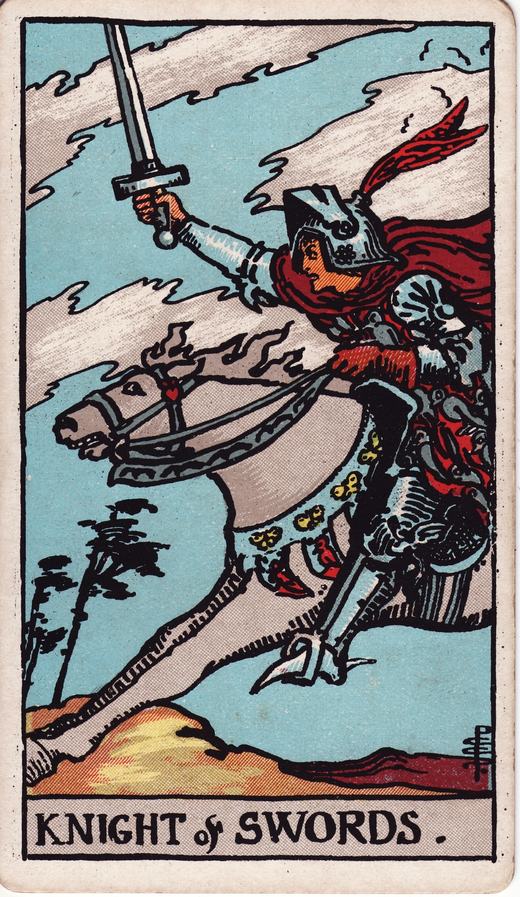
The Knight of Swords is the force of air at its most intense: rapid action, ambition, determination. Where the Page observes, the Knight charges. It is the energy of one who sets off with an idea and rides it down without hesitating, overturning obstacles — sometimes with too much dash, and at his own cost.
The symbolism of the card
An armoured knight sits a white horse at full gallop, reins taut, body pitched forward. In his right hand he holds a sword high, vertical, ready to strike. His cloak and the horse's trapping billow in the wind, and the sky is crossed by clouds and birds in fast flight, driven by the moving air. The ground under the hooves is uneven, and the whole scene conveys speed and urgency.
The white horse is the purity of the drive, the energy not yet reined in. The high sword does not defend, it threatens: the Knight is charging, not negotiating. The wind and the racing birds amplify the sense of urgency: air, the suit's element, is here a gale, not a breeze. The image catches the moment of the dash, before anything checks or corrects it.
The Knight of Swords upright
Upright, the Knight of Swords is dash and determination. He points to one who attacks an objective with full energy, no half-measures, finishing what he starts with speed and conviction. It is the moment to act rather than reflect further, to launch into the venture, to speak plainly even when it costs.
The card favours whoever has a clear idea and the force to carry it out. Its gift is the courage to begin, the will to win, the frankness that refuses to be cowed. But the Knight knows no nuance: it is all forward, always. When the situation needs drive he is priceless; when it needs calibration, he risks riding roughshod. The card invites you to honour his energy, and to remember that charging is only the first half of the battle.
The Knight of Swords reversed
Reversed, the dash turns to recklessness. Rapid action becomes impulsiveness, ambition aggression, determination obstinacy. The Knight charges without watching the direction, takes rash decisions, speaks before thinking, throws himself into ventures he has not prepared for. The high sword strikes at random.
A second reading concerns spent energy: the Knight has charged too long and now flags, ambition turning to fatigue, drive souring into frustration. In both cases the reversal asks you to halt the gallop, catch your breath, look at the direction before spurring on again. Courage without discipline becomes disaster: the card invites you to master the dash, not to smother it.
The Knight of Swords in love
In love the upright Knight of Swords is declared passion and direct courtship: someone who states what they want without detours, a relationship that begins with drive. It favours action over hesitation. Reversed, it flags romantic impulsiveness — premature declarations, heated rows, obstinacy about being right. The Knight's passion, poorly gauged, sweeps away whoever stands beside him. The card asks you to dose the dash, not to kill it.
The Knight of Swords in work and money
At work the upright Knight is the right push to start: launching a project, taking the initiative, telling an inconvenient truth, stepping up with ambition. He is precious when immediate action is needed. Reversed, he signals damaging haste — rash decisions, clashes with colleagues, projects launched without preparation. Charging helps, but only if you also know where you are going: before spurring the horse, it pays to check the direction.
How to read the Knight of Swords in spreads
A card's meaning shifts with the position it occupies. Here is how the Knight of Swords behaves in the most common spreads.
In the Celtic Cross
| Position | What it indicates |
|---|---|
| present situation | There is an energy of dash: someone or something is charging with determination toward a goal. |
| obstacle | What holds you back is impulsiveness or aggression: too much drive, too little attention to the direction. |
| near future | Rapid action is coming: an opportunity that will ask for courage and immediate decision. |
In the Three Card spread (past · present · future)
| Position | What it indicates |
|---|---|
| past | It tells of a dash already given, a charge that moved things in the past. |
| present | It catches you in full drive: the card invites you to use it, but with awareness of the direction. |
| future | It signals that courage and speed will be needed, but also measure: charge, yes — but watching where. |
Common mistakes in interpretation
The Knight of Swords is often painted as a simple “warrior” or as pure aggression. But his theme is the dash of the idea in action — the noble energy of one who pursues a goal with everything he has. To reduce him to violence is to lose his best quality, which is courage, and to confuse it with his pathology, which is recklessness.
Keywords
| Orientation | Meaning |
|---|---|
| Upright | rapid action, ambition, determination, dash, courage, candour |
| Reversed | impulsiveness, aggression, rash plans, recklessness, obstinacy, spent energy |
Frequently asked questions about Knight of Swords
Is the Knight of Swords a positive card?
Yes, especially when drive is needed: courage, determination, rapid action. His energy is precious, but it must be governed — without measure it risks riding roughshod.
Does the Knight of Swords represent a person?
It can point to a determined, ambitious, direct person, often male or with masculine energy. But above all it represents an attitude: the dash of one who charges at a goal without hesitating.
Is the reversed Knight of Swords dangerous?
More than dangerous, he is reckless: impulsiveness, rash plans, aggression. The Knight's energy, badly aimed, becomes chaos. The card invites you to halt the gallop and recover the direction.
Want to see the Knight of Swords in a full reading?
Try a free spread on Theurgos →