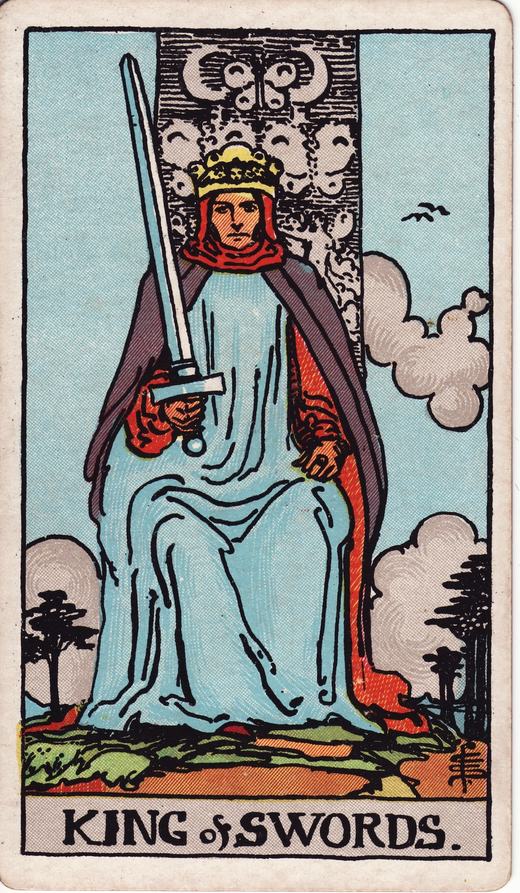
The King of Swords is the sovereign of air: intellectual authority, judgement, truth. Where the Queen applies lucidity to relationships, the King brings it to structures — laws, criteria, final decisions. He is the professional of the exact word, the one who can separate just from unjust without being shaken by the emotion of the moment.
The symbolism of the card
A king sits enthroned on a stone seat, gaze fixed and direct ahead. In his right hand he holds a sword vertical, erect at the side of the throne, and with his left he grasps the armrest. He wears a blue tunic beneath a purple mantle, and on his head a gold crown. On the back of the throne eagles are carved, an eagle is also set or embroidered, and another head of a child surmounts the crown among the clouds. On his left hand he wears a ring, and the sky behind him is crossed by clouds, with trees stirred by the wind in the distance.
The erect sword, sign of measure and judgement, is here the emblem of constituted authority: the King does not debate, he decides. The eagles recall the air element and the vision from on high. The ring speaks of alliances, bonds, given words. The royal mantle and composed posture say that this man has reached a position of command through intellectual discipline, and that he governs with the mind more than the heart.
The King of Swords upright
Upright, the King of Swords is intellectual authority and just leadership. He points to a person — or an attitude — that decides clearly, tells the truth, applies fair criteria, takes responsibility for their words. He is the upright judge, the competent professional, the father or boss who leads with firmness and honesty, even when it costs.
The card favours decisions grounded in principle, clear and loyal communication, roles of command exercised with justice. It can mark the need to take on that attitude: judge by criteria rather than by sympathies, say what is true even when awkward, take responsibility for a hard decision. The King is cold only on the surface: his justice is a high form of care, because he respects others enough not to lie to them.
The King of Swords reversed
Reversed, the authority degenerates. Clear judgement turns to tyranny, truth to manipulation, leadership to domination. It can point to someone who uses their intelligence to control, their authority to overpower, their words to wound or deceive. The King reversed is the tyrant, but also the corrupted wise man, who knows and uses knowledge against others.
A second reading concerns the loss of measure in judgement: excess criticism, intolerance, an inability to listen. The King without a heart becomes a harsh judge of everything and everyone, and ends up isolated. The reversal invites you to recover the balance: authority without overreach, truth without cruelty, judgement without condemnation. The true King of Swords uses the sword to make clarity, not to wound.
The King of Swords in love
In love the upright King of Swords marks a relationship governed by loyalty and clarity: a partner — or an attitude — who says what he thinks, keeps his word, holds responsibility. It favours unions built on respect and mutual honesty. Reversed, it flags manipulation, cold tyranny or harsh judgement: when authority replaces affection, the relationship becomes a courtroom. The card invites you to recover warmth without giving up truth.
The King of Swords in work and money
At work the upright King is a figure of competent and just authority: a leader who decides by criteria, a professional who excels through intelligence and honesty, a mentor who teaches with rigour. It favours roles of command, legal work, strategy, high-level consulting. Reversed, it flags a tyrannical boss, a manipulative colleague, or your own tendency to over-judge. The King's authority is service when it is fair, oppression when it overreaches: the difference lies in how the sword is held.
How to read the King of Swords in spreads
A card's meaning shifts with the position it occupies. Here is how the King of Swords behaves in the most common spreads.
In the Celtic Cross
| Position | What it indicates |
|---|---|
| present situation | Intellectual authority and judgement are needed: the situation asks for fair criteria and a clear decision. |
| obstacle | What holds you back is overreaching authority or too harsh a judgement: manipulation, coldness, intolerance. |
| near future | A decision to take with responsibility is approaching, or the entry of a competent authority figure. |
In the Three Card spread (past · present · future)
| Position | What it indicates |
|---|---|
| past | It tells of an authority figure already met, or a decision made with clarity and justice. |
| present | It invites you to exercise judgement and responsibility: decide by criteria, tell the truth, take up the role that is yours. |
| future | It signals that the right way runs through intellectual honesty and decisions made with justice, not impulsiveness. |
Common mistakes in interpretation
The King of Swords is often mistaken for cold detachment, or for severe authority in a punitive sense. But his theme is intellectual justice — the rule of the exact word and the fair judgement. To read him only as “stern father” or “rigid boss” is to lose his virtue, which is honest command in the service of the just.
Keywords
| Orientation | Meaning |
|---|---|
| Upright | intellectual authority, truth, clear judgement, leadership, justice, responsibility |
| Reversed | manipulation, tyranny, cruelty, harsh judgement, overreach, corrupted wise man |
Frequently asked questions about King of Swords
Is the King of Swords a positive card?
Generally yes: competent authority, clear judgement, truth. It is a card of honest command, precious when justice and responsibility are needed — provided the authority does not degenerate into tyranny.
Does the King of Swords represent a man?
It can point to an authoritative, fair, intellectually competent man, but above all an attitude: the rule of mind, judgement, the exact word. Like all court figures, read it as a quality before a person.
Is the reversed King of Swords dangerous?
He can be: tyranny, manipulation, intellectual cruelty. The King's authority, badly held, becomes oppression. The card invites you to recover measure: use the sword to make clarity, not to wound.
Want to see the King of Swords in a full reading?
Try a free spread on Theurgos →