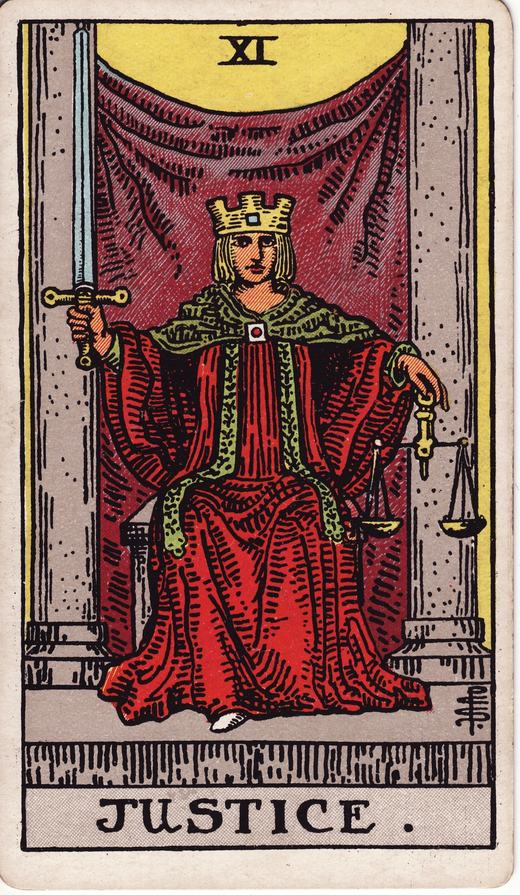
Justice closes the first half of the Major Arcana's journey with the principle that holds everything up: cause and effect. It is not the emotional justice of forgiveness, nor the social justice of the courtroom: it is the cold law of accounts coming due, by which every choice leaves a mark and every mark must sooner or later be acknowledged. The eleventh Arcanum asks for honesty — first of all with oneself.
The symbolism of the card
In the Rider-Waite image a solemn figure sits on a stone throne between two columns, behind a red drape that cuts across the background. In the right hand it holds a sword upright, vertical: the blade that cuts the false from the true and does not bend to convenience. In the left it holds a pair of scales, whose balance is what the sword protects. The sword is the decision, the scales are the measure: without one, the other loses meaning.
A crown encircles its head, and a fold of the mantle — red, the colour of will — falls to cover the right foot, a sign that authority too rests on a firm base and does not move by whim. The pose is frontal, the gaze direct: nothing escapes this figure, because Justice does not look in one direction only, it weighs everything. It is not a compassionate goddess: it is the precision that precedes peace.
The Justice upright
Upright, Justice brings clarity and rebalancing. It indicates that the accounts are coming due: a situation resolves in the right sense, a truth comes to light, a decision must be made with lucidity and impartiality. It is the card of responsibility taken on, of honesty — toward others and toward oneself — as the condition for things to settle.
Its justice is not vengeance but measure: it weighs what has been, acknowledges the consequences, restores the balance. When it appears, it asks you to look at the situation without favour and without excuses, and to act accordingly. It is a favourable card for those in the right and an honest one for those who are not: it gives each what they have sown.
The Justice reversed
Reversed, Justice signals imbalance: injustice suffered or inflicted, dishonesty, responsibilities dodged. Something does not add up, and denying it does not make it vanish — it only makes it heavier. It can indicate a situation in which you are in the wrong and know it, or in which you suffer a wrong you cannot yet set right.
The less immediate reading concerns a distorted use of the same card: a justice cold to the point of ruthlessness, a formalism that applies the rule without seeing the person, a judgement on oneself so harsh it leaves no room for forgiveness. The sword without the scales cuts at random: reversed Justice sometimes lacks balance not through excess of mercy, but through excess of rigour.
The Justice in love
In love upright Justice is clarity in the emotional accounts: a couple's situation weighed for what it is, a truth spoken after being withheld, a decision made with honesty instead of fear. It favours transparent bonds, where each gives and receives in reasonable measure. Reversed, it signals lasting imbalances, accumulated injustices, or the harsh judgement — of the partner or of oneself — that poisons the relationship. It asks you to level the scales again before demanding anything more.
The Justice in work and money
At work upright Justice is recognised fairness: fair contracts, decisions made on merit, legal matters resolving the right way. It is a favourable card for those who have reason and the facts on their side, and who seek clarification, negotiation, third-party judgement. Reversed, it signals professional injustices, biased evaluations, disputes that drag on or denied responsibilities. The way out is not resignation: it is bringing the matter to light, where the scales can weigh it again.
How to read the Justice in spreads
A card's meaning shifts with the position it occupies. Here is how the Justice behaves in the most common spreads.
In the Celtic Cross
| Position | What it indicates |
|---|---|
| present situation | The matter resolves in the direction of truth: the honesty of the accounts counts, not sympathies. |
| obstacle | An injustice, a dodged responsibility or a distorted judgement holds the rebalancing back. |
| near future | A clear decision approaches: it will be fair if the accounts are in order, severe if they are not. |
In the Three Card spread (past · present · future)
| Position | What it indicates |
|---|---|
| past | A decision made with honesty, or an account settled, from which the present balance or imbalance derives. |
| present | You are called to weigh the situation with lucidity: facts count more than intentions. |
| future | The accounts come due: what you have sown will show, one way or the other. |
Common mistakes in interpretation
The most frequent error is to confuse Justice with clemency or the law of forgiveness. It is the opposite: it weighs and cuts, gives each their due, and its mercy lies entirely in its precision. It is often reduced to a 'card of legal matters' — it can indicate those, but its true meaning concerns responsibility and moral balance in every field. Finally, it is mistaken for cold and detached: it is so in method, but its aim is peace, which is born only of restored balance.
Keywords
| Orientation | Meaning |
|---|---|
| Upright | truth, fairness, cause and effect, law, responsibility, clarity |
| Reversed | injustice, dishonesty, irresponsibility, bias, imbalance, distorted judgement |
Frequently asked questions about Justice
Is Justice a positive card?
It depends on how you stand with the truth. For those who are right and have acted honestly it is favourable: it gives the wrong to the wrong and the right to the right. For those with something to hide, even from themselves, it is a severe card. It neither rewards nor punishes at random: it returns to each their own.
Does Justice always concern legal matters?
It can indicate them, but it does not reduce to them. Its sphere is the principle of cause and effect applied to every field: relationships, work, personal decisions. It indicates that the accounts come due and that responsibility must be taken, whether or not a court is involved.
What does reversed Justice indicate?
Imbalance: an injustice suffered or inflicted, a dodged responsibility, a dishonesty. Sometimes it also indicates the opposite excess — a judgement too harsh, toward others or oneself, that applies the rule without measure. The sword without the scales cuts at random, and the remedy is to level the pan again.
Want to see the Justice in a full reading?
Try a free spread on Theurgos →