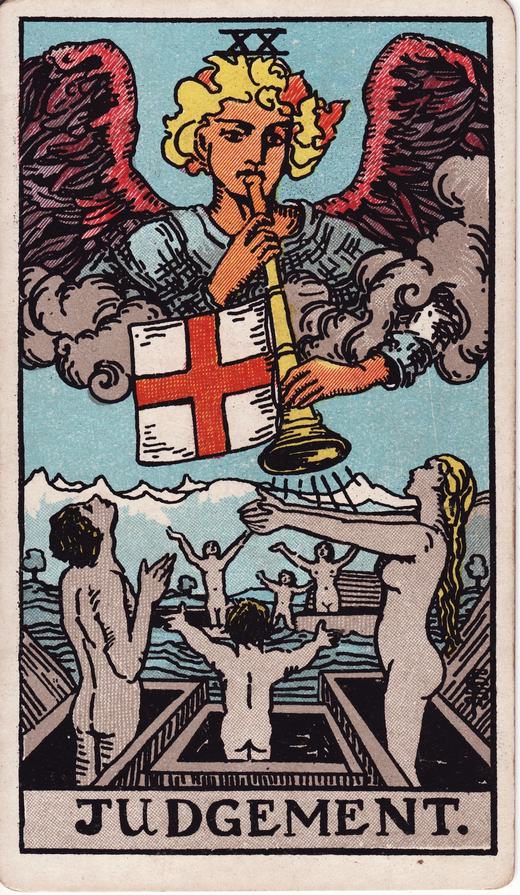
Judgement is the card of awakening and of reckoning. Twenty does not speak of a judgement that condemns, but of a call that lifts you up: the moment something within you wakes, looks back with clear eyes, and decides to begin again at a higher level. It is the passage in which the past is understood, forgiven and finally let go.
The symbolism of the card
An angel — traditionally Gabriel — sounds a trumpet from the clouds, and from open graves human figures rise with their arms flung upward. Men, women and children answer the summons, faces turned toward the sound, bodies lifting. From the trumpet hangs a banner bearing a cross.
The opening graves are what we believed finished and which instead returns asking to be heard; the trumpet is the call, a summons that comes from outside but resounds within. The raised arms do not beg: they welcome. It is an image of collective rebirth, of something that lay sleeping and now wakes — not to be condemned, but to rise transformed.
The Judgement upright
Upright, Judgement is awakening, calling and rebirth. It marks a decisive moment when you become aware of something essential: a vocation making itself felt, a truth about yourself you can no longer ignore, the need to make peace with your past. It is the time of the honest reckoning that frees rather than nails you down.
It invites you to answer the call: to rise, to forgive (yourself and others), to let go of what is finished so as to enter a new phase. It is not a judgement that weighs faults, but a summons to become a truer version of yourself. When it appears, you often already know, deep down, what you are being called to.
The Judgement reversed
Reversed, Judgement signals a call refused or unheard: you know what you should do but hesitate, or you judge yourself harshly and stay stuck in regret. It is resistance to the awakening, the temptation to postpone the reckoning with the past so as not to face it.
It can indicate excessive self-criticism, the difficulty of forgiving yourself, or the fear of a change you feel is necessary but that frightens you. The invitation is to stop condemning yourself and to listen to the call: not to punish you for what was, but to free you from it. The harshest judgement here is the one you turn on yourself.
The Judgement in love
Upright, Judgement in love speaks of awakening and decisive turning points: a relationship reborn on new ground, a clearing of the air that lets you forgive and begin again, or the sharp awareness of what you truly want. Reversed, it points to the weight of unresolved regret or the difficulty of forgiving: a story that will not close because you stay tied to the past, or an important decision endlessly postponed.
The Judgement in work and money
On the professional plane, upright Judgement is a vocation growing clear and a conscious turning point: understanding what you really want to do, taking stock of a path and setting out again with intention. It often marks the right moment for a long-postponed decision. Reversed, it signals hesitation before a necessary change, or a self-criticism that paralyses: you know the right step, but something holds you back from taking it.
How to read the Judgement in spreads
A card's meaning shifts with the position it occupies. Here is how the Judgement behaves in the most common spreads.
In the Celtic Cross
| Position | What it indicates |
|---|---|
| present situation | It describes a moment of awakening and reckoning: something calls, and asks you to rise into a truer form. |
| obstacle | What holds you back is resistance to the call or a harsh self-criticism: the regret that keeps you stuck in the past. |
| near future | It announces a conscious turning point on its way, a reckoning that frees you and opens a new phase. |
In the Three Card spread (past · present · future)
| Position | What it indicates |
|---|---|
| past | It tells of an awakening already lived, a realisation that changed your course. |
| present | It catches you before a call: it is time to answer and to make peace with the past. |
| future | It signals a rebirth: what is finished will be let go so you can set out transformed. |
Common mistakes in interpretation
The name misleads: Judgement is not the card of condemnation. Many fear it as a verdict that weighs faults, when it speaks of awakening and absolution — of a past understood so it can be released, not punished. Reading it as a harsh judgement inverts its meaning: its heart is liberation, not sentence.
Keywords
| Orientation | Meaning |
|---|---|
| Upright | awakening, calling, rebirth, reckoning, forgiveness, turning point |
| Reversed | call refused, self-criticism, regret, hesitation, stuck, reckoning postponed |
Frequently asked questions about Judgement
Is Judgement a negative card?
No, despite the name. It does not condemn: it awakens. It speaks of a call to rise, to make peace with the past and be reborn in a truer form. It is a card of liberation, not of sentence.
What does reversed Judgement mean?
It signals a call refused or unheard, excessive self-criticism and regret that keeps you stuck. It invites you to stop condemning yourself and to listen to the summons you feel is necessary.
Does Judgement answer yes or no?
It leans toward yes, but a yes that asks for awareness: it encourages you to answer the call and make the turn, after an honest reckoning.
Want to see the Judgement in a full reading?
Try a free spread on Theurgos →