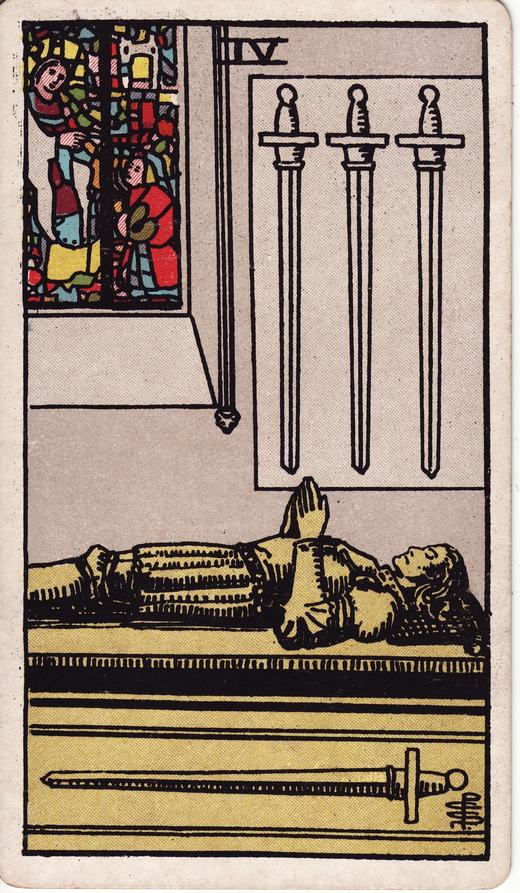
The Four of Swords is the card of conscious rest. Not the inertia of apathy, but the strategic pause of one who knows you cannot push on indefinitely without recharging. After the storm of the Three, this card asks you to lay your weapons down and lie back, because the next battle demands strength you do not currently have.
The symbolism of the card
On a stone sarcophagus is carved a knight in armour, hands joined in prayer, eyes closed as if in deep sleep. His own sword lies along his side, while three more swords hang on the wall above him, horizontal. The scene unfolds inside a church: a stained-glass window lights the space, and below it an image of a praying figure is visible.
The horizontal pose is the heart of the symbol: the knight is lying down, not standing. The hung swords do not threaten him — they are suspended, paused. The church and the stained glass suggest a retreat into a protected place, the silence needed to gather oneself again. This is not death: it is a sleep you wake from.
The Four of Swords upright
Upright, the Four of Swords prescribes rest. You have reached the end of a gruelling cycle, and body or mind is asking for a true pause — not a break snatched between commitments, but a real retreat. It is the card of recovery, of meditation, of the silence that puts you back in alignment.
The card announces no dramatic events: it announces the need to stop. It can mark convalescence, a season of chosen solitude, a phase in which it pays to say no so that later you can say yes with force. The risk, without this pause, is to resume weakened and fall. Rest is not a luxury: it is part of the strategy.
The Four of Swords reversed
Reversed, the rest is insufficient or overdue. You may need to stop and refuse to, ending in burnout — or you stopped and now struggle to start again, inertia settling in place of tiredness. The sleep lasts too long, becomes refuge, and the knight no longer rises from his sarcophagus.
A second reading is more encouraging: the reversal can announce the waking. The pause is over, the strength is back, it is time to stand up and take up the sword again. To tell which reading applies, look at the context: is the body still asking for rest, or already asking to move?
The Four of Swords in love
In love the upright Four of Swords marks a relationship entering a pause, or a season of chosen solitude to regroup after a trial. It is not abandonment: it is a temporary retreat, needed by both. Reversed, the pause drags on past its purpose — distances turning into drift, or the suppressed need to start again. The card asks you to tell rest that heals from flight that isolates.
The Four of Swords in work and money
At work the upright card is a clear warning: stop before you collapse. It signals a necessary break, a leave, a low-gear period to recover after sustained effort. Reversed, it flags burnout already underway, or else stagnation — you stopped and cannot get going again. The fourth step, after rest, has to be the waking.
How to read the Four of Swords in spreads
A card's meaning shifts with the position it occupies. Here is how the Four of Swords behaves in the most common spreads.
In the Celtic Cross
| Position | What it indicates |
|---|---|
| present situation | There is need for a pause: the situation asks for silence and recovery, not further action. |
| obstacle | What holds you back is accumulated fatigue, or the difficulty of granting yourself real rest. |
| near future | A period of restorative quiet is approaching, in which you can regain your strength. |
In the Three Card spread (past · present · future)
| Position | What it indicates |
|---|---|
| past | It tells of a pause already granted, a retreat that let you face what came after. |
| present | It catches you in full need of rest: the card prescribes silence, not action. |
| future | It signals that the rest will bear fruit, preparing a clearer waking. |
Common mistakes in interpretation
The Four of Swords is often mistaken for a card of death or abandonment, because it shows a knight laid out on a sarcophagus. But it is a sleep, not a demise: the knight has his eyes closed to rest, and the swords are suspended, not driven in. To confuse it with an ending is to lose its message, which is care.
Keywords
| Orientation | Meaning |
|---|---|
| Upright | rest, retreat, meditation, recovery, silence, strategic pause |
| Reversed | insufficient rest, burnout, inertia, stagnation, waking, return to action |
Frequently asked questions about Four of Swords
Is the Four of Swords a positive card?
It is a neutral, healing card: it prescribes rest, silence, recovery. It announces no events, only the need to stop — a wholesome invitation when you are running on empty.
What does the reversed Four of Swords mean?
It can point to rest denied and burnout, or to inertia that drags on: a pause that turns into hiding. Sometimes, though, it announces the waking: the break is over and it is time to get up again.
Does the Four of Swords answer yes or no?
It tends toward “not now”: the situation asks for a pause. It is not a no, but it invites you to suspend action until strength returns.
Want to see the Four of Swords in a full reading?
Try a free spread on Theurgos →