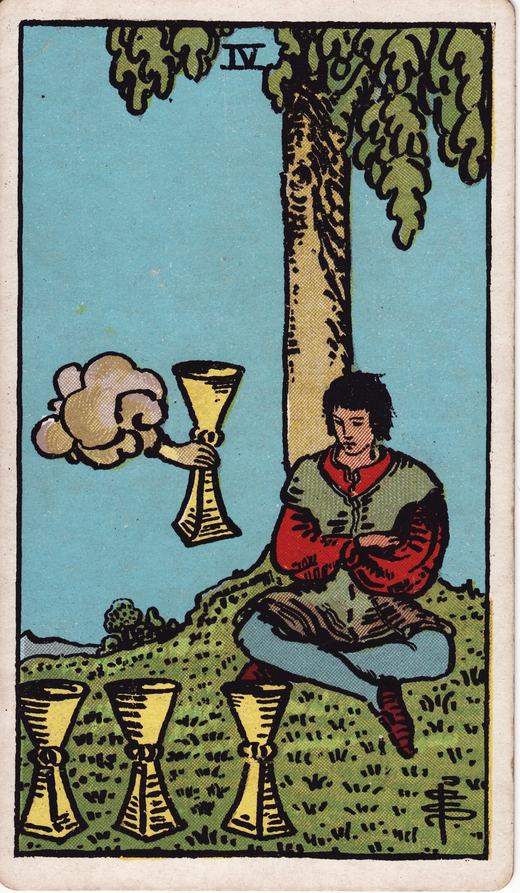
The Four of Cups is the card of melancholic satiety: you already have, and yet it is not enough; something is offered, and you do not see it. It is the energy of water turned stagnant — the emotion is still there but it has lost its flavour, the sensitivity has closed into an apathy that mistakes itself for wisdom.
The symbolism of the card
A young man sits under a tree, arms crossed, gaze lowered and brow furrowed. Before him on the grass stand three cups; from the opposite side, a hand emerging from a cloud offers him a fourth cup. He does not look at it: he is shut inside his mood, absorbed in what he lacks or does not want.
The tree behind him, of height much like his own, suggests a stuck, rooted situation. The fourth cup, offered from above, is the novelty, the chance, the gift life is holding out — and the figure chooses to ignore it, distracted by his own discontent.
The Four of Cups upright
Upright, the Four of Cups describes a moment of apathy, boredom or disgust with what you have. You are sated but unsatisfied, present to what is missing and absent to what you possess. The card often marks a loss of enthusiasm, an emotional weariness, a phase where nothing seems truly appetising.
It is not a card of acute crisis but of torpor: the danger is not collapse, it is the paralysis that makes you miss the chances. Its invitation is discreet — look again: something is being offered right now, and in your closedness you risk not even noticing it.
The Four of Cups reversed
Reversed, the Four of Cups signals an awakening: the apathy dissolves, fresh motivation returns, the once-refused cup is finally accepted. It is the moment you shake off the fixation and start to want again.
A less obvious reading speaks of acceptance through resignation: not a genuine renewal, but a surrender to what was refused because there is no alternative. Sometimes it also points to someone who, tired of refusing, throws themselves at anything just to escape the inertia — risking the confusion of true enthusiasm with a mere reaction to boredom. It is worth telling genuine reawakening apart from a flight from apathy.
The Four of Cups in love
In love it describes a tired relationship: you are together but bored, present yet absent. You fixate on what is missing and stop noticing what is there. Reversed, it points to a coming-together, a sudden wish to pick the bond back up, or — watch out — the resigned acceptance of a situation you never really wanted.
The Four of Cups in work and money
At work it signals demotivation, a draining routine, an offer (a project, a transfer, a promotion) being ignored because you are too focused on what is wrong. Reversed, it marks the return of interest and the willingness to finally seize the chance.
How to read the Four of Cups in spreads
A card's meaning shifts with the position it occupies. Here is how the Four of Cups behaves in the most common spreads.
In the Celtic Cross
| Position | What it indicates |
|---|---|
| present situation | A phase of apathy and emotional weariness: the energy is there but blocked, and you risk losing sight of what is being offered. |
| obstacle | What holds you back is mental closedness, disillusion, the inability to appreciate what you have. |
| near future | It promises an awakening, a fresh motivation, or a chance finally taken. |
In the Three Card spread (past · present · future)
| Position | What it indicates |
|---|---|
| past | It tells of a stretch of boredom or refusal lived through, which you are now leaving or which has coloured your outlook. |
| present | It catches you shut in melancholic satiety: three cups you already have, and a fourth you barely see. |
| future | It signals a chance coming: the risk is again to ignore it, the gift is to learn to catch it. |
Common mistakes in interpretation
It is often confused with deep depression, whereas it really describes a more surface torpor: boredom, disgust, satiety. The figure is not in mourning, just bored. Underrating it as a “small card” is a symmetrical mistake: its apathy, ignored, can lose you real opportunities.
Keywords
| Orientation | Meaning |
|---|---|
| Upright | apathy, boredom, reflection, overlooked opportunities, satiety, discontent |
| Reversed | awakening, new motivation, acceptance, wanting again, chance seized, shaking off inertia |
Frequently asked questions about Four of Cups
Is the Four of Cups a negative card?
Not dramatic, but uncomfortable: it describes apathy and disillusion, the sense of having lost the taste for things. It does not announce a disaster, but warns against letting life slide past you while an opportunity knocks.
What does the fourth cup represent?
It is the chance, the gift, the novelty being offered right now. The figure ignores it, absorbed in discontent: the whole meaning of the card lives in that refused offer, refused out of sheer distraction.
Does the reversed Four of Cups mean I accept the chance?
Often yes: it signals an awakening and the willingness to take what was refused. It is worth telling, though, whether the acceptance comes from genuine enthusiasm or only from weariness at refusing.
Want to see the Four of Cups in a full reading?
Try a free spread on Theurgos →