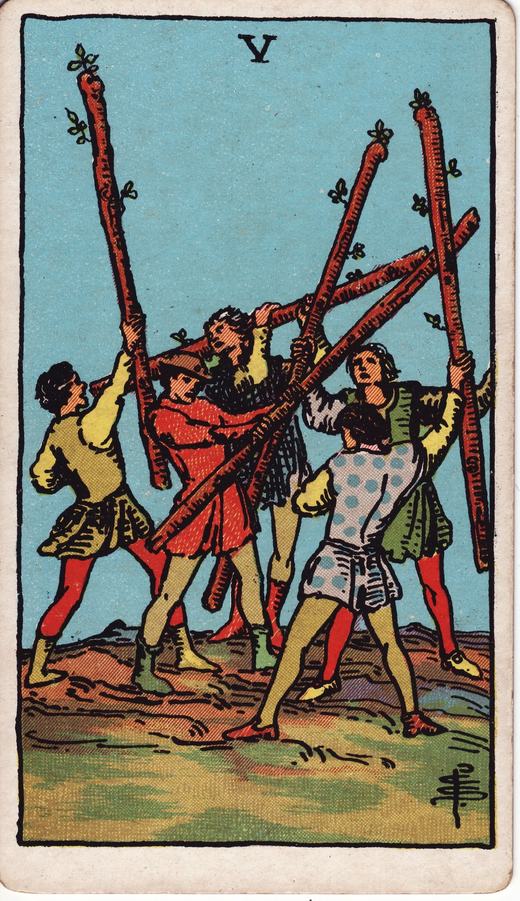
The Five of Wands is the card of creative tension and open conflict. After the feast of the Four, the energy of fire collides with itself: too many Wands in the same space, too many wills demanding attention, too much motion producing friction. It isn't total war, it's a scuffle — tiring but not destructive.
Its signature is live competition. The number five brings crisis and movement, and in Wands it reads as challenge, debate, rivalry. The conflict here isn't to be avoided: it's the place where things get defined by contrast, where ideas are tempered in the clash.
The symbolism of the card
Five young men with as many wands are caught in a confused scuffle, in a tight rocky space. The wands cross in the air, raised in postures that seem more gestural than truly combative — no one is really about to strike anyone, but the tension is palpable. The postures are strained, the faces focused.
There's no clear winner or clear loser: the scene hangs in a kind of energetic stalemate, where all together make a great deal of noise without reaching a conclusion. The background is bare and bright, a sign the conflict unfolds not in dramatic territory but in a neutral space where what matters is the clash itself, not the prize at stake.
The Five of Wands upright
Upright, the Five of Wands is competition, tension and debate: you find yourself in a situation where multiple forces push in different directions, where there are ideas or interests in conflict, where you have to fight to emerge. It isn't a card of harmony, but neither of ruin — it describes the healthy friction from which the best things are born, the confrontation that sharpens.
The card invites you not to flee the clash, but to handle it with lucidity. The Five of Wands rewards whoever can stay in the scuffle without being dragged under, who defends their position without trying to annihilate the others. Competition here isn't destructive: it's the fire where ideas are selected, hierarchies redrawn, projects hardened.
The Five of Wands reversed
Reversed, the Five of Wands can point to two opposite movements. On one hand, the truce: the conflict resolves, a compromise is found, you pass from scuffle to collaboration. On the other, the tension that sharpens or drags on without outlet: the conflict becomes unmanageable, or shifts into a covert, poisoned form.
A less obvious reading concerns conflict avoided: you pretend to get along while friction builds beneath the surface. Here the invitation is paradoxical — bring the tension into the open instead of repressing it, because an open scuffle, however tiring, is healthier than a fake peace that will rot.
The Five of Wands in love
In love, the Five of Wands upright signals tension and conflict in the couple: heated debates, opposing viewpoints, rivalries or jealousies surfacing. It isn't a card of rupture, but of a challenge the relationship must move through. Reversed, it can point to the truce or the resolution — or, conversely, to a tension held back that poisons in silence. The question is whether you're truly facing the differences or just accumulating them.
The Five of Wands in work and money
At work, the Five of Wands upright is explicit competition: rivalries between colleagues, debate over a direction, contest for a position. It favors whoever can defend their ideas without being overwhelmed. Reversed, it signals agreements reached after the clash, or unresolved simmering conflicts that undermine the climate. Before choosing whether to fight or yield, weigh whether the competition is healthy or has become a waste of energy.
How to read the Five of Wands in spreads
A card's meaning shifts with the position it occupies. Here is how the Five of Wands behaves in the most common spreads.
In the Celtic Cross
| Position | What it indicates |
|---|---|
| present situation | You're inside a scuffle: multiple forces or ideas in competition, tension to handle without being swept away. |
| obstacle | Conflict, open or hidden, is what's holding you back: either you face it or it keeps draining energy. |
| near future | Announces a phase of confrontation or competition, to move through with lucidity more than rage. |
In the Three Card spread (past · present · future)
| Position | What it indicates |
|---|---|
| past | A conflict or a competition you moved through that hardened your positions. |
| present | You're in the thick of a clash or a debate: defend your point without trying to annihilate. |
| future | Points to the tension finding an outlet — a truce, or a new composition of the forces in play. |
Common mistakes in interpretation
The most common mistake is reading the Five of Wands as a card of war or enemies. It isn't — it describes a scuffle, not a mortal combat, and its tension is often creative. A second misunderstanding is treating it as always negative: healthy competition selects, sharpens, grows. Fearing it by default means losing the energy the card makes available. Conflict here is material to work, not catastrophe.
Keywords
| Orientation | Meaning |
|---|---|
| Upright | competition, conflict, tension, rivalry, challenge, debate |
| Reversed | truce, compromise, end of conflict, collaboration, repressed tension, simmering conflict |
Frequently asked questions about Five of Wands
Is the Five of Wands a negative card?
Not catastrophically. It describes conflict and competition, yes, but of a live and often creative kind — the scuffle in which ideas are tempered and positions defined. It's a tiring card but not a destructive one. Its outcome depends on how you handle the tension — whether you use it to grow or just endure it.
Does the Five of Wands point to enemies or rivals?
It can, but more often it describes a situation of generic competition — colleagues pushing, ideas clashing, interests in friction — rather than personal enemies. It doesn't presume malice: sometimes the people in the scuffle are simply other wills claiming space, not adversaries out to get you.
Is the Five of Wands reversed positive?
Often yes, because it points to truce or resolution of conflict. But it can also signal a repressed tension that keeps working under the surface, or a conflict that sharpens instead of resolving. Context orients it: it isn't automatically positive, it depends on what kind of resolution it indicates.
Want to see the Five of Wands in a full reading?
Try a free spread on Theurgos →