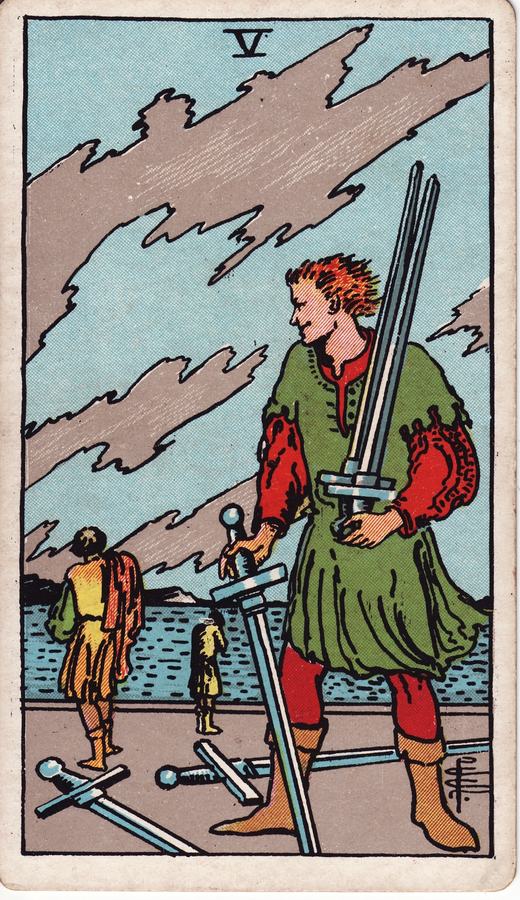
The Five of Swords is the card of the hollow win. You win, yes — but at a cost that empties the victory itself. It is the conflict in which there are no real victors, and the one who walks off with head held high carries the weight of what he had to trample to come first.
The symbolism of the card
In the foreground a man gathers three swords from the ground, a smirk of triumph on his face. Two more swords still stand driven into the earth, abandoned. In the background two figures walk away in a small cluster, bent, shoulders curved: the defeated leaving the field. Behind them a tent or pavilion is visible, and the sky is a heavy, almost threatening yellow.
The gatherer is no hero: he has won, but his greedy posture and the departing companions tell of a victory that broke the bond. The swords he has taken were not his — he took them from the others after beating them. The act of gathering, which in other cards is care, is here loot. The battlefield is empty of honour.
The Five of Swords upright
Upright, the Five of Swords describes a conflict won, but at a steep price. You may be right and have prevailed — and yet the cost in relationships, trust, reputation outweighs what you gained. It is the Pyrrhic victory, the argument you won but lost the person you loved, the career advanced by trampling colleagues.
The card poses an uncomfortable question: was it worth it? Sometimes yes, and the price is accepted. Often no, and the Five of Swords then asks you to weigh what you are willing to lose in order to win. Winning is not always winning — especially when, to do it, you are left alone on the field.
The Five of Swords reversed
Reversed, the conflict subsides: reconciliation arrives, forgiveness, the repair of damage. The gathered swords are returned, the defeated come back, scorn gives way to respect. It is a reading of possible repair, of resentment overcome.
A second reading is more bitter: the reversal can mark the conflict carried on inside — resentment working in silence, revenge nursed without being declared. There is no real truce, only an apparent one. The field is empty, but the war inside is not over. Here too, then, it pays to ask: have you truly reconciled, or only temporarily stood down?
The Five of Swords in love
In love the upright Five of Swords marks a conflict won at the relationship's expense: you were right, but at what cost? Quarrels where the goal is the last word more than understanding, leaving you alone with your grievance. Reversed, it opens onto reconciliation: apologies offered, damage repaired, trust rebuilt. Mind the resentment that hides under a fake peace, though — a real truce runs through forgiveness, not armed silence.
The Five of Swords in work and money
At work the upright card describes a Pyrrhic victory: the promotion gained by edging out a colleague, the project won with arrogance, the negotiation closed all in your favour that alienated the very people who must work with you. Reversed, it invites mending: repair damaged ties, give back what was taken, build on loyalty rather than rivalry. A solid victory does not stand on an empty field of the defeated.
How to read the Five of Swords in spreads
A card's meaning shifts with the position it occupies. Here is how the Five of Swords behaves in the most common spreads.
In the Celtic Cross
| Position | What it indicates |
|---|---|
| present situation | There has been a conflict, and you came out the winner — but at a cost that deserves an honest look. |
| obstacle | What holds you back is lingering resentment: the victory brought no peace, and your standing with others is frayed. |
| near future | An opening for reconciliation is taking shape: the battlefield can become a table for honest talk. |
In the Three Card spread (past · present · future)
| Position | What it indicates |
|---|---|
| past | It tells of a hollow win already lived, a conflict won that left a bitter aftertaste. |
| present | It catches you mid-clash: the card asks whether it is truly worth winning at any cost. |
| future | It signals that the better path runs through repair, not through insisting on being right. |
Common mistakes in interpretation
The Five of Swords is often read as plain “defeat”, but it is not — the one gathering the swords has won. Its real theme is the cheapened victory: winning in the wrong way, or winning what was not worth it. To mistake it for a loss is to miss the real question, which is about the price paid to prevail.
Keywords
| Orientation | Meaning |
|---|---|
| Upright | conflict, bitter defeat, victory at a cost, resentment, vengefulness, broken bonds |
| Reversed | reconciliation, forgiveness, repair, rebuilt peace, nursed resentment, apparent truce |
Frequently asked questions about Five of Swords
Is the Five of Swords a negative card?
It is a card of conflict and bitter victory: not always a loss, often a win emptied by its cost. Its message is to reflect on what was paid for what was gained.
Does the reversed Five of Swords mean peace?
Often yes: reconciliation, forgiveness, repair. But it can also flag resentment still nursed beneath an apparent truce — a fake peace hiding a war that is not over.
Does the Five of Swords answer yes or no?
It leans toward no: it indicates that even winning you lose, and that the better road is not conflict. It suggests not pressing to have it your way.
Want to see the Five of Swords in a full reading?
Try a free spread on Theurgos →