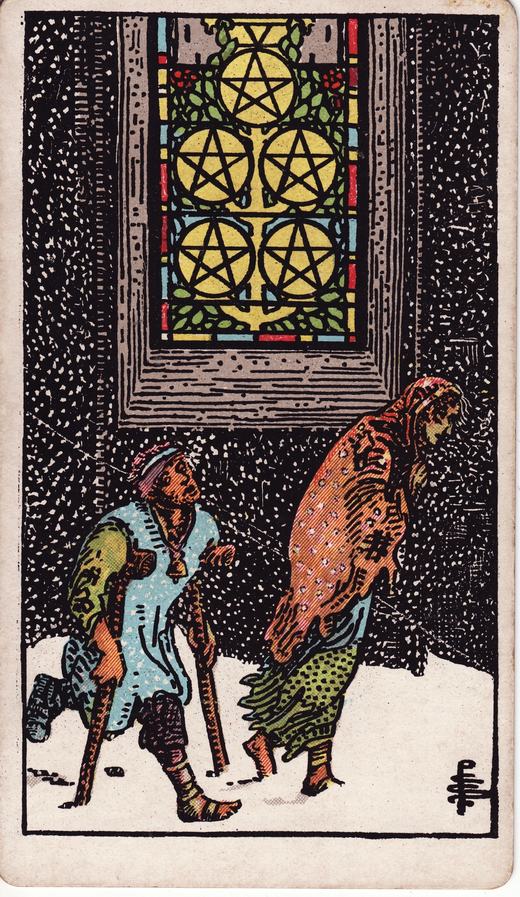
The Five of Pentacles is the card of material need, of the concrete crisis that bites: money missing, health faltering, warmth draining away. It isn't a symbolic discomfort — it's the real cold, the unpaid bill, the feeling of being outside while others are in.
It's one of the hardest cards in the deck because it speaks of real deprivation and of the pride or shame that stops you asking for help. Often the solution is already within reach: the problem is that whoever suffers can't see it, or won't allow themselves to knock.
The symbolism of the card
Two figures advance through the snow, wrapped in tattered cloaks, beneath a blizzard. The first, a woman with grey hair and a patched scarf, walks with head bowed; the second, a blindfolded man on crutches, hobbles beside her. They suffer the cold and the isolation, moving with no clear destination.
Behind them rises the wall of a church, and set into it are two glowing stained-glass windows, their colours bright with the warmth inside. Above the door, carved among the pentacles, shines a great star-shaped window. The message is painfully clear: the refuge, the light, the help exist — but the two beggars pass by without entering, turning their backs on precisely what could take them in.
The Five of Pentacles upright
Upright, the Five of Pentacles describes a stretch of real material difficulty: money problems, health trouble, isolation, a sense of exclusion. It doesn't hide the harshness and should be read honestly. The card says you're in the middle of the storm, and the cold truly bites.
Its invitation, though, is twofold. On one hand it acknowledges the pain — it should be received, not denied. On the other it indicates that help probably already exists, and that asking for it isn't weakness. The way out begins when you stop turning your back on the lit windows.
The Five of Pentacles reversed
Reversed, the Five of Pentacles announces recovery: the storm eases, help arrives or is finally accepted, the concrete crisis closes. It's one of the more relieved readings, because it marks the return of warmth and stability after a hard stretch.
The second reading instead concerns those who stay locked in need out of stubbornness: whoever refuses help out of pride, whoever confuses independence with isolation. Here the crisis drags on not for lack of outside resources, but for the inner inability to accept them.
The Five of Pentacles in love
In love the Five of Pentacles upright describes a relationship crossed by concrete difficulties — money, health, isolation — that put the couple under pressure, or a moment in which you feel lonely even while together. Reversed, it points to the bond recovering after a hard trial, the return of intimacy and warmth; or it warns that refusing your partner's support prolongs the crisis.
The Five of Pentacles in work and money
On the professional and financial front it signals real hardship: precarious work, debts, job loss, medical bills, practical problems that weigh. It's a call to ask for concrete help, not to carry everything alone. Reversed, it announces a turning point — new employment, help received, stability returning after the storm.
How to read the Five of Pentacles in spreads
A card's meaning shifts with the position it occupies. Here is how the Five of Pentacles behaves in the most common spreads.
In the Celtic Cross
| Position | What it indicates |
|---|---|
| present situation | You're moving through a concrete crisis: the need is real and deserves to be acknowledged without shame. |
| obstacle | What holds you back is the inability to ask for help: the lit window is there, but you turn your back to it. |
| near future | A path of recovery is approaching, but it runs through accepting support that's already available. |
In the Three Card spread (past · present · future)
| Position | What it indicates |
|---|---|
| past | It speaks of a concrete crisis overcome, or a stretch of need that marked your story. |
| present | It catches you in the cold of material, emotional, or health difficulty: you're not alone, even if it feels that way. |
| future | It points to recovery ahead: help will show up when you allow yourself to receive it. |
Common mistakes in interpretation
People fear the Five of Pentacles as a "card of bad luck" and read it only as misfortune. But its true theme is help within reach: the difficulty exists, but so, often, does the remedy. The opposite mistake is reducing it to a generic invitation to gratitude, emptying it of the concrete suffering it actually represents.
Keywords
| Orientation | Meaning |
|---|---|
| Upright | scarcity, marginalisation, hardship, isolation, need, material trial |
| Reversed | recovery, help, rebound, end of crisis, return of warmth, restored stability |
Frequently asked questions about Five of Pentacles
Is the Five of Pentacles a bad card?
It indicates real hardship, so take it seriously. But it isn't a sentence: it signals a stretch of need, often with help close at hand that only needs recognising and accepting.
Is it always about money?
No. It covers every form of concrete deprivation: health, home, social isolation, a sense of exclusion. The common thread is material or physical need felt as real cold.
What should you do when it comes up?
Ask for help. The card often shows that support already exists and is near: the problem is turning your back on it out of shame or pride. Knocking is the first step of recovery.
Want to see the Five of Pentacles in a full reading?
Try a free spread on Theurgos →