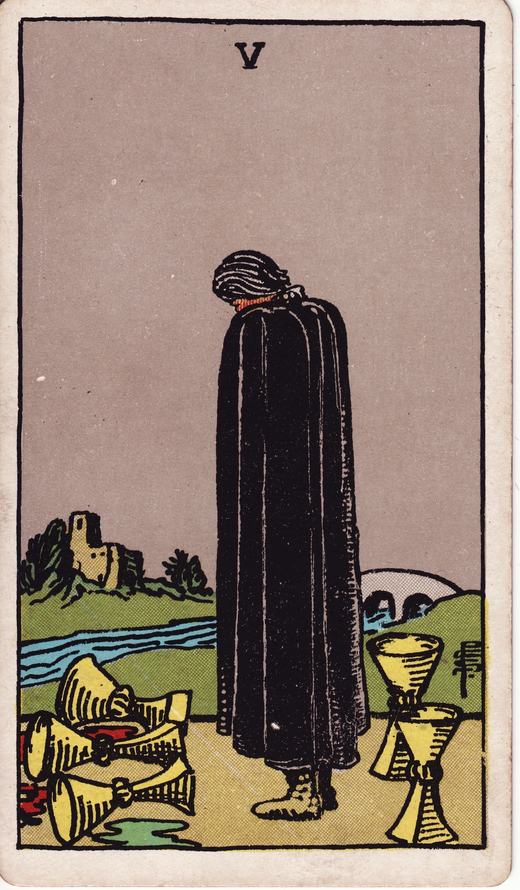
The Five of Cups is the card of loss lived, of the pain that absorbs the whole gaze. But subtly it is also the card of what is not yet lost: its grief is real, yet leaves in the background something intact — which the figure, taken up by mourning, will not or cannot yet see.
The symbolism of the card
A figure wrapped in a long black cloak stands before three spilled cups, head bowed, in an attitude of deep mourning. Behind him, ignored, two cups still stand full and intact. In the background, across a river, a castle and a bridge leading back to that safe house; above, a sky of clear light the figure does not raise his eyes to see.
The three fallen cups stand for what has been lost; the two still upright, for what remains. The bridge is the way back, always available; the castle, the inner or outer home you can return to. The black cloak is the mourning that covers everything, but it does not erase the two cups behind the back.
The Five of Cups upright
Upright, the Five of Cups signals loss, disappointment, regret: a break-up, a bereavement, a failure that occupies the whole gaze. You are focused on what has gone, and the suffering is legitimate and deserves to be felt to the bottom.
Yet the card does not say that everything is lost. While the pain is real, two cups still stand: there is still something — or someone — that remains, and that you can turn back to when you are ready to turn your head. The bridge and the castle remind you the return is possible; you need not do it at once, but knowing it exists changes the pain.
The Five of Cups reversed
Reversed, the Five of Cups points to acceptance, forgiveness, the phase where you finally turn toward the two intact cups. The mourning is being processed, the gaze widens again, you start to see what remains beyond what has fallen.
A less obvious reading sees it as loss held onto too long: pain prolonged beyond measure, cultivated as an identity, blocking the crossing of the bridge. Here the card does not announce a healing in progress but the risk of staying stuck in regret — and the invitation to finally choose to look at the cups that are still full.
The Five of Cups in love
In love it describes the end of a bond, a bitter disappointment, a relationship that has lost something unrecoverable. Reversed, it signals reconciliation, mutual forgiveness, or the moment you stop weeping for what ended in order to recognise the love still present. Sometimes it signals the loss was inevitable, and that accepting it is the way to heal.
The Five of Cups in work and money
At work it points to a setback, a failed project, a financial or professional loss that weighs. Reversed, it marks recovery: you learn from the defeat and start again with greater clarity. The two standing cups remind you that skills, contacts, resources remain that the failure did not touch.
How to read the Five of Cups in spreads
A card's meaning shifts with the position it occupies. Here is how the Five of Cups behaves in the most common spreads.
In the Celtic Cross
| Position | What it indicates |
|---|---|
| present situation | A loss or a disappointment fills the whole emotional space: the pain is real and deserves to be acknowledged. |
| obstacle | What holds you back is the inability to look past the loss, the regret that keeps your head down over the spilled cups. |
| near future | It promises the beginning of acceptance: the gaze will widen again toward the cups still standing. |
In the Three Card spread (past · present · future)
| Position | What it indicates |
|---|---|
| past | It tells of a loss lived and still present, that has coloured the current mood. |
| present | It catches you bent over regret: you have the right to grieve, but remember the two cups behind you. |
| future | It signals the moment you will turn toward what remains: healing is on its way, slow but possible. |
Common mistakes in interpretation
It is often read as a card of total ruin, whereas its strength lies in the detail of the two cups still full. It does not say “you have lost everything”: it says “you have lost much, and you are so taken by the mourning that you do not see what remains”. Underrating the two cups means repeating the figure's mistake: turning your back on what you still possess.
Keywords
| Orientation | Meaning |
|---|---|
| Upright | loss, regret, grief, disappointment, mourning, remorse |
| Reversed | acceptance, forgiveness, moving forward, recovery, processing grief, return to life |
Frequently asked questions about Five of Cups
Is the Five of Cups a final card?
No — quite the opposite: its iconography shows that something remains. The two cups still full and the bridge to the castle indicate the return is possible. The pain is real, but it is not the final word.
In love, does it mean a definitive break-up?
Often yes, it describes a break-up or a felt disappointment. But even here two cups remain: what was real in the bond does not vanish with the end. Reversed, it can signal reconciliation or forgiveness.
What should I do when the Five of Cups appears?
Feel the pain without denying it, but remember to turn your head. The card does not ask you to forget what you lost: it asks you not to lose also what remains, through the sheer distraction of grief.
Want to see the Five of Cups in a full reading?
Try a free spread on Theurgos →