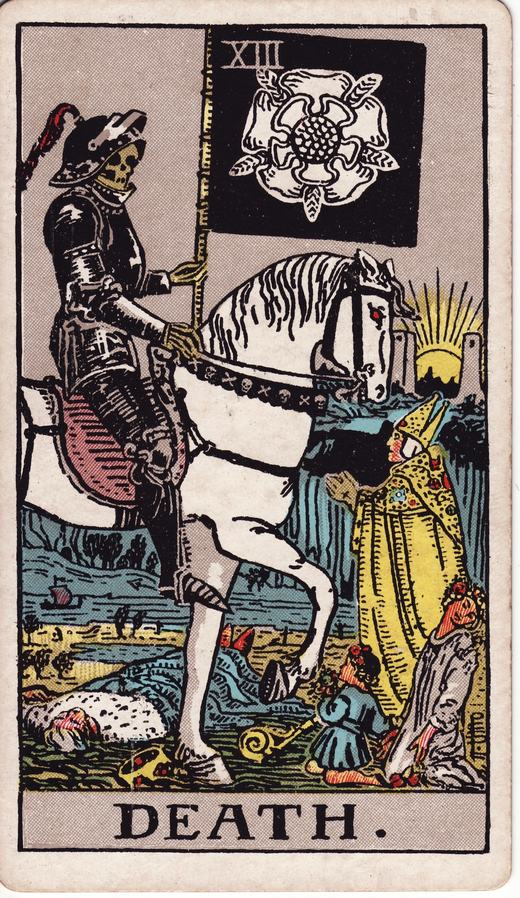
The thirteenth card of the Tarot has a name that frightens and a soul that transforms. What popular tradition calls by its label is, in the language of the Arcana, the force that ends a cycle so the new can exist: not cessation, but passage. It follows the Hanged Man as spring follows winter — and like spring, it presupposes that something has died.
For this it is one of the most necessary cards in the deck, and also one of the most misunderstood. It does not take away: it clears space. And it asks for the rare courage to let go of what is already over but is held on to out of habit or fear.
The symbolism of the card
In the classical image a skeletal rider in black armour advances on a white horse, bearing a black banner on which a white rose stands out. The armour makes him invulnerable: what he represents cannot be beaten, avoided or negotiated with. The rose, however, speaks of life: in its fragility and its beauty lies the meaning of the whole scene. Transformation passes through what withers, and precisely for that reason it blooms.
Under the hooves fall figures of every rank — a king thrown down with his crown, a cleric, a woman and a child kneeling: no one is spared, because change does not regard status. In the background, between two towers, the sun rises on the horizon and a river flows toward the sea. The whole picture says: this is a threshold, not a wall; what closes opens a dawn.
The Death upright
Upright, the thirteenth is deep transformation: something essential ends, and its departure is what allows the rebirth. It can be a relationship, an identity, a job, a phase of life that has long stopped nourishing. The card does not threaten: it observes. And it invites you to accompany, rather than obstruct, an ending already underway.
Its movement is slow and inexorable, and it must be met with courage. The more you resist, the more it costs; the more you trust, the more the shedding lets emerge what was already ready and new, waiting only for the old to withdraw. It is not a card to fear: it is a card to honour.
The Death reversed
Reversed, it indicates resistance to transformation: one clings to what is over, postpones the necessary ending, confuses stability with stagnation. The change deferred does not vanish — it stays there, and the longer it is held, the costlier the parting becomes, because what would be born is blocked too.
A less obvious reading concerns the kind of resistance: it is not always open fear, it can be a slow inner erosion, a refusal to grieve, a false normality built over something that is no longer there. The card suggests that what is stubbornly protected has often already changed: one has simply not yet dared to admit it.
The Death in love
In love it speaks of changes of state: a relationship transforming deeply, a phase closing to open another, or a bond come to its natural completion. It does not necessarily indicate separation — it can mark the passage to a more mature and true form. Reversed, it warns of a couple outliving itself, clinging to a version of the relationship now over: here the risk is not the ending, but the refusal to recognise it, which freezes both in a wait with no outcome.
The Death in work and money
At work it signals the end of a cycle — a project, a role, a career — that has exhausted its meaning, and whose very departure will make the next step possible. It can indicate restructurings, changes of sector, the necessary closure of what no longer holds. Reversed, it warns against artificially prolonging dead situations, defending untenable positions, failing to process a setback: holding what has already fallen costs energy needed elsewhere.
How to read the Death in spreads
A card's meaning shifts with the position it occupies. Here is how the Death behaves in the most common spreads.
In the Celtic Cross
| Position | What it indicates |
|---|---|
| present situation | A transformation underway, a necessary closure redrawing the picture. |
| obstacle | Resistance to change, attachment to what is already over. |
| near future | A deep shedding on its way: what falls will make room for the new. |
In the Three Card spread (past · present · future)
| Position | What it indicates |
|---|---|
| past | An important ending already crossed, from which the present descends. |
| present | You are in the midst of a transformation: accompany it instead of resisting. |
| future | A rebirth made possible by a closure finally accepted. |
Common mistakes in interpretation
The most widespread error is to take it literally and tremble: the thirteenth announces transformation, not calamity, and in many spreads it is one of the most fertile cards. The opposite error is to dismiss it as 'mere change' without depth: the closures it indicates are real, often painful, and must be honoured as such. Whoever trivialises them risks not respecting the grief the card carries — and which, once crossed, sets you free.
Keywords
| Orientation | Meaning |
|---|---|
| Upright | transformation, necessary ending, transition, rebirth, deep shedding, detachment |
| Reversed | resistance to change, stagnation, fear of the ending, clinging, postponement, refusal to grieve |
Frequently asked questions about Death
Does Death in Tarot announce a literal ending?
No. It indicates transformation: the closing of a cycle so the new can be born. It rarely concerns people; almost always it concerns phases, relationships, identities or habits that have exhausted their meaning. It is a threshold, not a sentence.
Is Death a negative card?
It is uncomfortable, not negative. It signals deep and sometimes painful changes, but necessary ones. A transformation welcomed is new life; only when obstructed does it become prolonged suffering. The rose on the banner is its symbol: through what withers, something blooms.
Does Death answer yes or no?
Usually no to what is asked, but because the question needs rephrasing: it is not the moment to add, but to let go. It is a 'no' that opens rather than closes — it invites you first to conclude, then to set off again.
Want to see the Death in a full reading?
Try a free spread on Theurgos →