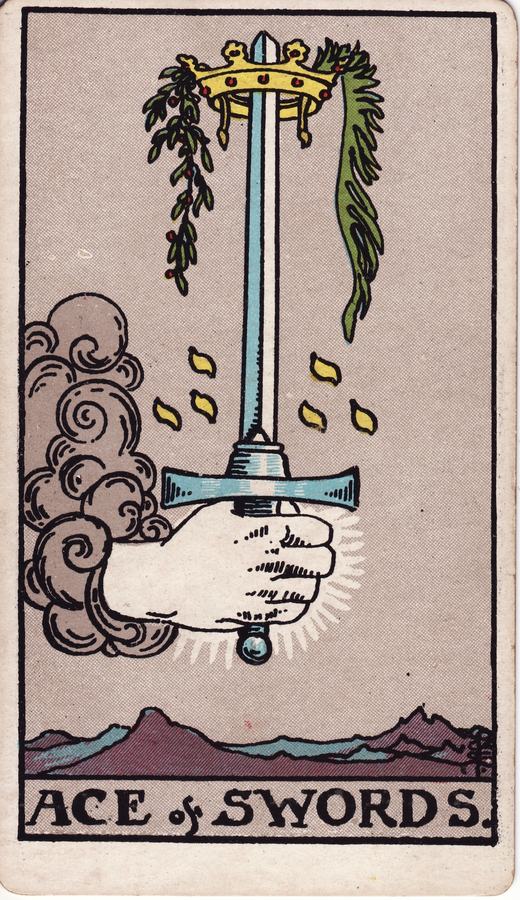
The Ace of Swords is the suit of air at its first beat: thought born sharp, the words that finally find the courage to be spoken. Like every Ace, it does not narrate an event but a force entering play — here the force of discernment, the clarity that separates what matters from what must be cut away.
The symbolism of the card
A hand emerges from a cloud at the centre of the card and grasps a sword held upright. Suspended from the tip of the blade is a crown, and from the crown hang branches of palm and oak. The sky is clear, crossed by distant mountains and a landscape divided sharply into light and shade.
The sword is upright because the energy here is vertical, descending: it cuts from above. The crown is the prize clarity carries — the power that comes from seeing things as they are. Palm and oak together speak of victory and endurance: the right idea prevails, but only because it held firm through doubt.
The Ace of Swords upright
Upright, the Ace of Swords is illumination: a truth that pushes through in a single stroke, an intuition that reorganises everything you thought you knew. It is the card of the “I finally understand” moment, when the fog dissolves and only the clean line of decision remains.
In practice it points to a new idea, direct communication, a cut that has to be made. It is time to name what you have been keeping quiet, to ask the awkward question, to choose with the head even where the heart would be more comfortable. The sword is not cruel: it is precise.
The Ace of Swords reversed
Reversed, the same blade clouds: clarity curdles into confusion, the right idea arrives distorted, communication breaks down into misunderstandings and half-truths. It can mark a truth delivered badly, or delivered to wound rather than to clarify.
A second reading is subtler: the Ace reversed can point to a truth you are not yet ready to receive. The blade is there, but it will not descend — because admitting it would cost too much, or because the courage to look is missing. Here the issue is not confusion but avoidance: clarity knocks, and you choose not to open.
The Ace of Swords in love
In love the upright Ace of Swords brings a conversation that changes everything: the truth laid on the table, the defining of an ambiguous bond, the moment you stop circling the point. It favours relationships built on candour more than on enchantment. Reversed, it warns of broken communication, half-promises or truths used as weapons: when words wound instead of clarify, the relationship is consumed by misunderstanding.
The Ace of Swords in work and money
At work the upright Ace is a lucid breakthrough: a new idea, a strategy that brings the problem into focus, a decision finally based on facts rather than feelings. It favours analysis, writing, direct negotiation. Reversed, it signals information chaos, decisions taken on muddled grounds, or a brilliant idea ruined by a messy pitch: before acting, it is worth putting the facts in order.
How to read the Ace of Swords in spreads
A card's meaning shifts with the position it occupies. Here is how the Ace of Swords behaves in the most common spreads.
In the Celtic Cross
| Position | What it indicates |
|---|---|
| present situation | The matter calls for clarity: there is a truth to recognise or an intuition asking to be followed. |
| obstacle | What holds you back is confusion or faulty communication: too many voices, none of them making the real point. |
| near future | A clean cut is approaching, a moment when the right decision will make itself unmistakable. |
In the Three Card spread (past · present · future)
| Position | What it indicates |
|---|---|
| past | It tells of an insight already arrived, an intuition that shaped the choices that followed. |
| present | It catches you in the flash: the fog is lifting and the path stands clear. |
| future | It signals that the way forward is to proceed with decision, trusting clarity over hesitation. |
Common mistakes in interpretation
The Ace of Swords is often mistaken for an aggressive card, a promise of conflict. But its blade is not war: it is the cut that makes order. To read it as “attack” is to lose its gift, which is discernment — the ability to see, and to say, what is true.
Keywords
| Orientation | Meaning |
|---|---|
| Upright | clarity, truth, new idea, illumination, clean decision, direct communication |
| Reversed | confusion, deception, broken communication, half-truth, truth avoided, misunderstanding |
Frequently asked questions about Ace of Swords
Is the Ace of Swords a positive card?
Yes, but in a cutting rather than a soothing way. It announces clarity, a fresh idea, a truth arriving — precious gifts, though they ask you to look at things without pretence.
What does the reversed Ace of Swords mean in love?
It points to broken communication: truths delivered harshly, misunderstandings, or silences that hide something. It can also mark a truth you would rather not face, for fear of what it would change.
Does the Ace of Swords answer yes or no?
It leans toward yes, but a yes that asks for honesty: the card encourages you to move forward, provided you look at the situation as it is, not as you would like it to be.
Want to see the Ace of Swords in a full reading?
Try a free spread on Theurgos →